Kilne-Carle: The Kiln Spirit of Scottish Folklore
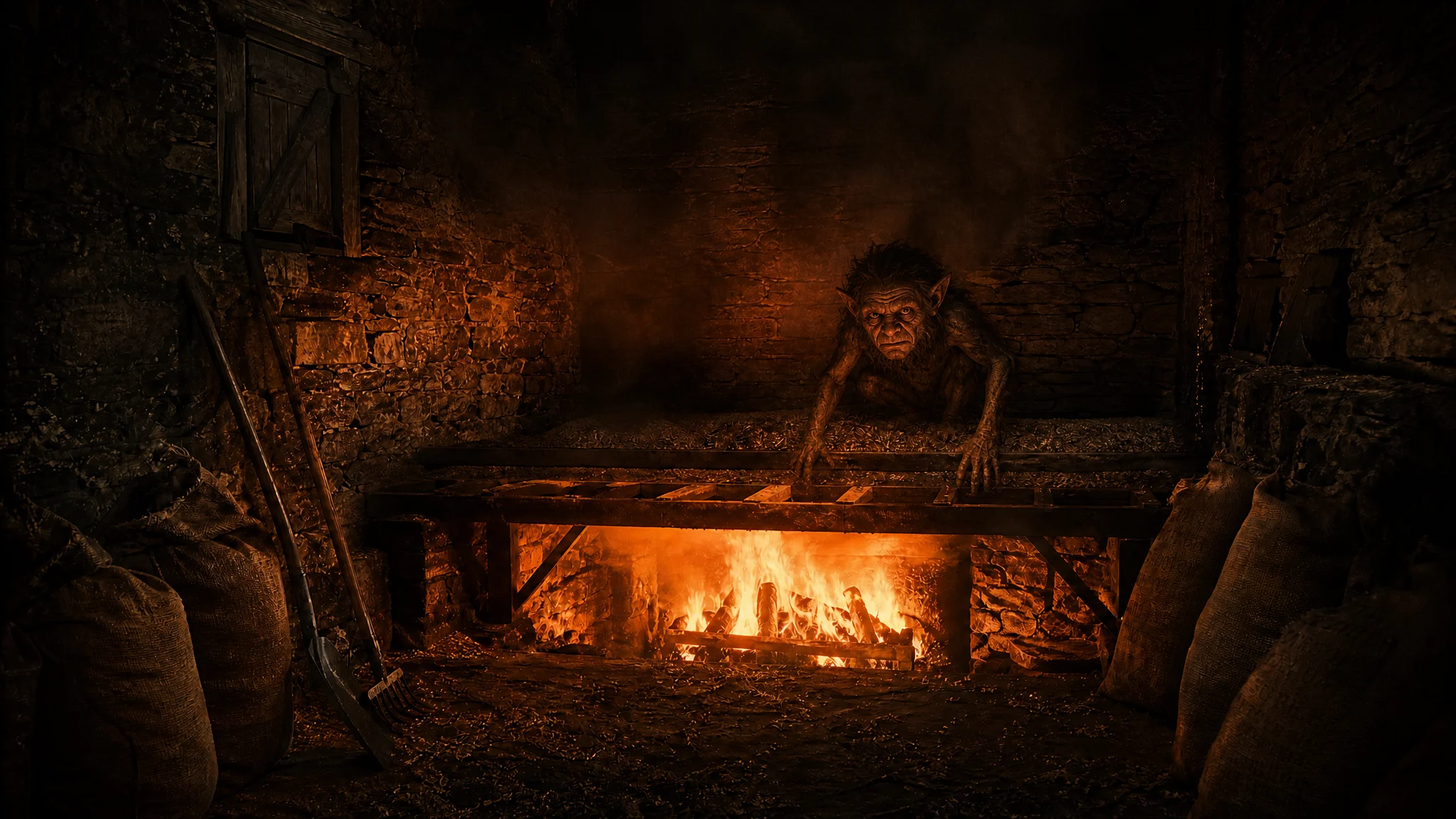
Kilne-Carle is a fierce kiln spirit from Scottish folklore, and it is also known as Kilmoullach in other parts of the country. It was believed to haunt the killogie, the space below the corn-drying floor where the kiln fire burned. However, this was not a harmless household brownie in every story. Instead, the spirit could become savage if provoked, and people in north-east Scotland feared entering the kiln alone after dark.
Name:
Kilne-Carle
Name pronunciation:
KILN karl, or kiln-carle
General Information:
Kilne-Carle is a brownie-like or goblin-like spirit linked to corn-drying kilns. F. Marian McNeill records it as a special kind of brownie, known in the south of Scotland as Kilmoullach and in the north-east as Kiln-Carle. Moreover, Walter Gregor noted that people were afraid to go into kilns at night because “feart things” were seen there.
This spirit belongs to the world of grain drying, milling, and fire. Before grain could be ground into meal, it had to be dried over a hot kiln fire. That work was necessary, but it was also risky. As a result, the kiln became a place where people expected danger, and folklore gave that danger a face.
Appearance:
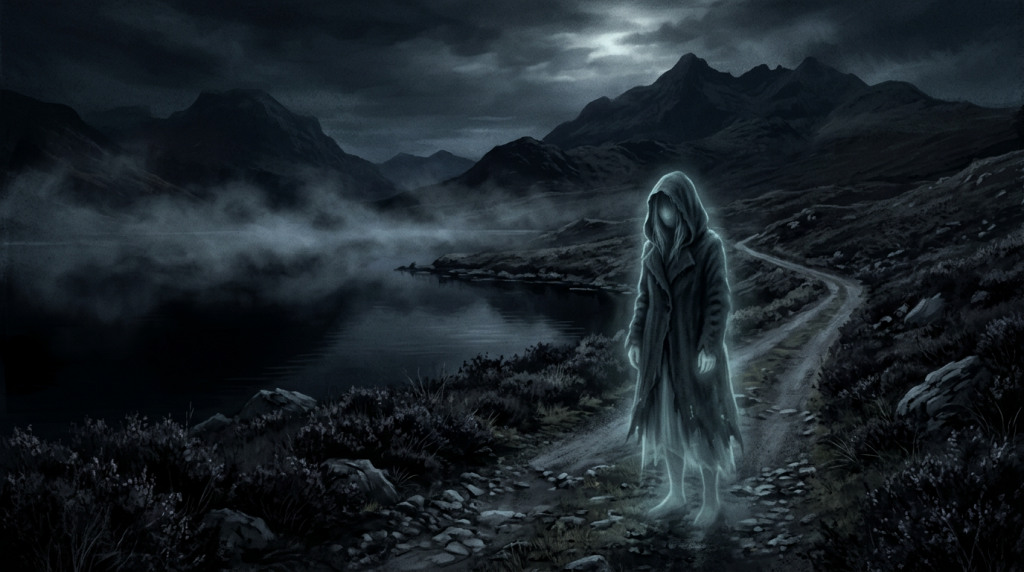
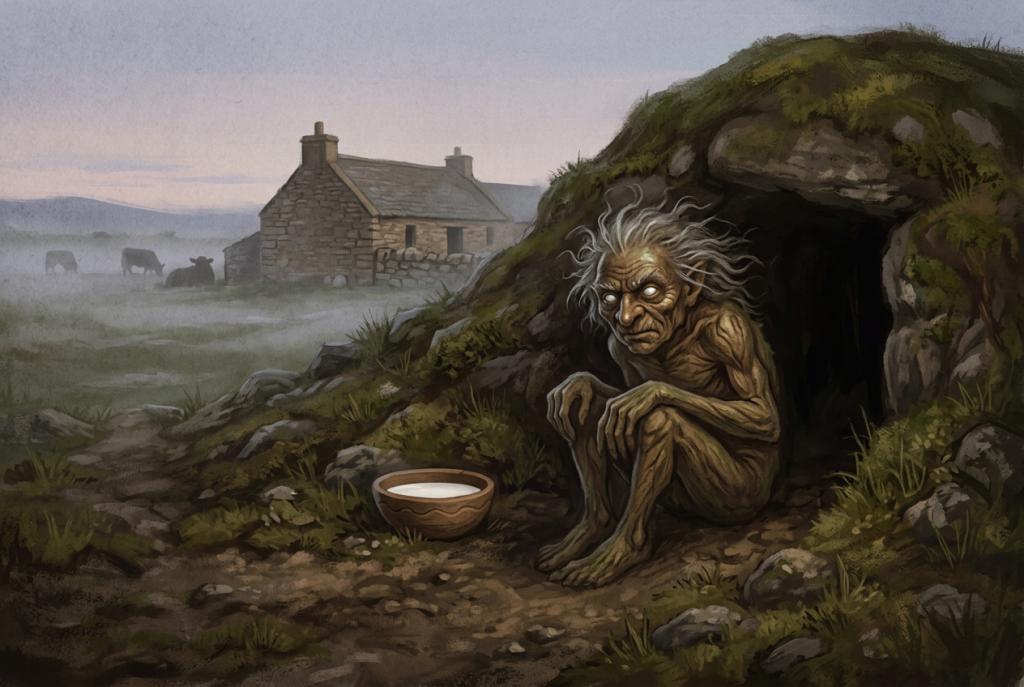
The historical sources do not give one fixed appearance for this spirit. Instead, it is presented as a presence, a feart thing, or a strange being sensed in the kiln. However, the folklore often places it close to brownie and goblin imagery, so it feels small, uncanny, and difficult to define.
One recorded account even describes a cat passing by a man and going straight through the furnace. That detail matters because it suggests an ambiguous, half-seen form. In other words, the spirit may appear in animal shape, or at least in a form that is difficult for human eyes to hold.
Habitat:
The spirit lives in the kiln, especially in the killogie beneath the drying floor.
Behaviour:
This is a territorial spirit, and it is often described as savage if provoked. No one, according to local belief, would have been bold enough to challenge it alone in the night. Therefore, the spirit works less like a helpful domestic brownie and more like a dangerous guardian of the kiln.
At the same time, the legend reflects real fear. The kiln was a practical but hazardous place, and the spirit gives that danger a personality. So, the folklore warns people not to behave carelessly around the drying fire.
Shape-shifting Ability:
The sources do not clearly define it as a shapeshifter. However, the recorded cat sighting suggests an uncanny ability to appear in strange or animal form. Therefore, it is safest to say that the spirit may manifest in unsettling, shifting ways rather than in one fixed shape.
Variant:
The main variant name is Kilmoullach, which is more common in central and western Scotland. In the north-east, Kilne-Carle is the preferred term. In the Northern Isles, similar local names also appear.
Location in Scotland:
Kilne-Carle belongs especially to the north-east of Scotland. However, related forms and names appear in other regions too. It belongs to working mills, grain kilns, and the wider rural landscape of Scotland.
Stories/ Sightings or Experiences:
The Cat Through the Furnace
Walter Gregor recorded a story from Dyke in which a man was drying grain at night. While he worked, he saw a cat go past him and straight through the furnace. That image is striking because it blurs the line between the natural and the supernatural. Moreover, it suggests that the kiln was never fully empty, even when no other person was there.
The Challenge at Lonmay
Gregor also records a local challenge from Lonmay:
“Kiln-carle teethless,
Come oot an mack me eesless.”
This was not a casual taunt. In fact, the rhyme shows that people feared the spirit enough to name it directly. The words mock it, but they also admit its power. Therefore, the challenge reads like a dare, a warning, and a form of local bravado all at once.
The Spirit in The Silver Bough
F. Marian McNeill later gathered the tradition into The Silver Bough, where she described the Kilmoullach and the north-eastern Kiln-Carle as a special kind of brownie linked to millers and the killogie. This matters because it places the spirit inside a wider Scottish belief system. Millers were often thought to possess unusual ‘skill’, and some traditions treated them as men with occult knowledge. Thus, the Kilne-Carle was seen as the miller’s equivalent of the witch’s familiar.
Purpose of the myth or Legend:
The legend explains danger, but it also teaches respect. The kiln was hot, enclosed, and potentially deadly, so folklore gave that risk a face. In addition, the story warns people not to enter such places carelessly, especially after dark.
It also reflects older ideas about millers and hidden knowledge. The kiln was part of ordinary farm life, yet it still felt uncanny. Therefore, Kilne-Carle turns a working space into a haunted boundary zone. That is why the legend lasts. It is practical, eerie, and memorable.