The Maiden dropped its blade on James Douglas, 4th Earl of Morton, at the Mercat Cross in Edinburgh on 2nd June 1581. Morton had served as Regent of Scotland. He was widely believed to have introduced the very machine that killed him. Whether that story is entirely accurate remains debated, but the irony has lodged itself firmly in Scottish historical memory, and it is a fitting entry point into the history of Scotland’s surviving guillotine.
A Machine Before Its Time
The Edinburgh Maiden predates the French Revolution by two centuries. It also predates the term “guillotine,” which only entered common use in the 1790s. Scotland had its own name and its own machine long before any Parisian scaffold darkened the Seine.
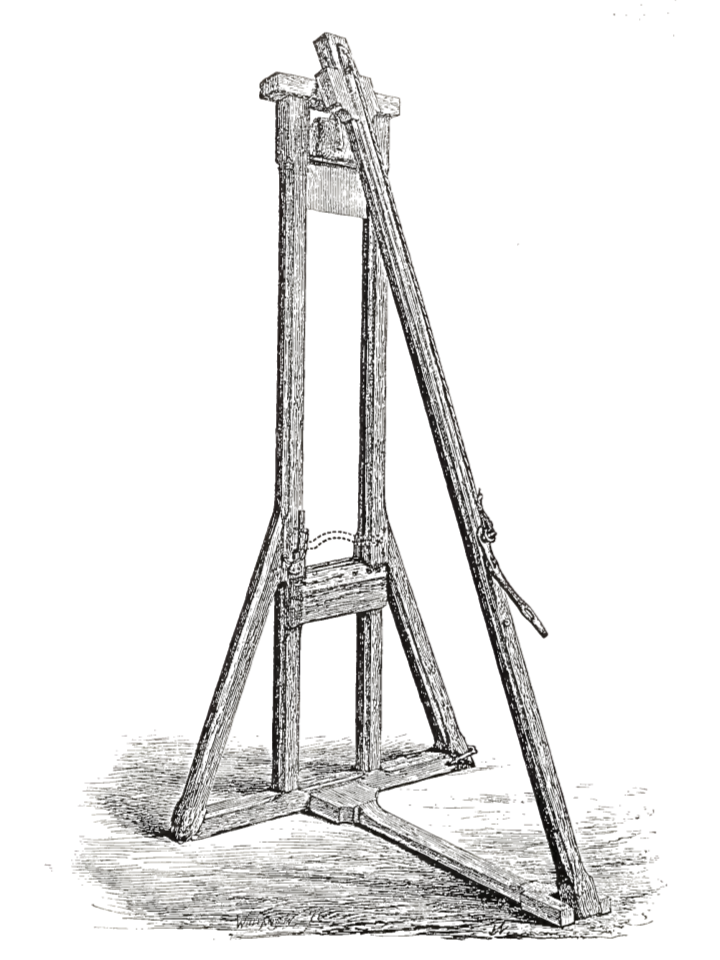
Morton is said to have encountered a similar device in England, likely the Halifax Gibbet in Yorkshire, and to have commissioned Scotland’s version on his return. The principle was straightforward. A heavy, sharpened blade fixed within a tall wooden frame was raised and then dropped. Death was swift and consistent, qualities that manual beheading rarely guaranteed. Good executioners were difficult to find, and botched beheadings were not uncommon. By the standards of the time, therefore, the machine was considered humane.
The Edinburgh Maiden operated from 1564 to 1710. Over that period, it claimed at least a dozen documented victims, several of them among the most powerful people in Scotland.
How It Worked
The condemned was positioned beneath an angled, weighted blade set within the wooden frame. The blade was hauled upward, held by a pin, and released. Death was near-instantaneous.
Maintenance records survive and give the device an unexpected domestic quality. A 1641 document from Shetland records payment for “mending the timber work of the maidin and making ane new ax therto” at £8 2s Scots. The blade and frame both required regular attention. These were working tools, maintained with the same practicality as any other instrument of civic administration.
Notable Victims
Morton was not the first to die beneath the blade. Thomas Scott was executed by the Maiden in 1565, the earliest recorded case, after being convicted of involvement in the murder of David Rizzio, secretary to Mary, Queen of Scots.
Morton followed in 1581, condemned for his alleged role in the murder of Lord Darnley, husband of Mary, Queen of Scots. The charge had long been a weapon held in reserve by his political enemies. When it finally fell, the machine reputedly of his own making was waiting.
Patrick Stewart, 2nd Earl of Orkney, met his end under the blade in 1615, condemned for treason. Known as “Black Patie,” Stewart was a brutal and widely feared overlord of Orkney and Shetland. His execution was reportedly delayed because he could not recite the Lord’s Prayer. His son Robert was executed shortly afterwards.
Christian Nimmo and her ghost
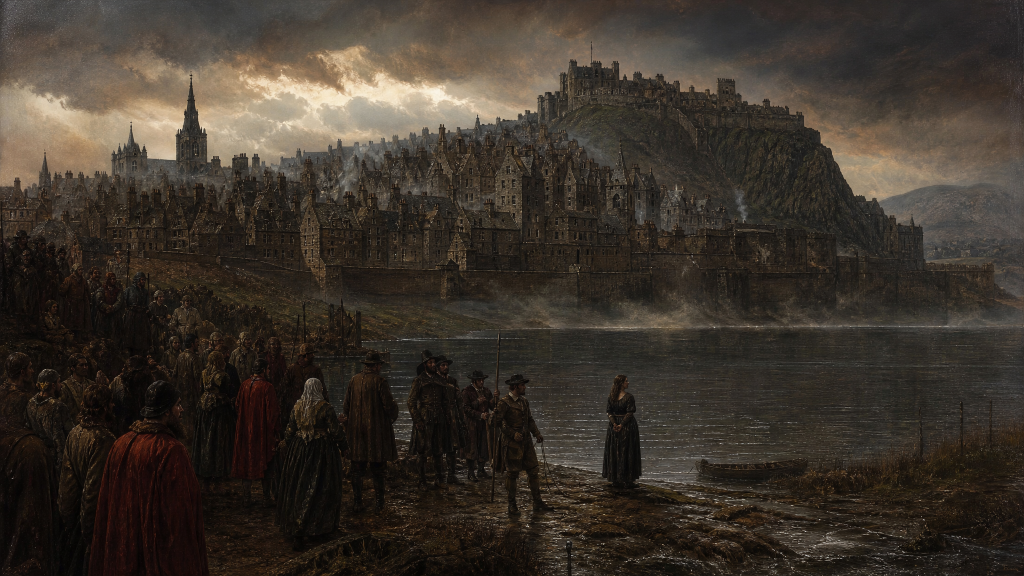
Then came Christian Nimmo. In 1679, she was executed by the Maiden at the Mercat Cross for the murder of her lover, James Forrester, Lord Forrester of Corstorphine. Contemporary accounts describe her as beautiful, volatile, and reputedly accustomed to carrying a sword beneath her petticoats. She stabbed Forrester during an altercation at Corstorphine Castle after he had spoken disparagingly of her in his cups. She went to her death dressed in mourning, exchanging her long veil for a white taffeta hood before the blade fell. By all accounts, she faced her execution with composure. An apparition known as the White Lady is still said to haunt the grounds at Corstorphine, sword in hand.
The Maiden subsequently claimed Archibald Campbell, 1st Marquess of Argyll, beheaded in 1661 following the Restoration of Charles II, and then his own son, Archibald Campbell, 9th Earl of Argyll, was executed in 1685 after a failed rebellion against James VII. John Hamilton, executed in 1710, was the last recorded victim of the Edinburgh Maiden.
Beyond Edinburgh: The Shetland Maiden
Edinburgh was not the only Scottish location to use such a device. Court records from late sixteenth and early seventeenth century Shetland, now held in the National Archives of Scotland, reveal that Shetland had its own version.
In 1618, an Orcadian named William Sutherland was sentenced to death at Scalloway Castle for the murder of his companion Adam Beg, stabbing him “to the hairt with an knyf in the left pape to the death.” The court ordered him to suffer death “be the maiden” in the west end of the castle garden.
The Shetland Maiden’s fate is unknown. Court records for most of the 1600s no longer exist, so whether it was used again cannot be confirmed. Nevertheless, a 1641 record of repairs suggests it remained in some form of readiness for at least two decades.
There is a grim circularity here. Scalloway Castle was built by Patrick Stewart, the same earl later executed under the Edinburgh Maiden’s blade. The builder of the Shetland Maiden’s home eventually fell beneath its Edinburgh counterpart.
Where to See It Today
The Edinburgh Maiden has survived. It is on permanent display in the Scotland galleries at the National Museum of Scotland in Edinburgh, where visitors can examine the original wooden frame and blade. It is one of the few surviving pre-revolutionary guillotine-style devices anywhere in the world.
The Shetland Maiden did not survive. No record of its final fate exists. Only the maintenance accounts remain, along with the court order that set it in motion and the name of the man who died beneath it.