Major Thomas Weir was one of Edinburgh’s most respected citizens — until the night he confessed to crimes so shocking that even the city’s Lord Provost refused to believe them.
Edinburgh’s Old Town has always kept its secrets well. Its closes are dark, its wynds are narrow, and its history is layered with stories that blur the line between fact and legend. Few stories, however, are as strange or as disturbing as that of Major Thomas Weir, the Wizard of the West Bow.
Who Was Major Thomas Weir?
Major Thomas Weir was born in 1599 in Carluke, Lanarkshire, into a well-established family. He built a distinguished military career as a Covenanting soldier, serving in Ulster during the Irish Rebellion of 1641. By 1650, he had risen to commander of the Edinburgh Town Guard. In this role, he oversaw the execution of Montrose in 1650.
Weir was a strict Presbyterian and a signatory to the Solemn League and Covenant. Consequently, he was a prominent figure in Edinburgh’s religious community. He was tall, lean, and severe-looking, rarely seen without his black thornwood staff. His gift for extempore prayer was legendary — people reportedly travelled forty or fifty miles to hear him.
He lived with his sister Jean, known to some as Grizel, in a house near the top of the West Bow. The street ran from the Royal Mile down toward the Grassmarket, and it was home to many of Edinburgh’s most devout Presbyterians. They were known collectively as the Bowhead Saints. Of all of them, Weir was considered the most pious. His neighbours called him “Angelic Thomas.”
Major Thomas Weir’s Dark Confession
In 1670, Major Thomas Weir fell ill. From his sickbed, the seventy-year-old began to confess to a lifetime of secret crimes so extreme that the authorities initially dismissed them as the ravings of a sick man.
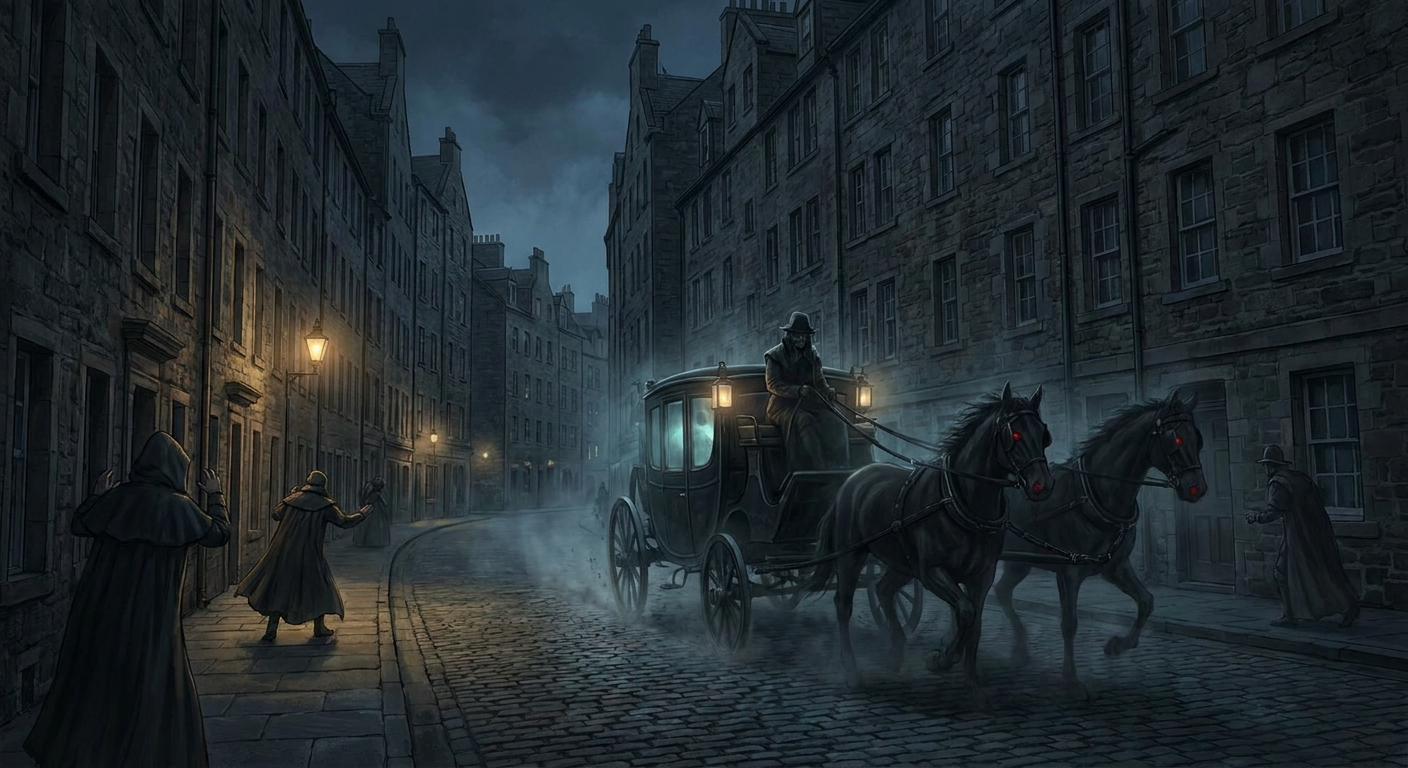
Weir confessed to incest with his sister Jean, bestiality, adultery, and dealings with the Devil. He claimed to have met Satan in Dalkeith, where he received supernatural knowledge. The Major described travelling through the countryside in a fiery coach drawn by six horses. He insisted he was damned beyond all hope of repentance, saying: “I find nothing within me but blackness and darkness, brimstone and burning to the bottom of hell.”
The Lord Provost, Sir Andrew Ramsay, sent physicians to examine him. Their verdict was unambiguous — Weir was in sound mind and body. Meanwhile, Jean corroborated everything. She added that their mother had been a witch, that she herself had been visited by a fairy who gave her a piece of tree root and silver, and that Thomas bore the mark of the Beast on his body. Furthermore, she claimed that on 7th September 1648, a fiery coach had transported them to Musselburgh, where the Devil informed Thomas of the Scottish army’s defeat at Preston.
Major Weir’s Black Staff
Central to the legend of Major Thomas Weir is his black thornwood staff. Jean insisted it was the source of all his power, given to him by the Devil himself. Carved with the grinning heads of satyrs, it was known as The Lilyroot.
Those who knew Weir noted that his prayers seemed to lose their power when he was without it. Moreover, witnesses claimed to have seen the staff move independently — running errands, opening doors, and acting as a lantern-bearer on dark nights. It was, by all accounts, as infamous as its master.
At his execution, the staff was thrown into the fire alongside Weir. Witnesses recorded that it took an unusually long time to burn and made strange turning movements in the flames.
The Trial and Execution of Major Thomas Weir
The trial of Major Thomas Weir and his sister Jean began on 9th April 1670, before a specially constituted court. The Lord Advocate, Sir John Nisbet of Dirleton, prosecuted. Notably, Weir himself was not charged with witchcraft — his charges were incest, adultery, and bestiality. Jean, however, was charged with witchcraft.
Both pleaded guilty and offered no defence. Both were sentenced to death.
On 11th April 1670, Weir was garroted and burned at the Gallowlee, on the road between Edinburgh and Leith, near what is today Pilrig Street on Leith Walk. His remains were subsequently gibbeted at the same site. When urged to pray for forgiveness, he refused. His last recorded words were:
“Let me alone. I have lived as a beast, and I must die as a beast.”
Jean was hanged the following day at the Grassmarket gibbet. Accounts describe her attempting to strip on the scaffold, to the horror of the assembled crowd. Both siblings were buried at the base of the gallows at Shrubhill.
Did Major Thomas Weir Have Dementia?
The question of Major Thomas Weir’s mental state has never been fully resolved. Dr Rankin, in his Notices on the Parish of Carluke — 1288 to 1874, suggests that Weir may have been suffering from senile dementia at the time of his confession. This is a credible hypothesis. Weir was in his seventies, and the sudden, compulsive nature of his self-accusation is consistent with certain forms of cognitive decline.
However, it does not explain everything. The physicians who examined him found him to be of sound mind. His confessions were detailed, consistent, and expanded over time rather than deteriorating. Jean’s corroboration — which went beyond simply agreeing with her brother and added new material — complicates any straightforward dementia diagnosis.
It is also worth noting that Weir was not charged with witchcraft. His actual charges — incest, adultery, and bestiality — were crimes that required no supernatural explanation. It is therefore possible that the crimes themselves were real, and that the supernatural elements were either embellishments by Jean, later additions by storytellers, or the product of a mind genuinely unravelling.
The truth, as is so often the case with Edinburgh’s darkest history, remains elusive.
The Haunting of West Bow
After the executions, the house of Major Thomas Weir on the West Bow stood empty for over a century. No one would live there. Locals reported strange lights in the windows at night, the sound of music and laughter from within the deserted rooms, and the shapes of enormous women moving behind the glass.
Around 1780, an ex-soldier named William Patullo purchased the house at a low price and moved in with his wife. They lasted one night. They fled after a ghostly calf appeared at the foot of their bed, propped its forelegs on the bedframe, and stared at them in the dark.
Additionally, residents of the West Bow reported seeing a phantom coach drawn by six horses thundering down the street at midnight. Others claimed to see the black staff moving through the closes on its own, searching for its master. The ghost of Weir himself — tall, dark, and leaning on his staff — was reportedly seen for a hundred years after his death.
The house was long believed to have been demolished in the nineteenth century. However, recent archaeological surveys have revealed that parts of the original structure survive within the shell of a later building. That building is now the Quaker Meeting House on Victoria Street. Staff have reportedly seen the figure of Major Thomas Weir walking through walls.
Whether you believe in ghosts or not, the West Bow has never quite shaken the shadow of its most infamous resident.