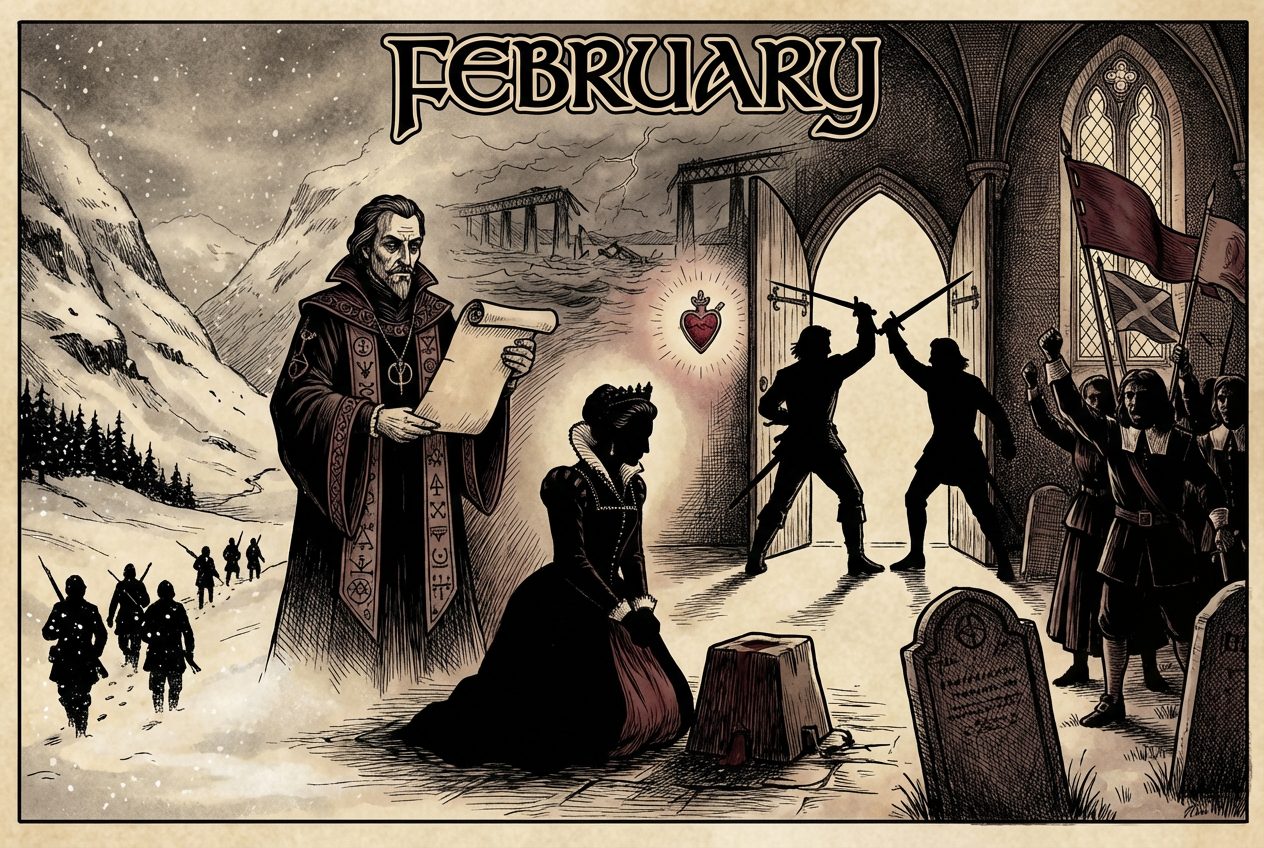
February is one of the darkest months in the Scottish calendar — not just in weather, but in history. It opens with the shadow of Glencoe, where government troops were already billeted with the MacDonalds, the massacre just days away. By the 13th, thirty-eight men, women and children lay dead in the snow.
This month also carries the weight of royal blood. Mary Queen of Scots was beheaded on the 8th, and Lord Darnley — her murdered husband — died in a suspicious explosion on the 10th. The Bonnie Earl of Moray fell to a rival’s blade on the 7th, his death immortalised in song.
February holds quieter stories too. Glasgow’s surprising connection to Saint Valentine, the founding of Aberdeen’s university, and the signing of the National Covenant at Greyfriars Kirkyard all fall within these short winter weeks. Scotland’s first Protestant martyr burned at St Andrews, and Kenneth MacAlpin — the first King of Scots — drew his last breath in this month.
February is also the month William Hare walked free, and Robert the Bruce committed sacrilegious murder in a Dumfries church — an act that changed the course of Scottish history forever.
1 February 1692: Troops move south from Fort William and are billeted with the MacDonalds in Glencoe. The soldiers ate at their hosts’ tables and slept under their roofs — a calculated deception that made the massacre, just days away, all the more chilling.
2 February 1645: The Battle of Inverlochy. Montrose’s forces descend on Argyll’s Campbell army in a dawn assault. Argyll watches from a boat on the loch as his men are slaughtered. It is the low point of his career — and Montrose’s greatest triumph.
3 February 1686: Sir Robert Gordon of Gordonstoun is elected a Fellow of the Royal Society. A man of genuine scientific learning, he was nonetheless shadowed by darker rumours — local legend named him a warlock who had sold his soul to the Devil. His legacy sits uneasily between the Enlightenment and the uncanny.
5 February 1829: William Hare walks free from prison, having testified against his partner William Burke for the West Port murders. He was equally guilty, but turning King’s evidence saved him from the gallows. He slipped out of Edinburgh and out of recorded history, leaving only questions behind.
7 February 1592: The Bonnie Earl of Moray is murdered at Donibristle by the Earl of Huntly — a killing born of rivalry and royal politics. His death was mourned in a famous ballad that outlasted everyone involved. He has been a symbol of tragic beauty and political treachery ever since.
8 February 1587: Mary Queen of Scots is beheaded at Fotheringhay Castle in England. Years of captivity and political intrigue ended on the block, her death ordered by her cousin Elizabeth I. Mary remains one of Scotland’s most haunting and contested figures — in death as much as in life.
10 February 1306: Robert the Bruce murders John Comyn — the Red Comyn — inside a church in Dumfries. The act was sacrilegious and deliberate, removing his only serious rival for the Scottish throne. It also left Bruce with no choice but to fight, launching a desperate war for survival that would define his legacy.
10 February 1495: Pope Alexander VI signs a papal bull establishing the University of Aberdeen. It becomes Scotland’s third university and the fifth oldest in the English-speaking world.
10 February 1567: Lord Darnley is killed at the Provost’s House on the edge of Edinburgh. An explosion levels the building, yet his body is found in the garden — unmarked by fire. Suspicion falls immediately on those closest to him, and whispers of a conspiracy involving Mary Queen of Scots spread fast.
13 February 1692: Government troops under Captain Robert Campbell turn on the MacDonalds of Glencoe in the early hours of the morning, killing thirty-eight of their hosts in their beds. The soldiers had eaten with these men and sheltered under their roofs. This “murder under trust” remains one of the most infamous acts in Scottish history.
14 February — Saint Valentine’s Day: Few people know that Glasgow has a genuine claim on Saint Valentine. A portion of his relics is kept at the Church of Blessed John Duns Scotus in the Gorbals, making the city an unlikely home for the patron saint of lovers. If you are in the mood for a romantic tale today, you might want to read about Mary Leslie or Helen Dunbar.
17 February 2026 — Shrove Tuesday: Pancake Day is here. Time to read the Tale of the Wee Bannock.
24 February 1303: The Battle of Roslin is fought south of Edinburgh, delivering a significant Scottish victory. Scottish forces reportedly defeated three separate English detachments in a single day of fierce fighting — a remarkable feat that gave the resistance a much-needed lift.
25 February 1822; Sir Thomas Bouch is born — the engineer who would later design the Tay Rail Bridge. The bridge collapsed in a storm in 1879, killing seventy-five people and destroying Bouch’s reputation overnight. His name has been synonymous with engineering disaster ever since.
28 February 1638: The National Covenant is signed by thousands of Scots at Greyfriars Kirkyard in Edinburgh. The document was a direct challenge to King Charles I’s interference in Scottish religious life. It lit the fuse for the Wars of the Covenant — a period of bitter and bloody conflict.
29 February 1528: Patrick Hamilton is burned at the stake in St Andrews, convicted of heresy. He was the first Protestant martyr to die for his faith in Scotland. His death was slow and agonising — and it drove more people towards the Reformation, not away from it.
February 840: Kenneth MacAlpin, traditionally regarded as the first King of Scots, dies of a tumour. His reign had seen the Scots and Picts brought together under a single crown. His death marked the close of a pivotal chapter in the making of Scotland.