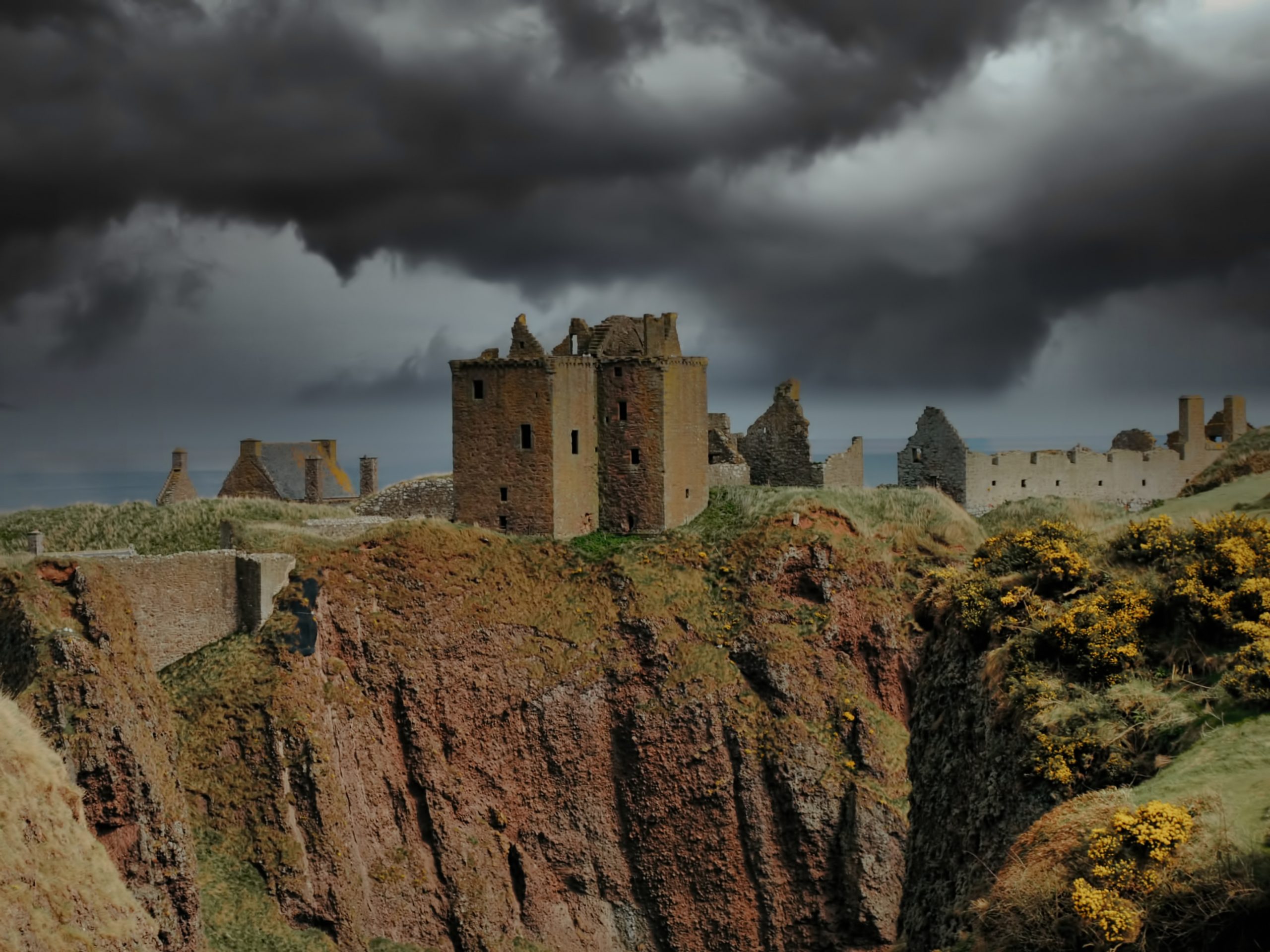
Dunnottar Castle clings to the wind-scoured cliffs south of Stonehaven, where the air feels thick with the spirits of those who have passed this way before. There is an inexplicable chill even on brightest summer days, accompanied by the sound of footsteps in empty corridors. Is it any wonder that spirits are said to roam it ruins? Dunnottar has a dark history: kings have been killed here, people have been cruelly imprisoned, and it has been besieged multiple times.
But who are these spirits who roam among the ruins? The most famous apparition is the “Green Lady”. Is this a glastig? Perhaps if the lore is true, she is the spirit a Pictish woman searching for her lost children. And could the ghost of a young girl wearing a tartan skirt be her lost daughter? Another frequent sight is a tall Scandinavian man, thought to be a Viking raider, pacing the ramparts as if still guarding the spoils of a long-forgotten raid. And what of the spectre of a deerhound seen on the grounds? A beloved pet? Some long-dead occupant’s hunting dog? It certainly is not the strangest of beasts to dwell within the fortress.
Most chilling of all is the atmosphere within the Whigs’ Vault. During the 1680s, Covenanters were packed into this dark, damp cellar with almost no light or air. Today, tourists claim to hear muffled whispers and the rhythmic scrape of chains against the stone floor. Some have even reported seeing a soldier in 17th-century uniform standing guard at the entrance to the vault, only for him to vanish when approached.
Pictish times and the first siege at Dunnottar
The headland was a site of power long before the first stone castle was raised. In AD 681, the Annals of Ulster record the siege of “Dún Foither,” which historians identify as the earliest mention of Dunnottar. King Bridei son of Beli, the powerful Pictish King of Fortriu, besieged the site to consolidate his rule over the north-east. A second siege followed in 694, proving that the rock was a vital strategic prize in the tribal wars of early Scotland.
It wasn’t the only Pictish site in the area. A nearby stack once housed the promontory fort of Dunnicaer. The Pictish stones found there have changed our understanding of when the Picts first began carving stones to much earlier than we had previously imagined.
In 900, the fortress became the site of a royal tragedy. The Chronicle of the Kings of Alba records that King Donald II, the first ruler to be styled rí Alban (King of Alba), was killed here during a Viking invasion. The Northmen destroyed the existing buildings, leaving the headland a charred ruin. This event marked a turning point in the Viking Age, as the Scots struggled to defend their eastern coastline from Scandinavian longships.
A generation later, in 934, the conflict shifted south. King Æthelstan of Wessex, the first king of all England, led a massive land and sea force into Scotland to assert his dominance. According to Symeon of Durham, Æthelstan’s army ravaged the land as far north as Dunnottar, where Constantine successfully waited out a month-long siege.
Dunnottar’s role in the Scottish Wars of Independence
During the Wars of Independence, Dunnottar became a pivotal military asset. In 1296, Edward I of England, known as “Longshanks,” invaded Scotland and personally visited the castle, leaving behind a strong English garrison. The English believed the sheer cliffs made the position impregnable, but they had not reckoned with the ferocity of Scottish resistance.
In 1297, William Wallace led a daring assault on the stronghold. Legend tells that the English soldiers, terrified by Wallace’s reputation, fled into the stone chapel, believing the Scots would not shed blood on holy ground. Wallace, however, set the building ablaze, trapping the garrison inside. Blind Hary’s fifteenth-century poem The Wallace captures the horror of the event:
Therefore a fire was brought speedily:
Which burnt the church, and all those South’ron boys:
Out o’er the rock the rest rush’d great noise;
Some hung on craigs, and loath were to die.
Some lap, some fell, some flutter’d in the sea;
And perish’d all, not one remain’d alive.
Extract of Blind Harry ‘Wallace’ c1470’s (Modern Translation)
Those who did not perish in the flames were driven over the cliff edges into the sea. The English returned in 1336 when Edward III ordered the castle refortified, but the Scottish Regent and son of the man who orchestrated the Battle of Stirling Bridge, Sir Andrew Murray, recaptured the castle that same year.
Mary, Queen of Scots and the Earls Marischal
In 1562, Mary, Queen of Scots, visited Dunnottar for the first time following the Battle of Corrichie. She found a much-transformed site, as the Keith family, the Earls Marischal, had begun turning the fortress into a palatial residence. Mary returned in 1564, spending two nights in the luxurious new quarters. Her son, James VI, would later stay for ten days in 1580, even convening a meeting of the Privy Council within the castle walls.
The Lion’s Den of Dunnottar and the Earl’s Menagerie
Dunnottar’s history is not all sieges and sorrow. For a time, it also had a touch of spectacle, because the Keiths kept a pet lion at the castle. George Keith, 5th Earl Marischal, brought the beast to Dunnottar in the late sixteenth century and housed it in what is still known as the Lion’s Den. This was not merely a whim; the lion was a living representation of the Keith family’s heraldic device. The Earl’s coat of arms featured two harts as supporters, but the lion was a potent symbol of the “Great Marischal of Scotland” office he held.
However, keeping a large predator in a clifftop fortress was not without its domestic challenges. Historical anecdotes suggest that the Earl’s wife, Margaret, was far from pleased with the noise and danger of the royal beast. Her complaints were frequent, and eventually, the lion died. Perhaps seeking a slightly less ferocious—though no less exotic—companion, the Earl is said to have replaced the lion with a bear. This shift from lion to bear reflects the Earl’s desire to maintain a menagerie that reflected his status as one of the most powerful men in Scotland.
The Honours of Scotland: the siege, the stakes, and the two rescue stories
The Honours of Scotland, the crown, sceptre and sword, are the most famous objects ever hidden at Dunnottar. They had been used to crown Charles II King of Scots at Scone on 1 January 1651. However, within months, Oliver Cromwell’s forces had seized Edinburgh and were tightening their grip on the country. The Honours could not safely be returned to the capital. Cromwell had already melted down the English crown jewels after the execution of Charles I. There was every reason to believe he would do the same to Scotland’s regalia if he found them.
As Great Marischal of Scotland, the Earl Marischal had formal responsibility for the regalia. The Privy Council decided they should be sent to Dunnottar for safekeeping. They were brought in concealed in sacks of wool, and Sir George Ogilvie of Barras was appointed lieutenant-governor of the castle and charged with its defence. When Cromwell’s men demanded surrender in late 1651, Ogilvie refused. A blockade began, and heavy artillery was eventually brought up to force the issue. With surrender looming, the defenders faced a single question: save the castle or save the Honours. The choice was the Honours.
What makes this episode so compelling is that there are two competing stories about how the Honours were rescued. Both place Christian Fletcher, wife of the minister of Kinneff, at the centre. However, they differ in method, timing, and theatricality.
Version 1: Christian Fletcher’s own account, smuggled out in stages
In the first version, Christian Fletcher later stated that she removed the Honours over the course of three visits in February and March 1652. Rather than one dramatic escape, it was a careful, repeated operation. The items were concealed among sacks and everyday goods that would not alarm the besiegers. Piece by piece, the crown, sceptre and sword were carried out past enemy eyes, then taken to Kinneff and hidden under the floor of the kirk.
Version 2: the beach and the creel, lowered down to the shore
The second version, recorded later, is more cinematic. In this telling, the Honours were lowered from the castle down the cliff to the beach below. Fletcher’s servant collected them there, hiding them in a creel said to be piled with seaweed to make it look mundane. The creel was then carried away as if it contained nothing more than the day’s haul. The same destination follows: Kinneff Old Kirk, where the Honours were buried under the floor for safekeeping.
What happened next, and why the story matters
Dunnottar eventually surrendered on 24 May 1652. The Cromwellian forces searched for the Honours and, finding them gone, imprisoned Ogilvie and his wife. A false story was later circulated that the regalia had been sent overseas. Only after the Restoration in 1660 were the Honours recovered from Kinneff and returned to Edinburgh Castle.
The Whigs’ Vault
Dunnottar Castle became a site of profound human suffering during the “Killing Times” of the late seventeenth century. In May 1685, 167 Covenanters, including 45 women, were marched from Edinburgh to the castle because they refused to take an oath of allegiance to the Catholic King James VII. These prisoners were supporters of the National Covenant, which asserted that God, not the monarch, was the head of the Church. Consequently, they were viewed as dangerous rebels and treated with extreme cruelty.
Upon arrival, the prisoners were forced into the Whigs’ Vault, a dark, damp cellar beneath the castle’s quadrangle. This space was entirely inadequate for such a large number of people. Because the vault was so cramped, the prisoners had to stand or sit in their own filth, with almost no light or fresh air. Furthermore, the guards charged the prisoners for every drop of water and every morsel of food they consumed. Those who could not pay were left to starve in the shadows.
Desperation eventually led to a daring escape attempt. One night, twenty-five prisoners managed to scramble out of a window and down the sheer, dangerous cliffs. However, two tumbled to their deaths. Another fifteen were recaptured and subjected to horrific torture as a deterrent to others. Despite these brutal conditions, the survivors remained steadfast in their faith. After several weeks of misery, the remaining prisoners were marched to Leith and transported to the American colonies. Today, the Covenanters’ Stone in the nearby Dunnottar Kirkyard stands as a grim memorial to those who perished in the vault.
Dunnottar and the Jacobite Rising
The castle’s military life ended with the Jacobite Rising of 1715. George Keith, the 10th Earl Marischal, supported the Stuart claim to the throne. He led Jacobite cavalry at the Battle of Sheriffmuir. Following the defeat, he was forced into exile, and his titles and lands were forfeited.
A Poignant Grave Marker at Dunnotter
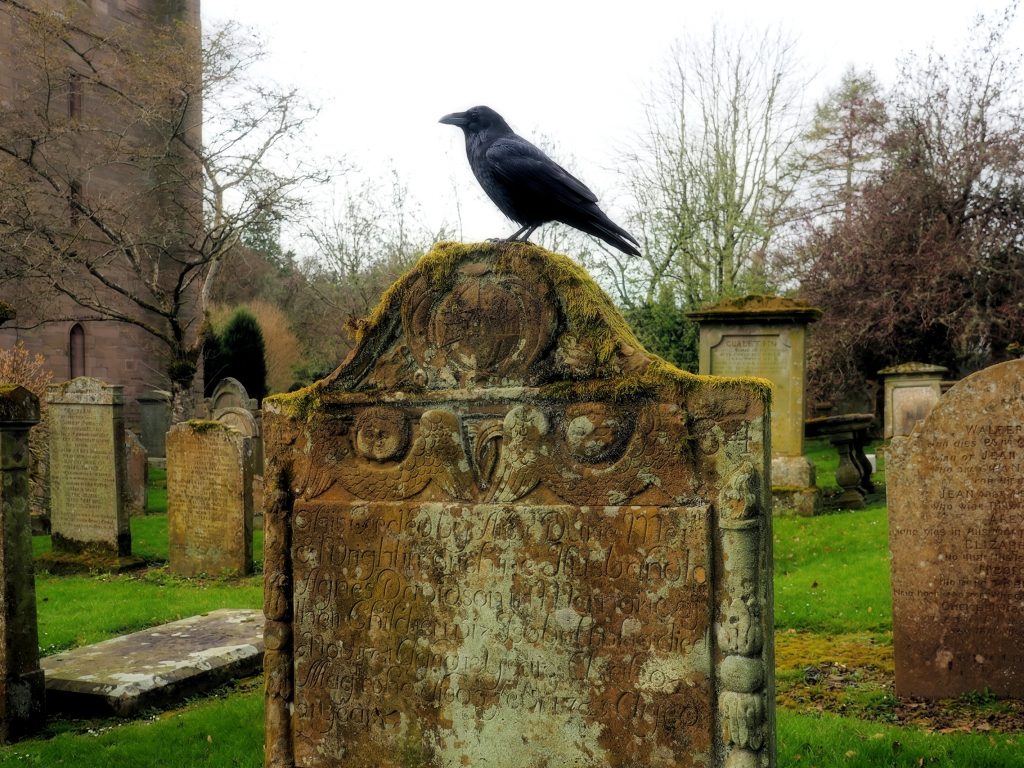
The ruins now stand as a silent monument to these turbulent eras. Among the ruins of Dunnottar, is a stone memorial in a grass enclosure dedicated to a “bairn of nyn years.” It is dated 1685, the year the Covenanters were imprisoned within Whig’s vault. Could this be the nameless child of a Covenanter? It seems hard to contemplate such ruthless cruelty.
The ghosts of Dunnottar are not merely legends. They are the echoes of a history so violent and dramatic that the stone itself seems to remember. As the North Sea continues to batter the cliffs, the spirits of Picts, Vikings, and Covenanters remain bound to the rock, ensuring that the castle’s story is never truly finished.