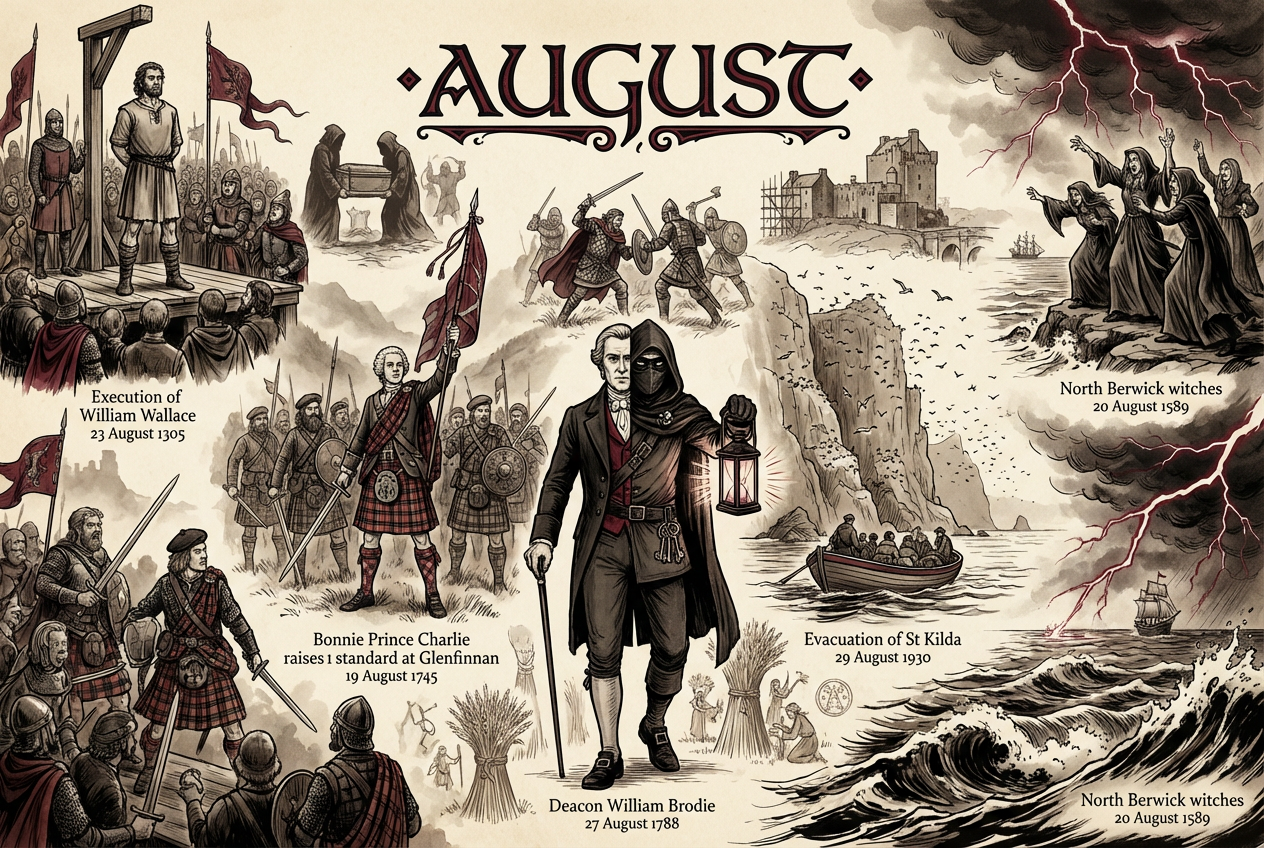
August opens with Lughnasaidh, the ancient harvest festival, and rarely lets up from there. It is one of the most event-packed months in the Scottish calendar — spanning two thousand years of history, from the death of Duncan I to the evacuation of St Kilda in 1930.
Royal drama runs through the month like a thread. Mary Queen of Scots sailed to France as a child of five, returned as a widow of eighteen, was arrested on the evidence of her own letters, and visited Dunnottar in the aftermath of battle — all in August, across different years. The Stone of Destiny left Scotland on the 8th, and two kings — Duncan and Macbeth — both met violent ends in this month, decades apart.
August is also the month Scotland became officially Protestant. The Confession of Faith passed through Parliament in 1560, permanently reshaping the nation’s spiritual and political identity. Three years later, the Solemn League and Covenant tied Scotland’s religious ambitions to the English Civil War.
The Jacobite cause looms large too. Bonnie Prince Charlie raised his standard at Glenfinnan on the 19th, and the Battle of Dunkeld was fought just days later. William Wallace casts a long shadow over the whole month — captured near Glasgow at its opening and executed in London at its close, his story bookends August with the loss of Scotland’s most iconic freedom fighter.
1 August — Lughnasaidh and Lammas: Lughnasaidh and Lammas mark the traditional start of the harvest season. Communities gathered for fairs and rituals to give thanks and secure a good crop. The month begins, as it has for thousands of years, with Scotland’s deep roots in the land and its older, pagan rhythms.
1 August 1747: The Act of Proscription bans the wearing of Highland dress — tartans, kilts, and the trappings of clan identity — except within the army. It was one of several measures designed to break the clans after the Jacobite rising. The very fabric of Highland culture was driven underground.
3 August 1305: William Wallace is captured near Glasgow after years as a guerrilla leader. He is taken to London, where trial and a brutal execution await him later in the month. Scotland’s struggle for independence loses its most iconic guardian.
5 August 1600: An alleged attempt on James VI’s life takes place at the hands of the Gowrie family in Perth. Some historians suspect the King invented the plot to escape a substantial debt he owed them. The Gowrie Conspiracy remains one of Scotland’s most enduring royal mysteries.
7 August 1548: Five-year-old Mary Queen of Scots sets sail for France, sent abroad to escape the destructive military campaign Henry VIII called the “Rough Wooing.” It is the beginning of a long exile from her homeland. Her story, though, is only just beginning.
8 August 1296: Edward I of England removes the Stone of Destiny from Scone Abbey and carries it south to London. In taking Scotland’s coronation stone, he was making a deliberate statement about sovereignty. The stone begins a centuries-long journey away from its rightful place.
11 August 1306: Robert the Bruce attacks John MacDougall of Lorne at the Battle of Dalrigh near Tyndrum and is defeated. Forced into the wilderness as a fugitive, his path to the throne looks bleaker than ever. This is the low point before the long climb back.
11-12th August 1332: The Battle of Dupplin Moor (August 11–12, 1332) was a decisive victory for Edward Balliol’s smaller, English-backed force over a much larger Scottish army, marking the first major battle of the Second War of Scottish Independence
11 August 1586: Mary Queen of Scots is arrested after a letter is found in which she approves a plot to assassinate Elizabeth I. The evidence was gathered through a sting operation. The walls of her long imprisonment begin, finally, to close in.
15 August 1040: Duncan I is killed at the Battle of Pitgaveny while attempting to assert his authority over northern Scotland. Macbeth of Moray defeats him and is crowned King at Scone. The historical Macbeth takes the throne through blood and battle — just as Shakespeare imagined, if not quite as he told it.
15 August 1057: Malcolm Canmore defeats Macbeth at the Battle of Lumphanan in Aberdeenshire, ending his reign. The crown of Scotland shifts again through violent conflict, as it so often did. The House of Canmore begins its long rule.
15 August 1645: Montrose and his Royalist forces crush the Covenanters at the Battle of Kilsyth, killing around 3,000 men. The victory gives Montrose effective control of much of Scotland, including Glasgow and Edinburgh. His dominance, however, will not last.
17 August 1560: The Scottish Parliament passes the Confession of Faith, making Scotland officially Protestant. The authority of the Pope is ended and the Mass outlawed in a single session. The spiritual and political landscape of the nation is permanently transformed.
17 August 1643: Scotland offers military support to the English Parliament in exchange for acceptance of the Solemn League and Covenant. The agreement is an attempt to spread Presbyterianism south of the border. Religious and political fates become tightly bound together.
19 August 1561: Mary Queen of Scots returns to Scotland as an eighteen-year-old widow. She steps ashore into a country that turned Protestant during her years in France. The tension is immediate — she is a Catholic queen in a nation that no longer wants her faith.
19 August 1745: Charles Edward Stuart raises his standard at Glenfinnan, launching the final Jacobite rising. The clans are called to arms. The Bonnie Prince begins his legendary — and ultimately tragic — campaign.
19th August 1848: The Moray Firth Fishing Disaster caused by a hurricane sees the loss of 124 boats and the lives of 100 men.
20 August 1589: James VI marries Anne of Denmark by proxy. When she attempts to sail to Scotland, violent storms repeatedly drive her back — storms that were blamed on witches. The episode sparks the North Berwick witch trials, one of the most notorious in Scottish history.
21 August 1689: The Jacobite Highland army attacks government forces at the Battle of Dunkeld. Street fighting tears through the town, leaving much of it in ruins. The Jacobite momentum stalls with heavy losses on both sides.
23 August 1305: William Wallace is tried and executed in London for treason. His death is meant as a warning. Instead, it makes him a martyr — and his legend grows larger still.
23 August 1913: Work begins on rebuilding Eilean Donan Castle, which had lain in ruins since 1719. The project takes nearly twenty years. One of Scotland’s most photographed landmarks is slowly brought back to life.
25 August — Bull Sacrifices at Loch Maree: Records show that bull sacrifices to Saint Mourie were still taking place at Loch Maree long after the Reformation. Livestock were offered to the saint in hope of curing insanity. It is a striking example of how ancient, pagan-tinged customs quietly survived in the Highlands, long after they were supposed to have been stamped out.
26 August 1562: Mary Queen of Scots visits Dunnottar Castle in the aftermath of the Battle of Corrichie. The coastal stronghold serves as a royal refuge during a period of internal conflict. It is one of several moments in August that place Mary at the centre of Scotland’s turbulent politics.
26 August 1565: Mary Queen of Scots leads an army out of Edinburgh to put down a rebellion by her half-brother, the Earl of Moray. The rebels flee without a major engagement — the campaign is known as the Chaseabout Raid. Mary’s authority holds, at least for now.
27 August 1788: The trial of Deacon William Brodie opens in Edinburgh. Respected councillor by day, burglar by night — his double life scandalises the city. He later becomes the inspiration for the story of Jekyll and Hyde.
29 August 1930: The islands of St Kilda are evacuated, ending over two thousand years of continuous human habitation. The remaining islanders are moved to the mainland as their way of life becomes impossible to sustain. The island is left to the sea and the birds.