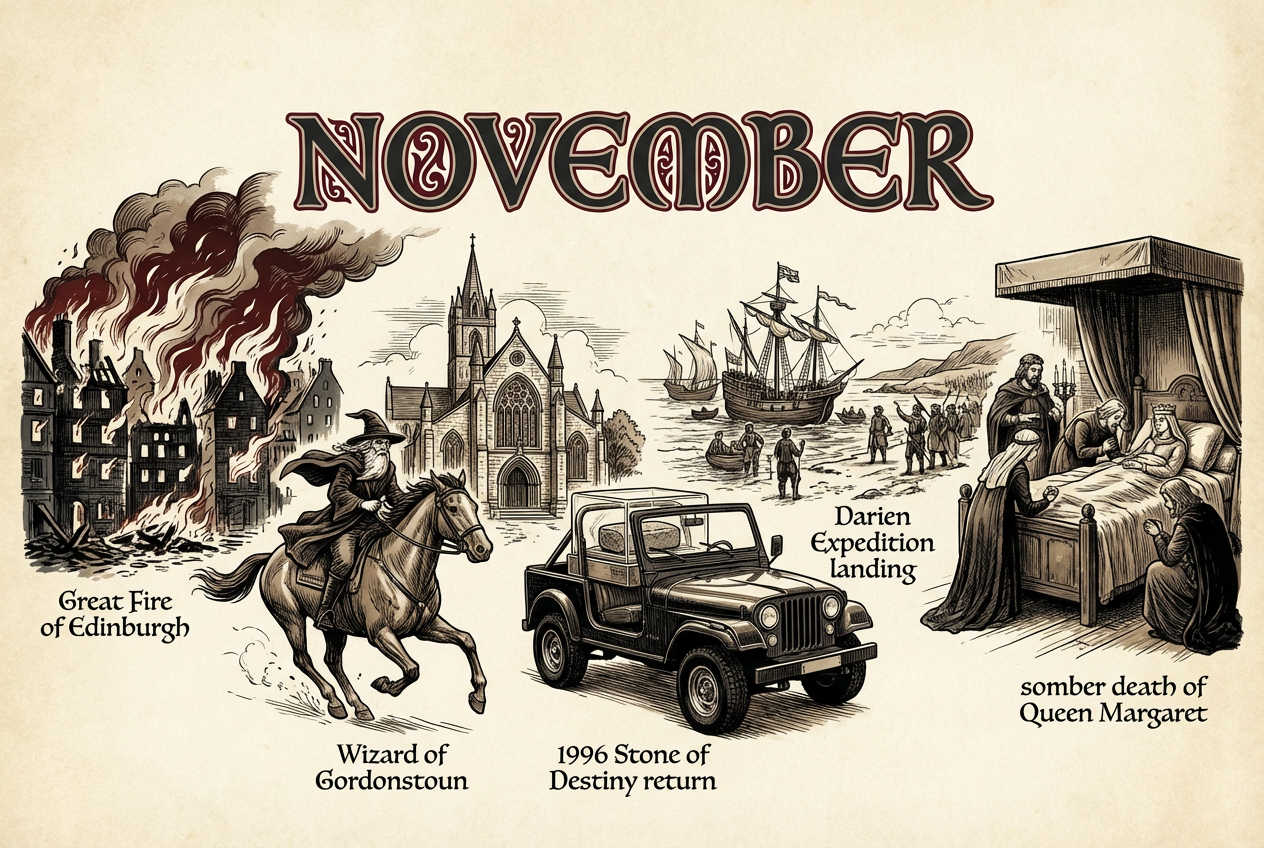
November is a month that carries the weight of endings. Kings die, queens grieve themselves to death, and great ambitions collapse in cold and rain. It opens with the Darien settlers landing in Central America, full of hope, and barely pauses for breath before the next disaster.
The month is bookended by two moments of Scottish identity. At its close, Saint Andrew’s Day falls on the 30th — and in 1996, 10,000 people lined the Royal Mile to watch the Stone of Destiny return to Scotland after 700 years in England. At its opening, those same national ambitions echo in the settlers naming their doomed colony “New Caledonia.”
Royal deaths cluster here. Malcolm Canmore was killed in Northumbria on the 13th, his son dying with him. Three days later, Queen Margaret died of grief and was buried at Dunfermline. Their deaths triggered a dangerous succession crisis — and Margaret’s cult began almost immediately, eventually making her Scotland’s only royal saint.
Religious conflict runs through November too. John Knox died on the 24th, his legacy already divisive. The Covenanters suffered at Rullion Green on the 28th, and a shipload of prisoners left Leith for forced labour in the Americas the year before. Meanwhile, in 1590, a servant’s forced confession in Tranent lit the fuse for the North Berwick Witch Trials.
November also holds the Black Dinner of 1440, the birth of Charles I at Dunfermline, and the death of the Wizard of Gordonstoun — chased to his end at Birnie Kirkyard in circumstances that folklore has never quite let go of.
2 November 1698: The first Darien expedition arrives in Central America. The settlers land and name their new home “New Caledonia,” in what is now Panama. The dream is vivid and ambitious — and it will not last.
3 November 1715: The Battle of Sheriffmuir is fought between Jacobite rebels and government forces. It ends in a bloody stalemate, with both sides claiming some form of victory. The Jacobite rising of 1715 begins to lose its momentum in the cold of winter.
13 November 1093: Malcolm Canmore is killed on another raid into Northumbria. His eldest son by Margaret dies with him. Scotland faces a dangerous succession crisis at the start of winter.
15 November 1824: The Great Fire of Edinburgh breaks out and burns for five days, claiming thirteen lives. The Old Town fills with smoke, panic, and ash. It remains one of the most destructive fires in the city’s history.
16 November 1093: Queen Margaret dies, said to be overcome by grief at the loss of her husband and son. She is buried at Dunfermline, in the church she founded. Her death is the beginning of a cult — she will eventually become Saint Margaret, and Dunfermline a place of pilgrimage.
16 November 1700: The outlaw Jamie Macpherson is hanged in Banff. His story sits in the borderland between fact and legend, and his name still carries a folk echo of defiance.
17 November 1292: John Balliol is appointed King of Scotland by Edward I of England. The choice is legally sound, but deeply political. Scotland’s kingship becomes entangled with English power from this moment on.
19 November 1600: The future Charles I is born at Dunfermline Palace. His reign will later tear kingdoms apart. It is a quiet beginning to a coming storm.
22 November 1515: Marie de Guise is born in France. She will become Queen Consort to James V, mother of Mary Queen of Scots, and Regent of Scotland. A foreign birth shapes Scottish politics for a generation.
24 November 1440: The young Earl of Douglas and his brother are invited to dinner at Edinburgh Castle by William Crichton. Before the meal is over, Crichton’s men seize them, accuse them of treason, and have them executed. This is the Black Dinner — one of the most cold-blooded acts of political murder in Scottish history.
24 November 1572: John Knox dies in Edinburgh. He reshaped both worship and power in Scotland, and his influence remains divisive to this day.
27 November 1679: A ship carrying Covenanter prisoners leaves Leith, bound for the Americas and forced labour. They were taken after the defeat at Bothwell Brig. Punishment, it seems, was not content to stay within Scotland’s borders.
28 November 1666: The Battle of Rullion Green is fought in the Pentland Hills near Penicuik. Government troops under Tam Dalyell of the Binns defeat Covenanter rebels. The conflict hardens into a story of punishment and martyrdom.
November 1590: Geillis Duncan of Tranent is accused of witchcraft by her employer, David Seton. Under torture, she makes accusations that ignite the North Berwick Witch Trials. A single servant’s forced confession becomes the spark for a national panic.
November 1704: The Wizard of Gordonstoun’s pact with the Devil is said to reach its end. Robert Gordon is chased, thrown from his horse, and killed at Birnie Kirkyard. Folklore seals his fate where stone and graveyard meet.
30 November — Saint Andrew’s Day: Saint Andrew’s Day is Scotland’s national feast — a day for remembering Scottish identity, symbols, and story.
30 November 1292: John Balliol was inaugurated as King of Scots at Scone, following the ‘Great Cause’ with Edward I of England as the administrator of the court. It soon became apparent that Balliol was a puppet king , earning him the name ‘Toom Tambard.’
30 November 1699: The Second Darien fleet arrives in Panama to discover that the original colony had already deserted .
30 November 1996: On Saint Andrew’s Day, around 10,000 people line Edinburgh’s Royal Mile to watch the Stone of Destiny return to Scotland for the first time in 700 years. At a service in St Giles’ Cathedral, the Moderator of the Church of Scotland formally accepts its return. The stone is taken to Edinburgh Castle and placed alongside the Honours of Scotland.
November 1289: The Treaty of Salisbury sets the conditions for Margaret, Maid of Norway’s journey to Scotland.