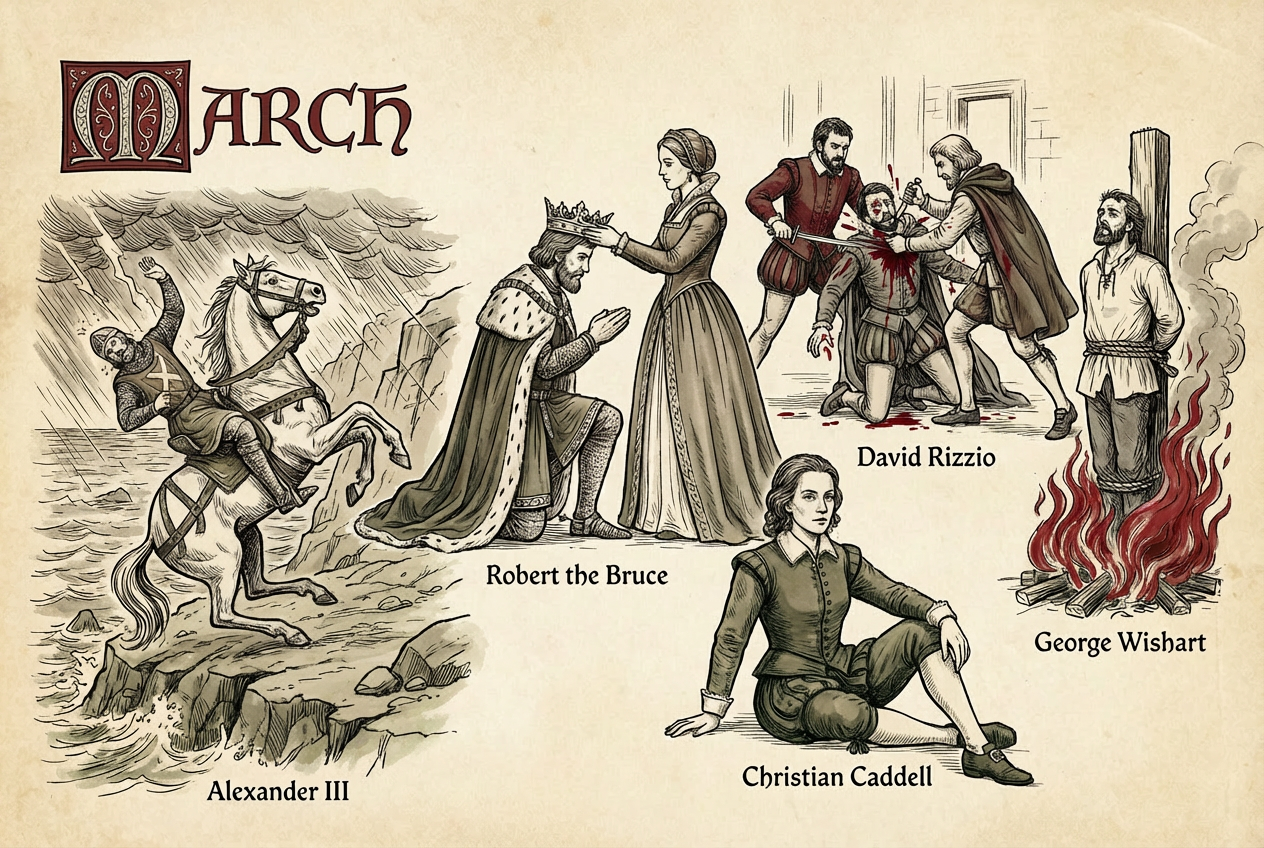
March is a month of crownings and killings, martyrdoms and massacres. It opens with the burning of George Wishart at St Andrews — an act that accelerated the Scottish Reformation and signed Cardinal Beaton’s own death warrant. It closes with a witch-pricker working her way through the north-east under a false name, leaving a trail of trials and executions behind her.
Royal fortunes dominate the month. Robert the Bruce was crowned at Scone on the 25th, defiant and outlawed, launching the war that would define his legacy. King James I was seized by pirates at twelve years old and handed to the English, leaving Scotland without its king for eighteen years. Alexander III vanished into a stormy night in Fife on the 19th, his death triggering a succession crisis that eventually brought Edward I to Scotland’s door.
The Wars of Independence run through March like a fault line. Edward I massacred the inhabitants of Berwick on the 30th of March 1296. Two years later, William Wallace was named Guardian of Scotland — but already facing resistance from the nobility he was supposed to lead.
Violence touches the domestic sphere too. David Rizzio was stabbed over fifty times in Mary Queen of Scots’ presence at Holyroodhouse. Two Edinburgh women sold a murdered child’s body to anatomy students for a few shillings. March rarely offers mercy.
1 March 1546: Cardinal Beaton has the Protestant reformer George Wishart burned at the stake for heresy at St Andrews, in front of a gathered crowd. The martyrdom fuels the growing fire of the Scottish Reformation. It also seals Beaton’s own fate — violent retaliation follows.
7 March 1598: Black Saturday, an eclipse that occurred in Scotland during the Scottish Witch Trials.
7 March 1607: Archibald Campbell, the man who would become the most powerful nobleman in Scotland, is born. As 1st Marquess of Argyll, he would champion the Covenanting cause, crown a king — and die for it.
9 March 1566: David Rizzio, Mary Queen of Scots’ private secretary, is murdered at the Palace of Holyroodhouse. A group of conspirators including Lord Darnley drags him from the queen’s presence and stabs him over fifty times. The attempted coup fails when Darnley helps Mary escape to Dunbar.
10 March 520: St Kessog is killed at Bandry on the western shore of Loch Lomond. Regarded as the original patron saint of Scotland before Saint Andrew, his death was a significant blow to the early Celtic church. Legend holds that he was martyred, and his memory remains tied to the haunting beauty of the loch.
14th March 1314: Thomas Randolph climbs the cliff face at Castle Rock to reclaim Edinburgh Castle from the English army.
17 March 1328: The Treaty of Edinburgh–Northampton (1328) formally ended the First War of Scottish Independence, recognising Scotland’s independence and Robert the Bruce as its king.
18 March 1752: Helen Torrance and Jean Waldie murder nine-year-old John Dallas in Edinburgh and sell his body to anatomy students for a few shillings. They are executed shortly afterwards — the city’s first anatomy murderers brought to justice.
19 March 1286: King Alexander III falls from his horse during a stormy night in Fife while riding to reach his new bride, Yolande de Dreux. He vanishes in the darkness and is found dead the next morning. His granddaughter Margaret becomes heir to the throne at three years old, and when she too dies on the voyage from Norway, Scotland is plunged into the political instability that opens the door to Edward I.
22 March 1406: King James I is captured by pirates off Flamborough Head while sailing to France. The twelve-year-old prince is handed over to Henry IV of England and held for ransom. Scotland is left without its rightful monarch for eighteen years.
24 March 1603: King James VI of Scotland becomes King James I of England following the death of Elizabeth I. The Union of the Crowns shifts the centre of power south, and the monarch moves his court from Edinburgh to London. He promised to return often. He came back once.
24 March 1848: Donald MacAulay and Ann Matheson are evicted from Badanluig during the Highland Clearances. Their removal was part of a systematic displacement of the Gaelic-speaking population across the Highlands. Many families were left homeless, or forced onto ships bound for the colonies.
25 March 1306: Robert the Bruce is crowned King of Scotland at Scone. He is an outlaw in the eyes of the English, but he claims his ancestral right to the throne regardless. The ceremony launches a long and bloody struggle for independence that will eventually define his legacy.
27 March 1625: King James I/VI dies at fifty-eight and is succeeded by his son, Charles I. The new king ascends the throne with an absolute belief in the Divine Right of Kings and little understanding of Scottish religious and political sensitivities. The road to civil war begins here.
29 March 1298: William Wallace is formally titled Guardian of Scotland, acting in the name of the exiled King John Balliol. His military successes have brought him to this point. The Scottish nobility, however, remain wary of his influence — and the pressure is already building.
29 March 1652: Mirk Monday: an eclipse that lasted so long, the birds fell from the skies.
30 March 1296: Edward I of England attacks Berwick-upon-Tweed and massacres its inhabitants. Thousands of men, women, and children are killed as the town is destroyed. Wallace and his followers retaliate with their own violence across the border at Hexham.
March 1662: The witch-pricker Christian Caddell arrives in Elgin under the alias John Dickson. Her presence signals the start of a wave of witch trials across the north-east. Many of those she examines face torture and execution on the strength of her evidence alone.