William Little served twice as Lord Provost of Edinburgh, helped establish the city’s university, and joined an official commission authorised to interrogate and torture suspected witches. His dual legacy reveals the stark contradictions of Renaissance Scotland, where educational modernisation coexisted with state-sanctioned paranoia.
Today, visitors to Greyfriars Kirkyard can view an elaborate stone monument commemorating Little. Under an imposing stone canopy, his life-sized effigy rests calmly on one elbow.
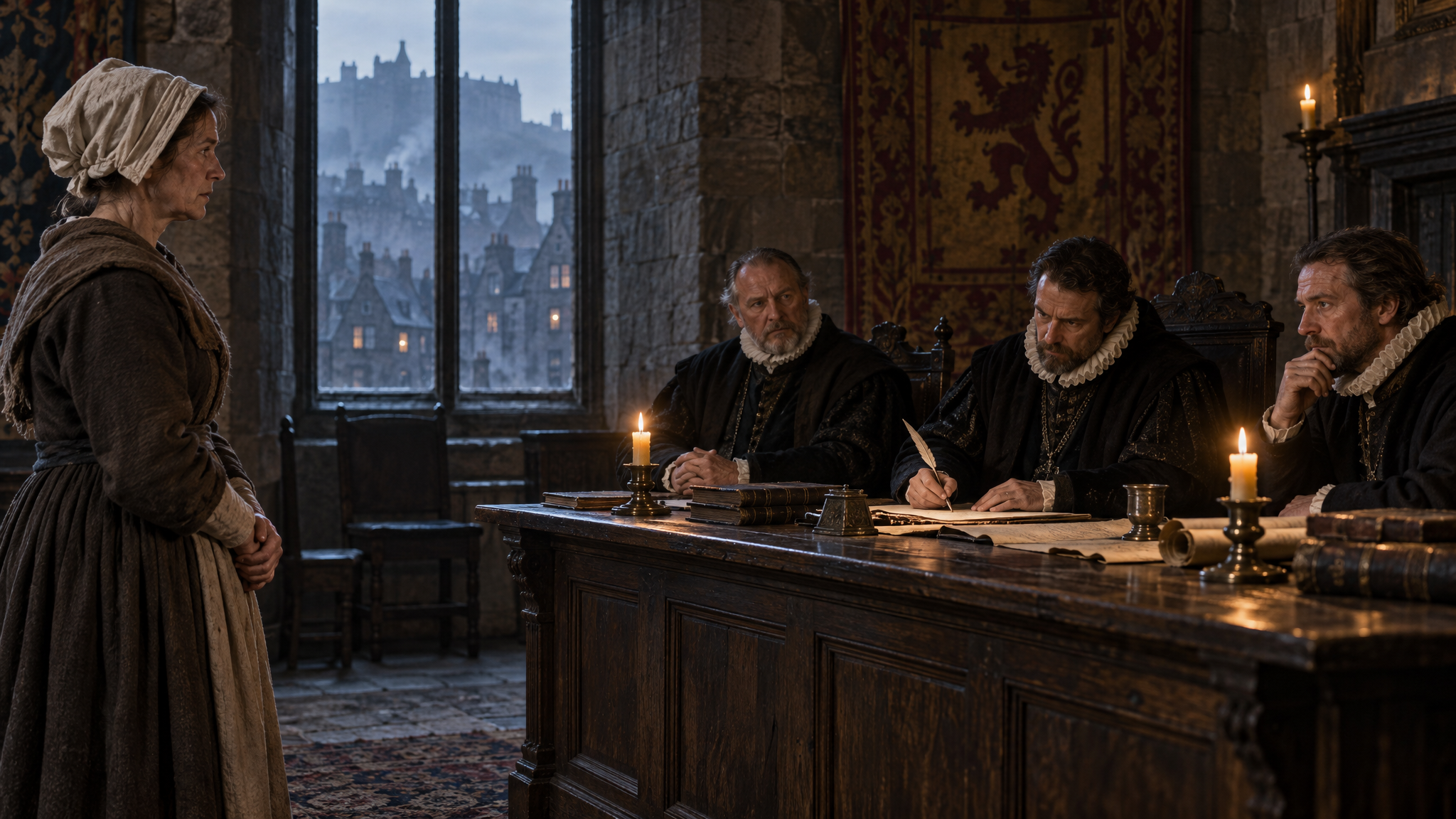
However, that placid monument conceals an unsettling chapter of Edinburgh’s civic history. On 26 October 1591, the Scottish Privy Council appointed Little to an elite commission tasked with interrogating people accused of witchcraft.
Critically, Little was not an itinerant, commercial witch-pricker wielding pins for blood-money. Instead, he represented the high-ranking civic authority that legalised and supervised state-sanctioned torment.
Who was William Little?
William Little, frequently recorded in contemporary rolls as Litill or Littil, was an Edinburgh merchant, burgess, and landowner. Living from 1525 to 1601, he navigated the turbulent decades of the Scottish Reformation as Edinburgh developed its Protestant civic identity.
In public office, he attained the city’s highest municipal rank, serving two terms as Lord Provost across 1586–1587 and 1591–1592. Thus, his second provostship coincided directly with the hysteria surrounding the North Berwick witch trials.
Beyond politics, Little directed significant energy towards civic education. Alongside his elder brother Clement, William actively promoted the municipal scheme to establish a University in the capital.
Nevertheless, his intellectual projects did not protect him against prevailing religious terrors. His career proves that witch persecution was not confined to rural zealots, but was directed from the apex of municipal power.
The 1591 commission: legalised torture by a Presbyterian government
On 26 October 1591, the Privy Council issued a royal warrant establishing a formal commission for the discovery of witches.
The council named six men to this commission:
- Sir John Cockburn of Ormiston (Justice Clerk)
- Master David MacGill of Nesbit (King’s Advocate)
- Robert Bruce (Minister)
- John Duncanson (Minister)
- William Little (Provost of Edinburgh)
- John Arnot (Burgess and former Provost)
The warrant empowered any three of these men acting conjunctly to convene suspects, take depositions, and compile official case files for subsequent trial before an assize.
Crucially, the primary source clarifies their coercive mandate. The royal commission explicitly commanded them:
“the personis wilfull or refusand to declair the veritie to putt to tortour, or sic uthir punishement to use and caus be usit as may move thame to utter the treuth”
Let us call this what it was: legalised torture sanctioned by a Presbyterian government and Crown authority. Torture was not an informal abuse or extralegal excess, but an explicitly approved bureaucratic weapon designed to break human bodies.
The panic behind the warrant
The legal foundation for prosecuting sorcery rested upon the Scottish Witchcraft Act of 1563. By late 1591, however, the North Berwick witch trials had transformed scattered local suspicions into an acute royal obsession.
King James VI had personally interrogated suspects earlier that year, convinced that demonic covens had raised storms to drown him at sea. The pamphlet Newes from Scotland quickly capitalised on this fever, presenting the trials to a fascinated, terrified public.
Within this context of perceived treason, the Crown required reliable administrators to secure convictions. Men like Little, Cockburn, and MacGill represented legal competence and unwavering civic authority.
Therefore, William Little’s commission operated as an investigative pipeline for the crown. Their interrogations systematically manufactured the formal testimonies required to send frightened women and men to the stake.
Founding a university without Rome
William Little’s educational legacy belongs to a radical shift in Scottish intellectual history. Scotland’s earlier medieval universities—St Andrews, Glasgow, and Aberdeen—were all brought into being under the authority of a Papal Bull.
Edinburgh was entirely different. Founded in 1582 on the site of Kirk o’ Field, it was a post-Reformation civic university established by royal charter and municipal burgh initiative.
These were rapidly changing times. A newly Protestant capital was asserting its independence from Rome while constructing its own rigorous moral order.
William and his brother Clement championed this civic foundation. When Clement died in 1580, he bequeathed 276 volumes to the Town and Kirk of Edinburgh, which were transferred to the new college in 1584 as the founding core of the library.
Surviving records show this collection consisted primarily of theological treatises. The same civic energy that established a university without the Pope was now constructing an inquisitorial apparatus to hunt witches.
The sinister rise of the professional pricker
In the seventeenth century, witch-finding in Scotland took an even more sinister turn with the advent of the professional witch-pricker.
Interrogations in Little’s era were conducted by municipal magistrates and kirk ministers. By the 1630s and 1640s, however, a freelance trade emerged, turning persecution into a lucrative private enterprise.
Historical records identify around ten named professional prickers operating across Scotland:
- James Scobie (Musselburgh and Edinburgh)
- John Balfour (Corshouse)
- George Cathie (Lanark)
- Alexander Bogs (Ayrshire)
- John Dick/ James Paterson AKA Christian Caddell (Inverness, Elgin, Forres, Wardlaw, Tain and northern burghs)
- John Kincaid (Tranent, Dalkeith, Dirleton, Forfar, and Kinross)
- John Bain
- David Cowan (Tranent)
- Thomas Crauffourd (Dumfries)
These men were paid large sums by town councils and kirk sessions to probe accused women and men with long needles, hunting for the so-called Devil’s mark.
The superstition of the Devil’s mark
Scottish demonology dictated that upon sealing a diabolical pact, Satan branded the initiate with an insensible mark.
Suspects were stripped, shaved, and scrutinised for birthmarks, scars, or areas of thickened tissue.
Prickers asserted that true demonic stigmata would neither bleed nor register sensation when punctured.
In his modern clinical assessment, anatomist S. W. McDonald noted that perceived insensitivity could stem from ordinary dermatological anomalies, neuropathies, or the sheer paralysis of terror.
Nevertheless, finding an insensible spot was accepted by church courts as presumptive proof of guilt.
The infamous career of John Kincaid
Among the most notorious practitioners of this trade was John Kincaid of Tranent, active during the mid-seventeenth century.
Parish records across the Lothians demonstrate his relentless employment. In 1661, the magistrates of Forfar were so delighted with his lethal efficiency that they awarded him the freedom of the burgh.
However, his predatory methods eventually attracted scrutiny. In 1662, the Privy Council ordered Kincaid’s imprisonment in Edinburgh’s Tolbooth following complaints of cruelty and extortion.
After nine weeks, the aging pricker petitioned successfully for release, claiming prison was ruining his fragile health. The council freed him under strict bond never to prick again without royal warrant.
Paterson and the northern terror
Further north, an equally destructive operator emerged under the name of James Paterson.
According to the seventeenth-century Wardlaw Manuscript, Paterson roamed Inverness-shire in 1662, accompanied by two paid assistants and charging heavy fees per head.
In the church of Wardlaw alone, Paterson stripped and pricked fourteen women and one man in a single session. Several victims died in cold cells before ever reaching a formal trial.
Remarkably, the chronicler recorded that this feared interrogator was eventually exposed as Christian Cadell, a woman dressed in male attire.
Catherine Liddell and legal resistance
Resistance to these ruthless operators occasionally surfaced within the Scottish legal system itself.
In 1678, Catherine Liddell of Tranent took the extraordinary step of lodging a criminal complaint against David Cowan, an apprentice of Kincaid.
Cowan had seized Liddell without warrant, subjected her to excruciating pricking, and left her body severely injured and bruised.
Refusing to submit, Liddell pursued Cowan before the Privy Council for violent assault and public defamation.
The Lords found Cowan guilty of unlawful abuse and committed him to prison during their pleasure. Her courage demonstrated that local communities were growing weary of unbridled charlatans.
A horrid cheat exposed
As the seventeenth century waned, eminent Scottish jurists began systematically dismantling the legitimacy of the witch-prickers.
Sir George Mackenzie of Rosehaugh, Lord Advocate, condemned pricking in his legal treatises as a “horrid cheat”.
Mackenzie observed that naturally occurring insensible tissue was common, and noted that accused women were often terrified into numbness or tricked with spring-loaded pins.
Similarly, Lord Fountainhall examined suspects and concluded that the trade was operated by fraudulent roguery.
By the late seventeenth century, the central courts increasingly rejected prickers’ testimonies as untrustworthy fabrications.
The monumental tomb in Greyfriars
William Little died on 24 November 1601 and was buried within the grassy expanse of Greyfriars Kirkyard.
His grand monument, however, was not erected until 1683—more than eighty years after his death.
An early seventeenth-century clearance banned headstones from central grassy plots, restricting grand memorials to the perimeter walls.
Consequently, Little’s great-grandson paid the substantial fee of 3,000 Scots pounds to erect an imposing mural monument on the eastern boundary.
The structure displays Little reclining beneath six Corinthian pillars, surmounted by allegorical figures representing Justice and Prudence.
Yet, for all its marble piety, the memorial remains completely silent on the terrified cries sanctioned by his 1591 commission.
The double life of Edinburgh’s elite
William Little’s life shows the complexities of the time. On the one hand, he was an educated Renaissance magistrate who channelled his resources into universities while using judicial violence against the marginalised.
Sources and Historical Citations
- Register of the Privy Council of Scotland, Vol. IV (1585–1592), p. 680. Primary source warrant authorising Cockburn, MacGill, Bruce, Duncanson, Little, and Arnot to interrogate and torture witchcraft suspects (26 October 1591).
- W. N. Neill, “The Professional Pricker and His Test for Witchcraft”, The Scottish Historical Review, Vol. 19, No. 75 (1922), pp. 205–213.
- S. W. McDonald, “The Devil’s mark and the witch-prickers of Scotland”, Journal of the Royal Society of Medicine, Vol. 90 (1997), pp. 507–511.
- University of Edinburgh Heritage Collections, Clement Litill Collection (1580). Institutional documentation recording the foundational gift of 276 theological books.
- Sir George Mackenzie, The Laws and Customs of Scotland in Matters Criminal (1678). Contemporary critique condemning witch-pricking as a fraud.