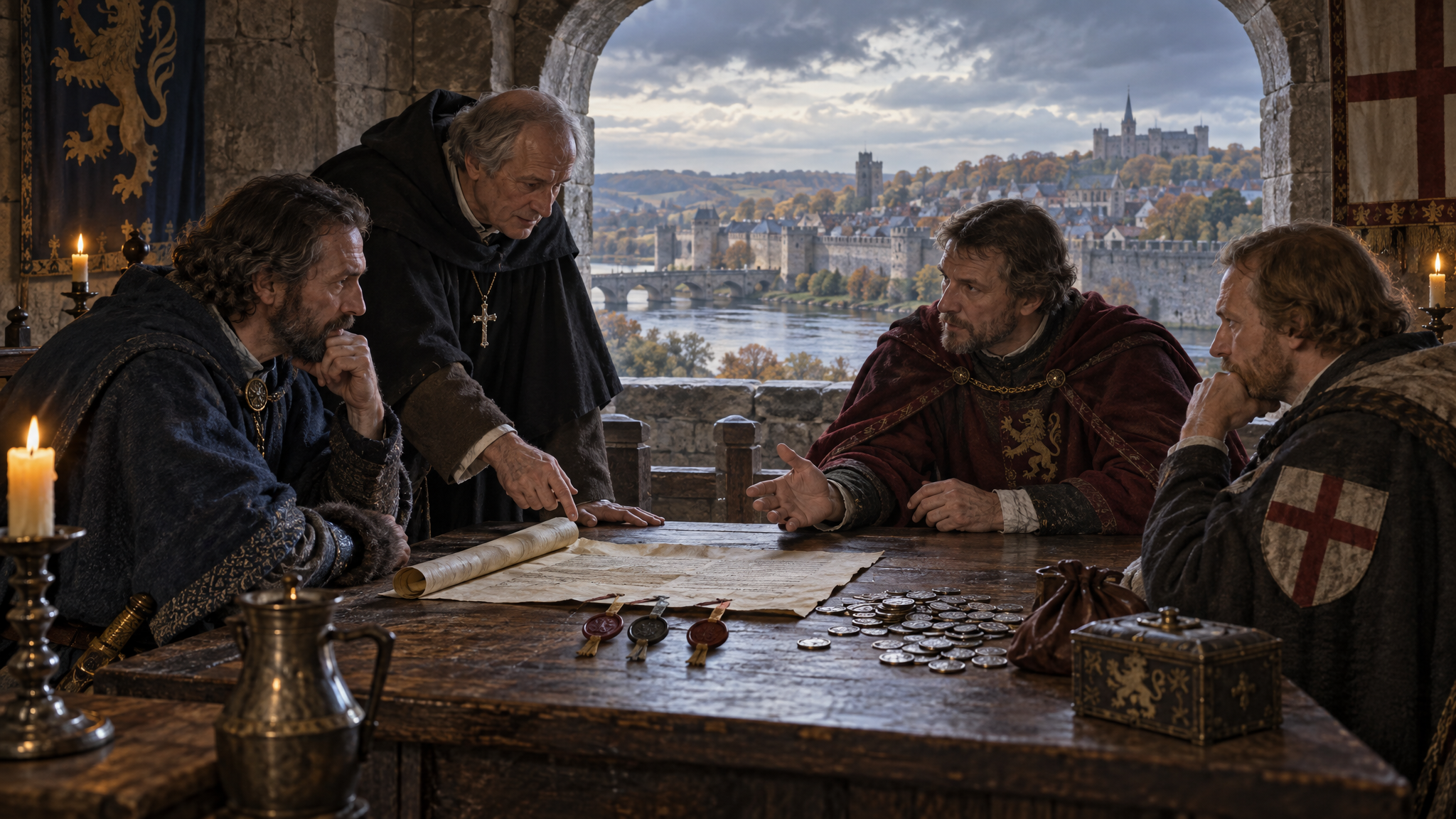
The Treaty of Berwick, signed at Berwick-upon-Tweed on 3 October 1357, officially brought an end to the Second War of Scottish Independence. Thus, it closed a brutal twenty-five-year chapter of invasion, dynastic dispute, and border devastation. King Edward III of England agreed to release King David II, the only surviving legitimate son of Robert the Bruce, after eleven long years of English captivity. In exchange, the Scottish political community agreed to pay an astronomical ransom of 100,000 merks, which was equivalent to roughly £66,667 sterling.
Additionally, this pact was structured to secure an immediate cessation of hostilities without forcing Scotland to surrender its sovereign integrity. The conflict had begun in 1333 when Edward III attempted to install the puppet claimant Edward Balliol on the Scottish throne. While the treaty secured David’s personal liberty, the exorbitant price tag cast a long, destabilising shadow over the kingdom’s finances for decades to come.
What Was the Treaty of Berwick (1357)?
The Treaty of Berwick was a formal diplomatic peace accord negotiated between royal commissioners representing Edward III and the Scottish guardianship. Concluded on the border on 3 October 1357, the pact focused on ending active cross-border warfare and arranging the return of Scotland’s captive monarch. English clerks drafted duplicate Latin instruments authenticated with the seals of both delegations. Following these preliminary agreements, the Scottish three estates assembled at Scone on 6 November 1357 to ratify the articles formally.
To guarantee the enormous financial penalty of 100,000 merks, the English crown demanded that twenty to twenty-three high-status youths from leading noble families be surrendered as hostages. Crucially, the agreement contained no formal acknowledgement of English feudal overlordship. Neither did it demand sweeping territorial dismemberment beyond existing English garrisons like Berwick itself. Scotland retained its status as an autonomous kingdom, yet it assumed a crippling economic commitment that severely tested its political fabric.
Why Was King David II Captured at Neville’s Cross?
King David II’s path to captivity began in the autumn of 1346. Scotland remained bound to France through the historic mutual defence pact known as the Auld Alliance. Therefore, when Edward III launched his continental offensive and crushed the French host at the Battle of Crécy in August 1346, King Philip VI of France sent desperate appeals northward. He urged David to invade northern England, assuming the English border marches lay stripped of defenders.
David assembled a substantial army of roughly 12,000 men and crossed the border near Carlisle in early October. However, Scottish tactical planning critically underestimated local northern resilience.
On 17 October 1346, at the Battle of Neville’s Cross outside Durham, the Scottish host encountered a regional army commanded by Ralph Neville and William Zouche, the Archbishop of York. English longbow formations wreaked havoc on the dense Scottish schiltrons on uneven ground. David fought bravely, taking two arrows to the head and face, but English men-at-arms captured him alongside several leading earls.
For the next eleven years, the Scottish king was imprisoned in England. Meanwhile, his nephew Robert Stewart took charge of the realm as Guardian of Scotland.
Terms and the Royal Ransom: The Price of Freedom
The financial core of the treaty required Scotland to discharge 100,000 merks in ten annual installments of 10,000 merks each, due every Midsummer. Because this liability equalled several years of ordinary royal income, the crown was forced to overhaul its administrative apparatus to extract the money. Customs duties on wool exports were tripled, and general levies fell heavily upon estates and clergy alike.
To enforce compliance, the noble hostages remained detained in England as tangible security against fiscal default. Furthermore, David swore personal oaths to uphold the peace, agreeing not to bear arms against Edward III while the debt remained outstanding. This condition effectively tied Scotland’s hands, preventing the nation from providing military relief to France during the ongoing Hundred Years’ War. However, it achieved peace along the frontier and required the evacuation of several occupying English garrisons from Scottish soil.
Fiscal Turmoil, Embezzlement, and the Rebellion of 1363
Paying the annual tranches proved difficult almost immediately. Scotland was already reeling from decades of scorched-earth border warfare, combined with the catastrophic arrival of the Black Death in 1349.
Although the first installment was delivered punctually to English receivers, the second payment arrived late. Thereafter, regular full payments ground to a halt. Parliament raised customs duties on staple exports like wool, hides, and sheepskins, while imposing heavy direct taxes on estates, clergy, and burghs.
Public fury intensified when David began to divert revenue from the dedicated ransom fund into his own royal household expenses. This blatant misuse of communal taxation triggered widespread resentment among the nobility.
In the spring of 1363, simmering fury boiled over into open rebellion. Robert Stewart joined forces with Patrick V, Earl of March, and William, 1st Earl of Douglas. Together, they launched an armed protest against royal misgovernance and financial malpractice.
Nevertheless, David acted with unexpected speed and firmness. He mobilised loyalist forces, caught the dissidents off guard, and crushed the uprising before it gained broad momentum. Stewart and his confederates were forced to submit, renew their solemn oaths of fealty, and yield political control back to the monarch.
The Succession Crisis and the Rise of the Stewarts
Desperate to lift the crushing burden of the debt, David pursued an alternative diplomatic escape route. In late 1363, he travelled to London to confer directly with Edward III. David was completely childless, as his marriage to Queen Joan of the Tower had produced no legitimate heirs. A later union with Margaret Drummond proved equally barren. This lack of an immediate successor left the crown vulnerable, giving the king leeway to contemplate radical dynastic concessions to wipe away the financial arrears.
David proposed that England cancel the outstanding debt in exchange for naming an English prince, such as Lionel of Antwerp, as heir to the Scottish throne if he died without issue. When this scheme was put to the Scottish Parliament at Scone in March 1364, the three estates issued an immediate, indignant refusal. The community of the realm declared that they would never permit an English prince to sit upon the throne of Robert the Bruce, firmly rejecting financial relief at the cost of national autonomy.
Ultimately, Scotland paid roughly three-quarters of the total ransom sum, around 75,000 merks, through sporadic payments. When David died unexpectedly on 22 February 1371, the succession passed directly to his nephew, Robert Stewart, who ascended the throne as King Robert II. This transition firmly established the Royal House of Stewart, Scotland preserved its hard-won freedom.
Primary Sources and Historical References
Bower, Walter. Scotichronicon. Edited by D. E. R. Watt. Aberdeen: Aberdeen University Press, 1987–1998. (A vital chronicle recording 14th-century Scottish parliamentary actions, the 1363 rebellion, and the rejection of the 1364 English succession plan).
Fordun, John of. Chronica Gentis Scotorum (Chronicle of the Scottish Nation). Edited by W. F. Skene. Edinburgh: Edmonston and Douglas, 1872. (Near-contemporary Scottish narrative documenting David II’s reign, captivity, and release).
Rymer, Thomas. Foedera, Conventiones, Literae, et Cujuscunque Generis Acta Publica. London: J. Tonson, 1704–1735. (The definitive collection of official treaties, recording the complete Latin text and articles of the Treaty of Berwick, 1357).
Acts of the Parliaments of Scotland (APS). Vol. 1 (1124–1423). Edited by T. Thomson and C. Innes. Edinburgh, 1844. (Primary parliamentary records detailing the ratification at Scone, special wool customs duties, and the 1364 debate).
Nicholson, Ranald. Scotland: The Later Middle Ages. The Edinburgh History of Scotland, Vol. 2. Edinburgh: Oliver & Boyd, 1974. (Authoritative academic analysis on the financial mechanics, administrative reforms, and diplomatic fallout of David II’s ransom).