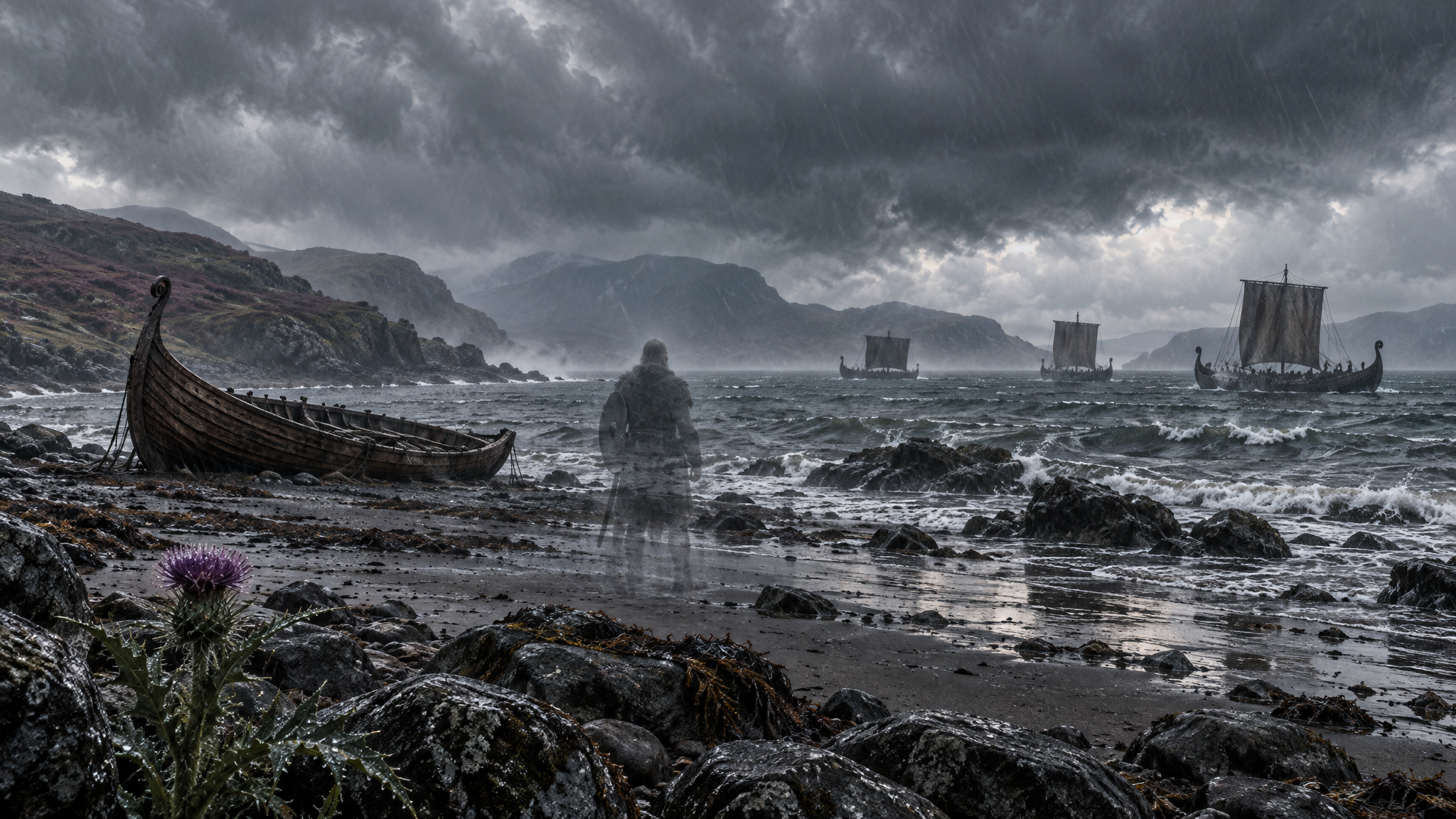
The Battle of Largs was fought on 2 October 1263 between Scottish defenders and Norse invaders. Centuries later, local folklore placed the restless spirit of a slain Norse warrior on that same Ayrshire shoreline. According to folklore, this mail-clad figure paces the beach near the Pencil Monument whenever violent autumn gales rise. Furthermore, sightings intensify each September during the annual Largs Viking Festival. However, behind this romantic shoreline ghost lore lies a grim reality of thirteenth-century territorial ambition and medieval warfare. To understand why this apparition supposedly wanders the strand, one must examine the fierce clash over the western seaboard.
Territorial Friction Across the Western Seaboard
Tensions over western Scotland had simmered for centuries before open warfare erupted. . Norse settlers dominated the Hebrides and parts of Argyll since the ninth century, establishing the semi-independent Kingdom of the Isles. Although local magnates ruled their territories autonomously, they acknowledged the formal overlordship of the kings of Norway.
During the early thirteenth century, the Scottish Crown actively expanded its royal authority. King Alexander II sought to absorb the western islands, yet he died on expedition in 1249 before completing his conquest. Subsequently, his son Alexander III renewed diplomatic efforts to purchase the islands from King Haakon IV. When financial negotiations failed, Scottish lords raided Skye in 1262 with brutal ferocity. Consequently, Haakon resolved to assemble an overwhelming punitive expedition to crush Scottish territorial ambitions.
The Great Armada and Autumn Equinoctial Gales
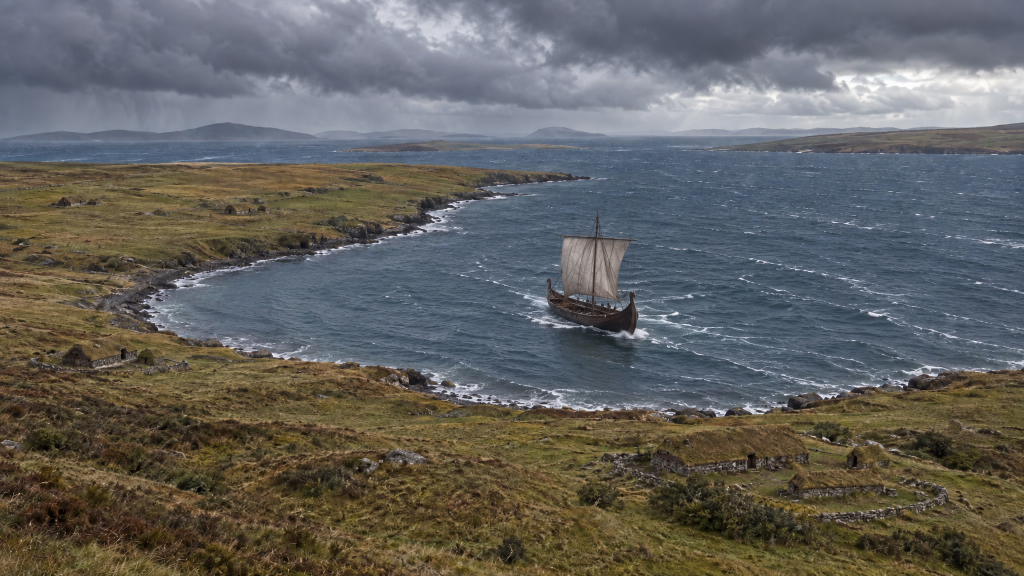
Haakon sailed from Bergen in July 1263 at the helm of an enormous royal fleet. Reinforced by island vassals, the fleet may have numbered up to two hundred vessels. Therefore, this formidable armada posed the greatest foreign amphibious threat to mainland Scotland in centuries.
Realising that his forces faced numerical disadvantage, the twenty-three-year-old Alexander III adopted a shrewd defensive strategy. Operating from Ayr, the Scottish king entered into deliberate, protracted diplomatic negotiations with Norwegian envoys. This calculated stalling pushed the confrontation into October, when severe autumn storms historically ravage the Clyde. Consequently, on the night of 30 September, furious equinoctial gales struck Haakon’s exposed anchorage off the Cumbraes. Several Norse vessels dragged anchor, running aground on the shingle near modern-day Largs.
The Beach Skirmish and Salvage Fighting
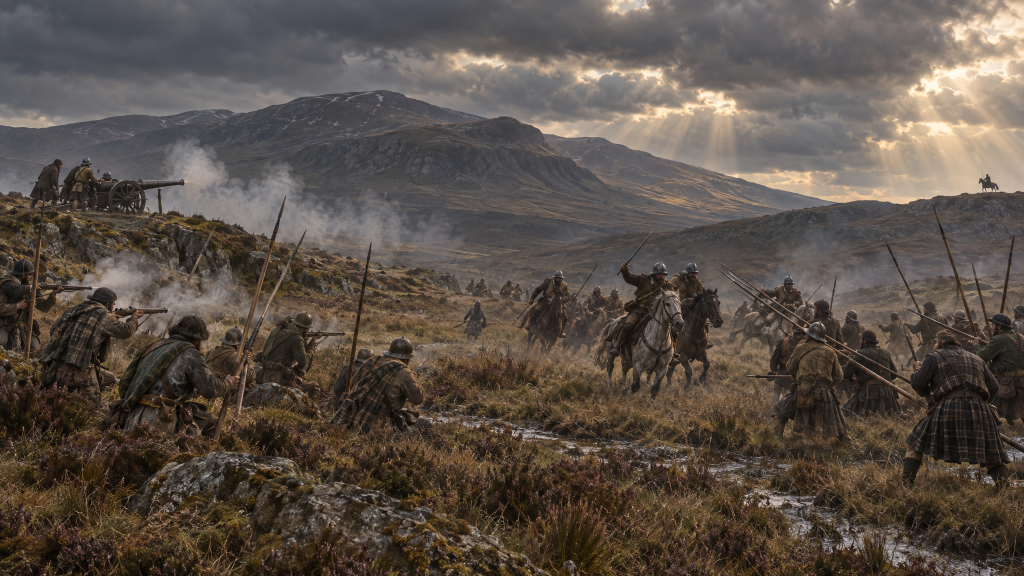
On the morning of 2 October 1263, Haakon landed ashore with salvage parties to rescue grounded ships and retrieve provisions. However, Scottish forces rapidly converged on the landing site under Alexander of Dundonald, High Steward of Scotland. Supported by local levies and cavalry, the Scots threatened to isolate a Norse detachment posted on an inland mound.
Seeing the Scottish advance, the detachment withdrew toward the shore to avoid encirclement. Unfortunately, this movement caused panic among the troops below, who mistook the withdrawal for a general retreat. Fierce fighting erupted along the water’s edge as Norse warriors made a desperate stand beside their beached longships. Late in the day, the Norse rallied and briefly recaptured the mound before making an orderly withdrawal. The following morning, Haakon’s men returned only to collect their dead and burn the ruined hulls.
The Treaty of Perth and the Rise of Ayrshire Families
Strategically, the engagement at Largs inflicted terminal damage on Haakon’s campaign. With food running low and winter closing in, the king sailed to Orkney to disperse his fleet. Tragically for the Norse cause, Haakon fell ill and died at the Bishop’s Palace in Kirkwall in December 1263.
Without Haakon’s resolve, Norwegian rule across western Scotland crumbled rapidly. In 1266, King Magnus VI concluded the Treaty of Perth with Alexander III. Under this agreement, Norway ceded the Hebrides and the Isle of Man to Scotland for monetary compensation. Furthermore, the engagement elevated influential Ayrshire families, including the Boyds and the Mures of Rowallan. Sir Robert Boyd earned his family motto Confido at Goldberry Hill, cementing lands that shaped Scottish politics for generations.
The Legend of the Scottish Thistle at Largs
The Battle of Largs also serves as the traditional setting for Scotland’s most famous botanical legend. According to popular folklore, a Norse raiding party planned a stealthy night assault against the encampment. The raiders removed their boots to creep silently across the sand and turf.
Consequently, the plan went disastrously wrong when an unsuspecting warrior trod heavily upon a wild thistle. His sudden cry of agony carried through the coastal darkness. As a result, the Scottish defenders awoke, grasped their weapons, and repelled the ambush.
Tradition claims that this timely warning inspired Alexander III to adopt the prickly plant as Scotland’s national emblem. Furthermore, the tale remains one of the most enduring pieces of Scottish battlefield lore.
However, primary historical sources tell an entirely different story. Neither the Norwegian sagas nor early Scottish chronicles mention barefoot Norsemen or screaming sentries. In fact, contemporary accounts describe chaotic daytime beach skirmishes driven by autumn gales.
In addition, historical evidence indicates that the thistle appeared as a royal badge centuries later. James III first minted coins displaying the prickly flower in 1470. While the legend of Largs and the thistle endures, it remains a romantic myth rather than documented history.
Ghost Lore, The Pencil, and Battlefield Archaeology
Antiquarians in the nineteenth century transformed this indecisive beach skirmish into an epic national victory. In 1912, the community erected The Pencil, a seventy-foot whinstone round tower commemorating the battle. However, modern battlefield research confirms that this monument stands roughly a mile south of the actual combat zone.
Early historians mistakenly linked the fight to nearby Bronze Age standing stones and a Neolithic burial cairn nicknamed Haco’s Tomb. Today, the probable battlefield lies further north near modern housing, where the combat mound remains largely unmarked. Nevertheless, the legend of the wandering Norse phantom endures along the coastline. Whether viewed through spectral folklore or cold historical reality, Largs marks the decisive moment when Scandinavian rule finally vanished from mainland Scotland.