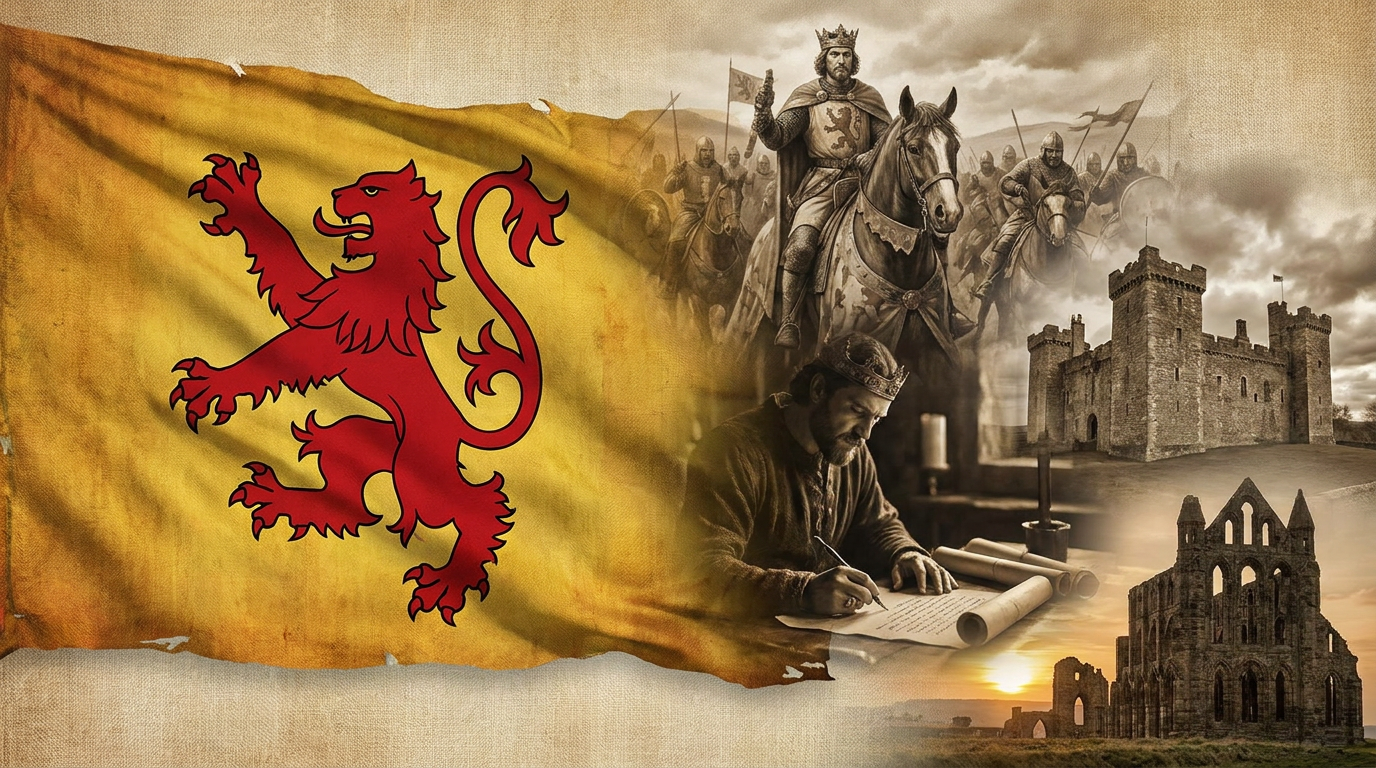
The Lion Rampant stands today as the quintessential emblem of Scottish defiance. Yet, the history of the Royal Banner of Scotland is not one of straightforward glory. Instead, it is a narrative forged in the fires of medieval power struggles and the personal humiliations of the man most closely associated with its legend: King William I, known to history as “the Lion.”
A Banner Born of Iron and Ink
While the red lion on a gold field is iconic, its early documentation is elusive. The first firm evidence of the Lion Rampant appears on the Great Seal of Alexander II in 1222. However, tradition has long tethered the symbol to his father, William the Lion.
William (1165–1214) was a monarch defined by a desperate, often violent, ambition to restore the northern borders of his kingdom. He sought to reclaim Northumberland, an obsession that would eventually lead him into a trap and alter the course of Scottish sovereignty.
William the Lion and a difficult inheritance
William became King of Scots in 1165 after the death of his elder brother, Malcolm IV. He ruled until 1214, making his reign one of the longest in medieval Scottish history.
His great political fixation was Northumberland. This was not merely an aggressive attempt to expand Scotland southwards. It was a lost family inheritance.
William’s grandfather, David I, had gained extensive influence in northern England during the civil war between King Stephen and the Empress Matilda. David’s son Henry, Earl of Northumberland, was William’s father. The family therefore held Northumberland, alongside other northern English territories, during William’s youth.
However, Henry died in 1152. Then, David I died the following year. William’s brother Malcolm IV inherited the Scottish crown, but in 1157, Henry II of England forced Malcolm to surrender Northumberland, Cumberland and Westmorland.
William retained the English earldom of Huntingdon. Yet Northumberland was gone.
To English eyes, Henry II had restored royal control over a strategically vital border region. To William, the territory was his paternal inheritance, taken while he was still too young to defend it. Thus, when he became king, he repeatedly sought its return.
Northumberland mattered for more than ancestry. It held major castles, revenues and routes between Scotland and England. Control of it would have driven Scottish royal influence far south of the Tweed. However, William’s claim rested on gains made by David I when England was divided by civil war. By the 1160s and 1170s, he faced Henry II, ruler of a vast Angevin dominion that reached from the Scottish border to the Pyrenees.
William was attempting to recover a lost inheritance from one of Europe’s most formidable kings.
Chains at Alnwick and Captivity in France
In 1173, Henry II faced a dangerous revolt led by his own sons, including the future Richard the Lionheart, and backed by Louis VII of France. William saw an opening. The rebels promised him Northumberland, and he invaded northern England in support of their cause.
The gamble failed at Alnwick in July 1174. William had divided his forces and was left with only a small company when English knights surprised him. His horse was killed beneath him and he was captured.
His humiliation was deliberately public. William was taken first to Newcastle, then to Northampton, with his feet shackled beneath the belly of his horse. This was not the treatment normally shown to a fellow monarch. It marked him as a defeated and dependent captive.
Henry II then had William sent across the Channel to Normandy, first to Caen and then to Falaise. Normandy was part of Henry’s vast continental dominions. By holding the Scottish king there, far from his own nobles, kingdom and potential rescuers, Henry made the imbalance of power unmistakable. William was imprisoned for around five months while Henry crushed the wider rebellion.
The Treaty of Falaise, issued in December 1174, was the price of release. William agreed to become Henry’s liegeman “against every man” for Scotland and all his other lands. Scottish bishops, abbots, earls and barons were also required to swear fealty. England received control of the castles of Berwick, Roxburgh, Jedburgh, Edinburgh and Stirling, while William had to meet the cost of their English garrisons.
In 1175, he publicly performed homage to Henry at York. Scotland was still a kindgom, but the treaty placed its king, leading churchmen and political elite under an exceptionally direct form of English superiority.
Two Lions: Buying the Kingdom Back
The restoration of Scottish independence came not through a battlefield victory, but through a financial transaction with one of history’s most famous figures. In 1189, Richard the Lionheart took the English throne. Richard was a man possessed by the crusading spirit and was desperate for funds to finance the Third Crusade.
Seeing an opportunity, William offered 10,000 marks—a staggering sum at the time—to cancel the Treaty of Falaise. Richard accepted, signing the Quitclaim of Canterbury. Therefore, the “Lion of Scotland” literally bought his kingdom’s freedom from the “Lionheart.” This moment of pragmatic kingship restored the sovereignty that underpins the pride of the Lion Rampant today.
Richard’s charter was important because it expressly dismantled the settlement imposed on William in captivity. Richard declared that he had freed the Scottish king from the compacts which Henry II had “extorted” through new charters and by William’s capture. The wording recognised the coercive basis of Falaise. Yet its shadow remained. During the Great Cause, the contested process to choose a Scottish king after 1290, Edward I revived English assertions of overlordship. Falaise no longer bound Scotland, but its unusually blunt language gave Edward a useful historical precedent.
The MacWilliam Threat: Bloodlines in the North
Internal peace remained as elusive as external independence. Throughout his reign, William faced the “Meic Uilleim” or MacWilliams—a rival royal bloodline descended from King Duncan II. They viewed William’s branch of the family as usurpers and launched frequent, bloody rebellions from their power bases in Moray and Ross.
These were not mere skirmishes; they were existential threats to William’s legitimacy. The conflict was often personal and brutal. In 1187, the rebel leader Domnall mac Uilleim was killed at Mam Garvia, and his severed head was presented to the King. This grim reality of “heads on pikes” provides a stark contrast to the noble posturing of royal heraldry.
Arbroath Abbey: A Grave of Red Sandstone
In 1178, William founded Arbroath Abbey, dedicating it to Thomas Becket.
The choice was politically charged. Becket had been murdered after his conflict with Henry II, the same English king who had held William prisoner and imposed the Treaty of Falaise. It would be too simplistic to claim the abbey was merely an anti-English gesture. Medieval religious foundations had spiritual, dynastic and institutional purposes. Still, William’s dedication to Becket cannot be detached from the politics of his reign.
Arbroath became a major royal foundation. It was also William’s burial place.
When he died at Stirling in 1214, he was buried before the high altar at Arbroath rather than at Dunfermline, the traditional burial place of earlier Scottish kings. The choice gave the abbey a particular dynastic weight. The king who had spent his reign defending royal authority and negotiating its limits was laid to rest within a house he had created.
The Lion Rampant after William
The Royal Banner of Scotland is traditionally described as a red lion rampant on a yellow or gold field, surrounded by a double red border decorated with fleurs-de-lis. It remains the personal banner of the monarch in Scotland, rather than a general public flag. It is associated with the motto Nemo me impune lacessit—”No one attacks me with impunity.”
The lion was certainly in royal use by the reign of Alexander II, William’s son. Under later kings, it became more firmly established as the royal arms of Scotland. It was later incorporated into the royal arms of England after the Union of the Crowns in 1603, and subsequently into the arms of the United Kingdom.
William’s legacy is more interesting than a simple origin story. He did not leave behind a clean tale of victory. He left a reign marked by the loss of Northumberland, imprisonment in France, coerced submission, expensive recovery and recurrent rebellion within his own kingdom.
The Lion Rampant is not merely an emblem of triumph. It is a symbol of resilience. It is a symbol shaped by a kingdom that could be humiliated, threatened and constrained, yet still endure.