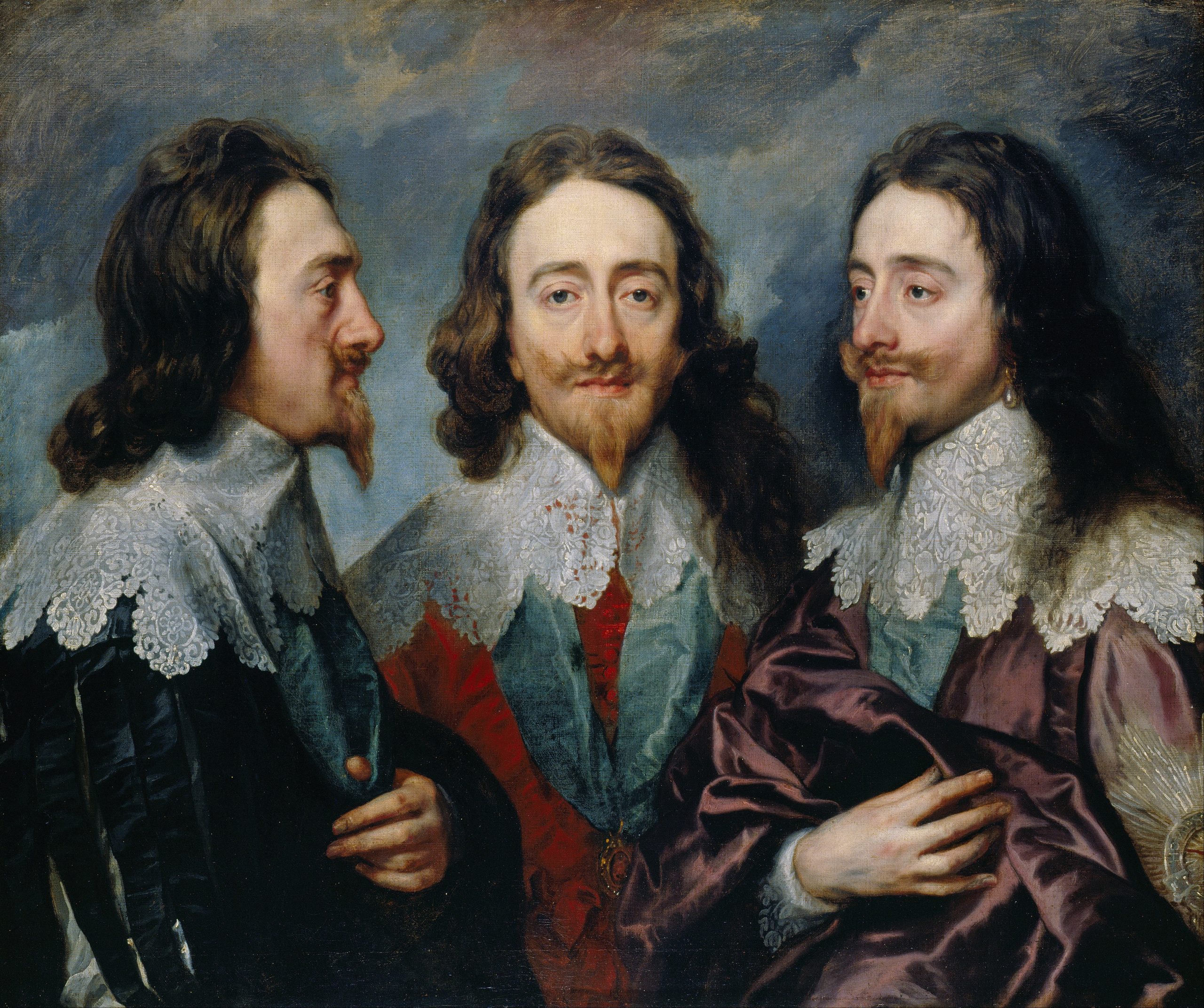
The Scottish invasion of England 1648 began on 8 July, when a Covenanter faction known as the Engagers crossed the border near Carlisle. They marched south in support of King Charles I, already defeated and imprisoned by Parliamentary forces. It was a gamble that would cost thousands of lives and ultimately seal the king’s fate.
The Last Stuart King Born in Scotland
Charles I holds a poignant distinction in Scottish history: he was the last Stuart king born on Scottish soil. He came into the world at Dunfermline Palace on 19 November 1600, the second son of James VI of Scotland and Anne of Denmark. He was a frail, sickly child, initially left behind in Scotland when his father travelled to London in 1603 to claim the English throne as James I. Charles followed the following year, and Scotland would never again be the birthplace of a British monarch.
His connection to Scotland, however, was anything but straightforward. It was his attempts to reshape the Scottish Kirk that triggered the chain of events leading directly to civil war. In 1637, his imposition of a new Anglican prayer book on the Church of Scotland provoked riots across the country. The following year, the National Covenant united much of Scotland in resistance. Charles responded with military force and failed twice, in the Bishops’ Wars of 1639 and 1640. The humiliation stripped him of authority and resources, pushing him towards the confrontation with his English Parliament that ignited the First Civil War in 1642.
By 1647, the king born in Dunfermline was a prisoner. Nevertheless, he continued negotiating, playing factions against each other with a persistence that many of his contemporaries found infuriating and his enemies found unforgivable. It was this relentless scheming that produced the Engagement — and set the Scottish Engager army on its doomed march south in July 1648.
A Kingdom Divided: The Engagement
To understand the invasion, you first need to understand the bitter split it caused in Scotland. By 1647, Charles I was a prisoner of the English Parliament. Nevertheless, he continued to negotiate secretly with anyone who might restore him to power.
In December 1647, he reached a secret agreement with a Scottish delegation at Carisbrooke Castle on the Isle of Wight. This deal, known as the Engagement, promised that Charles would impose Presbyterianism in England for three years and suppress the Independent religious faction. In return, the Scots would send an army to enforce his claim to the throne.
The Engagement fractured Scotland. The Kirk Party, led by the Marquess of Argyll, denounced it as sinful and contrary to God’s law. They did not trust Charles and saw the alliance with English Royalists as a betrayal of the Covenant. However, by April 1648, the Engagers had gained a narrow majority in the Scottish Parliament. They began raising an army despite fierce opposition and despite the fact that most experienced Scottish generals, including Lord Leven and David Leslie, flatly refused to serve.
An Army Ill-Prepared
The army that crossed into England was, by most accounts, poorly equipped and poorly led. Most veterans from the earlier wars had been demobilised. Recruitment was hampered by widespread refusal to serve. The Duke of Hamilton, appointed to command, was an inexperienced general. His deputy, the Earl of Callendar, was overconfident and argumentative. Their infantry commander, William Baillie, had direct experience of the New Model Army and privately doubted their chances.
Furthermore, a corps of around 2,800 experienced veterans recalled from Ulster, commanded by Major General George Munro, refused to accept Hamilton’s authority. Munro operated as an entirely independent force throughout the campaign. This fragmentation of command would prove fatal.
Crossing the Border: 8 July 1648
On 8 July 1648, Hamilton’s army crossed the River Sark into England near Carlisle. They joined with English Royalists under the cavalry commander Marmaduke Langdale, bringing their combined strength to approximately 24,000 men. In contrast, the Parliamentarian force under Major General John Lambert numbered fewer than 3,000. Lambert fell back steadily, gathering intelligence and harassing the flanks as he went.
The Scots advanced south along the west coast road through Appleby and Hornby. Their progress was slow; the summer of 1648 was exceptionally wet and stormy. Meanwhile, Lieutenant General Oliver Cromwell was concluding the siege of Pembroke Castle in Wales. By 1 August he was marching north. His infantry veterans covered 287 miles in thirteen days, concentrating with Lambert at Wetherby on 12 August.
The Battle of Preston: 17–19 August 1648
Cromwell made a bold and, in the eyes of his opponents, barely credible decision. Rather than advancing directly northward, he swung east across the Pennines to strike the Royalist flank. Hamilton, convinced no sane commander would force-march an army and then seek battle against a force more than twice its size, dismissed repeated warnings from Langdale that the Parliamentarians were closing fast.
On the morning of 17 August, Cromwell’s 9,000 men fell on the strung-out Royalist army at Preston. Hamilton’s forces were dangerously dispersed. Munro and his veterans were at Kirkby Lonsdale, 30 miles to the north. The bulk of the cavalry was scattered 16 to 20 miles to the south, foraging. The Scottish infantry were in the middle of crossing the Ribble bridge, their backs to the developing battle.
Langdale’s 4,000 English Royalists bore the brunt of the initial Parliamentarian assault. Many were poorly armed and undertrained. They held for over an hour behind hedgerows and the deep cut of Eaves Brook before they broke and fled. A separate, ferocious two-hour battle then erupted for control of the Ribble bridge itself. By the end of 17 August, approximately 1,000 Royalists were dead and 4,000 captured.
The Retreat and the Battle of Winwick
The surviving Scots abandoned their baggage and ammunition and fled south through the dark and driving rain. Cromwell’s cavalry pursued relentlessly throughout 18 August. By the following morning, the Scots were hungry, soaking, exhausted and critically short of dry powder. Roughly nine miles south of Wigan, near the village of Winwick, they turned to fight.
For more than three hours, the Scots held off repeated Parliamentarian assaults in fierce close-quarters fighting. Eventually, however, a flanking movement through dead ground brought fresh Parliamentarian troops onto their flank and rear. The sight broke the exhausted Scots. Many fled to Winwick church, where they were taken prisoner. The cavalry withdrew south to Warrington, only to find Hamilton had already abandoned them. They surrendered on 19 August. Hamilton himself surrendered at Uttoxeter on 24 August, too ill to continue.
Aftermath: A King’s Fate Sealed
Defeat at Preston destroyed the Engager regime. The Kirk Party, with Cromwell’s backing, seized control of Edinburgh and expelled the Engagers from government. The 1649 Act of Classes formally banned Engagers and Royalists from holding political or military office.
The consequences, however, reached far beyond Scotland. The king’s continued scheming had exhausted Parliament’s patience. In December 1648, the New Model Army purged Parliament of its moderate members in Pride’s Purge. The remaining Rump Parliament appointed a High Court of Justice and tried Charles I for treason. He was beheaded on 30 January 1649. Hamilton followed him to the block on 9 March. Many ordinary Scottish prisoners who had served voluntarily were sold into slavery, transported to labour in the Americas or sent as galley slaves to Venice.
Winwick had been the final battle of the Second Civil War. Its outcome set in motion the execution of a reigning English monarch and, ultimately, the collapse of Scottish independence by 1654.