Rosemarkie sits quietly on the Black Isle, a small, picturesque village in a sheltered bay on the Moray Firth. However, beneath its peaceful surface lies a past of remarkable darkness. Stone Age middens run under the High Street. A Pictish man was brutally killed in a coastal cave. Fairy lore curls through the woodland at the edge of the village, and the ground itself has given up secrets buried for nearly three thousand years. Few places in Scotland carry quite so many layers.
Here, the past is not merely old. It is strange, violent, and sometimes deeply unsettling.
The Bones Beneath the Village
Rosemarkie’s history begins before recorded memory. Stone Age people left their middens beneath the High Street. Bronze Age settlers chose the sheltered bay, and a stone cist unearthed near the Manse confirmed their presence. More recently, excavations at the Greenside building site in 2020–21 uncovered something even more striking: a Bronze Age hoard of nine bronze ornaments, including six bracelets, buried almost 3,000 years ago.
The hoard had been carefully packaged in bracken and bast, the inner bark of trees. Analysis by Guard Archaeology revealed it included the most complete penannular ringed ornament yet discovered in Scotland. The original owners, researchers concluded, intended to retrieve it. They never did. As archaeologist Rachel Buckley noted, the mystery is not why it was buried, but why no one ever came back.
The surrounding settlement was occupied for approximately six centuries. Evidence of metalworking, including moulds for swords, spearheads and sickles, suggests a skilled community. Traces of Mesolithic and Neolithic activity, including a bear bone and an axehead fragment, indicate that this corner of the Black Isle has drawn people for a very long time indeed.
Rosemarkie Man: A Brutal Death in the Dark
However, the discovery that drew national and international attention came in 2016. Volunteers from the Rosemarkie Caves Project, surveying the coastal caves of the Black Isle, found the skeleton of a young man buried in a cave recess. He had been placed in an unusual cross-legged position, with large stones pinning down his arms and legs. There had been nothing to indicate his presence. The find was, in the words of project founder Simon Gunn, completely unexpected. The buria in a cave is re
Radiocarbon dating placed his death between 430 and 630 AD, squarely within the Pictish period. Forensic anthropologist Dame Sue Black of the University of Dundee led the examination of his remains. She identified a minimum of five severe impacts to his skull. The first broke his teeth on the right side. The second fractured his jaw. The third fractured the back of his head as he fell. The fourth drove a weapon through his skull from one side to the other, as he lay on the ground. The fifth blow, larger and of a different character, struck the top of the skull. Whether it was a coup de grâce or a post-mortem act of ritual, Dame Sue Black said plainly, “we simply can’t tell.”
An Elite Warrior?
Further analysis deepened the mystery rather than resolving it. Chemical examination of his bones revealed a high-protein diet of a kind rarely documented in Scotland during that period, and strongly associated with high status. Gunn described him as “built like a rugby player.” He was approximately five feet six inches tall, around 30 years old at the time of his death, and carried no prior injuries. He was not, by the evidence, a warrior or a labourer. Researchers suggested he may have been royalty or a chieftain. Genomic analysis by researchers at the Universities of York and Huddersfield linked him genetically to Iron Age people from Knowe of Skea, a small island off Orkney’s northern coast — suggesting he was not a local man in any simple sense.
Yet someone killed him with considerable force, and considerable repetition. Then they buried him with care: placed in a dark alcove of a cave that the community had already been using for iron-smithing. Excavation leader Steven Birch drew a deliberate parallel with Iron Age bog bodies, ritual killings in which the dead were pinned in watery, liminal places. It is also reminiscent of the Pictish executions that took place in Sculptor’s Cave near Lossiemouth. The cave itself may have been chosen as an entrance to the underworld. If so, whoever placed him there was making a statement that modern archaeology can identify but not fully translate.
The case attracted significant media attention. The Sky History channel, as part of its Ancient Mysteries season, brought in Louisiana homicide detective Rod Demery and forensic scientist Turi King to examine the evidence. Isotope analysis revealed further details about where and how Rosemarkie Man had lived. The question of who killed him, and why, remains open.
The Pictish Stones of Groam House
By the early medieval period, Rosemarkie had become a significant religious centre. St Moluag, a contemporary of Columba, is said to have founded a monastery here in the late 6th century. Later, in the early 8th century, St Boniface — also known as Curitan or Curetán — enlarged the monastery and, according to tradition, was buried here aged 84. His relics were preserved and venerated for centuries.
The evidence of that early Christian centre survives in remarkable form. Groam House Museum on the High Street houses one of the largest collections of carved Pictish stones at a single Scottish site. The centrepiece is the Rosemarkie Stone, a magnificent pink sandstone cross-slab found in two pieces beneath the floor of the old church in 1819. Standing 2.6 metres high, it bears Pictish symbols, Christian crosses, Celtic interlace and Anglian ornament.
Where the Stones were found
What is striking is how widely scattered the remaining fragments were, and how recently some were found. Several pieces came from the surrounding churchyard, recovered in the 19th century and presented to the National Museum of Scotland in Edinburgh in 1885. Others turned up far closer to home: fragments discovered in garden rockeries along the High Street as recently as 1994, 1995, and 1998, hidden in walls and flowerbeds, recognisable only to those who knew what they were looking at. One fragment emerged in 1990 during routine work to lower drainage pipes beneath the church. Together, the stones tell of a monastery that stretched under the buildings on both sides of the High Street, all the way down to the beach — and whose remains are still, occasionally, being found.
The finest pieces include parts of an altar, a possible bishop’s tomb, and a shrine for a saint’s relics. However, the identity of the saint remains contested. Nevertheless, the sheer quantity and quality of the sculpture confirm that Rosemarkie was, by around 700 AD, a place of considerable power and an important centre of pilgrimage.
Rosemarkie’s ecclesiastical prominence was, however, finite. When David I of Scotland established the Diocese of Ross around 1126, the first Cathedral was founded here. It lasted for over a century before the cathedral was relocated to nearby Fortrose. From that point, Rosemarkie’s role as the organisational heart of religion in Ross diminished. The monastery fell, the cathedral moved on, and the carved stones were absorbed into walls, floors and garden rockeries. What had been one of the most significant early Christian sites in northern Scotland became, in time, a quiet village on the Moray Firth — its importance legible only in fragments.
Old Beliefs in New Clothes
Christianity arrived in Rosemarkie early and took firm root. Nevertheless, the folk practices that survived in and around the village suggest that older belief systems did not simply disappear. Instead, they persisted alongside the new faith, finding new forms and new justifications. The Fairy Glen, a short walk from the village centre, is where that older world is most clearly visible.
The Fairy Glen
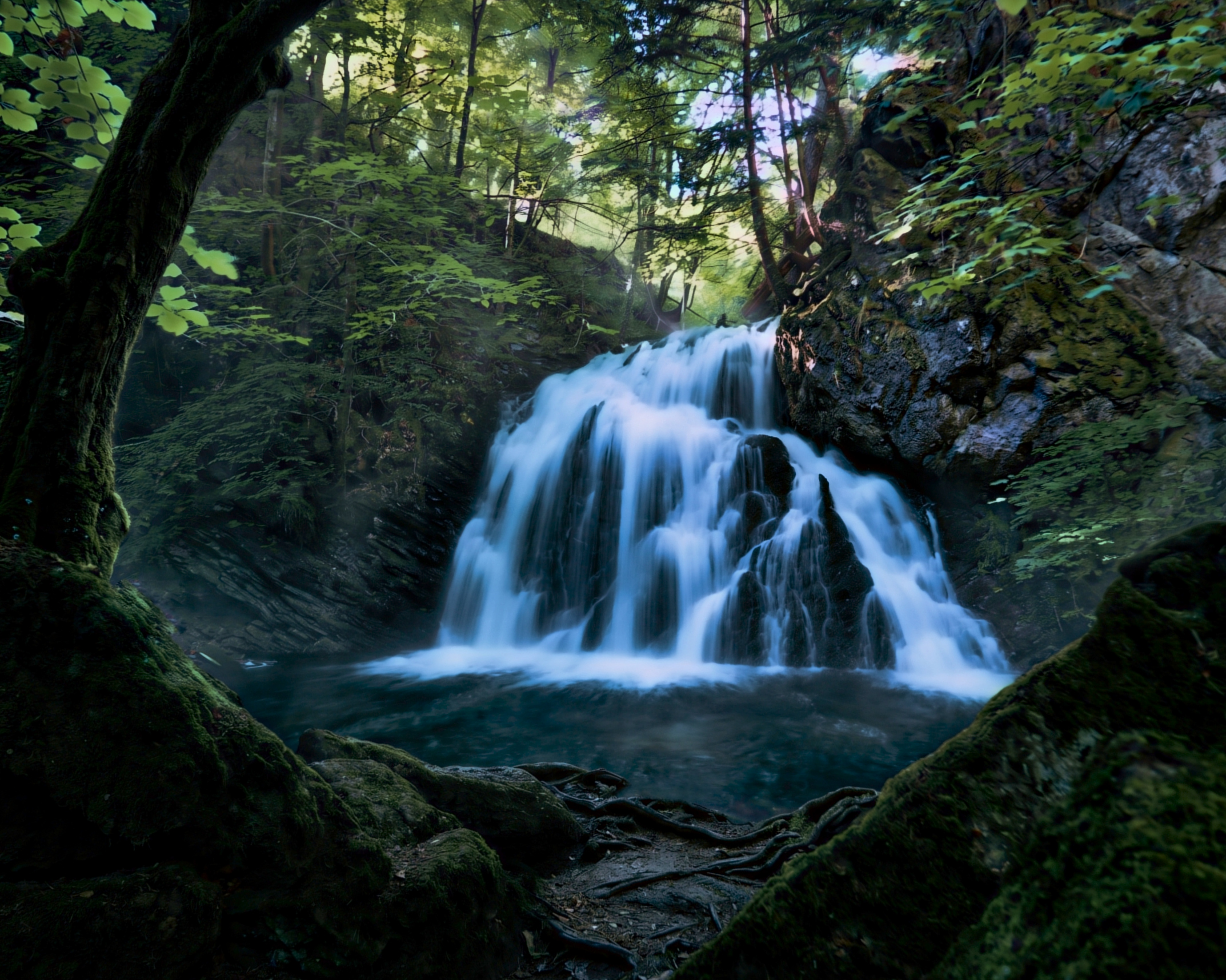
First, a necessary clarification: this is not the famous Fairy Glen on the Isle of Skye. The Rosemarkie Fairy Glen is an RSPB nature reserve on the Black Isle, and it is, in its own right, extraordinary. The Markie Burn tumbles through steep-sided woodland past waterfalls and deep, reflective pools. Geologist Hugh Miller wrote that he knew no other place in Scotland where boulder-clay was “hollowed into ravines so profound.” The atmosphere, even in daylight, carries a quality of watchfulness about it.
The folklore of the glen is older than its botanical reputation. Children once cast flower petals into the burn to encourage the fairies to keep the water fresh. At a pool within the glen, a dressing ritual was performed to keep the fairies content. Look today for the Money Trees: old logs studded with hundreds of coins hammered into the bark. In modern tradition, these are pressed in for luck or wishes. In the older tradition, however, they were offerings to prevent the fairies from stealing human babies and leaving changelings in their place. The Christian God may have been worshipped in the church on the High Street, but the fairies still required their dues at the burn. It should be noted that the RSPB actively discourages this old practice, as the coins will kill the tree. This practice is also seen at Loch Maree.
Folklore also records a witch who fashioned a clay image of her enemy and held it under a waterfall each day, until, like the figure, the victim wasted away. The glen is beautiful. Nevertheless, it carries, like so much of Rosemarkie, an undertow of much older and much darker belief.
A Village That Remembers
Rosemarkie is not, on the surface, a dramatic place. Yet peel back any layer and what emerges is a community that has stood at the crossroads of the ancient and the violent, the sacred and the strange. From its Bronze Age metalworkers to its brutally killed Pictish chieftain, from its carved monastery stones to the coin-studded trees in the glen, the village has absorbed and preserved a great deal of human darkness.
That it remains so quiet today may, in itself, be cause for unease