The Treaty of Union is an emotive subject in Scotland that still echoes in our songs, our politics, and our sense of identity. I remember as a teenager questioning my Mam about the lyrics of the famous song, Such a Parcel of Rogues in a Nation. Unlike the traditional ballads that praise figures like Wallace, Bruce, or Bonnie Prince Charlie, this song does something different. It accuses Scotland’s own leaders of a shameful betrayal.
The words go like this:
Such a Parcel of Rogues in a Nation
Fareweel to a’ our Scottish fame,
Fareweel our ancient glory,
Fareweel ev’n to the Scottish name,
Sae fam’d in martial story.
Now Sark rins o’er the Solway sands,
And Tweed rins to the ocean,
To mark where England’s province stands –
Such a parcel of rogues in a nation.
What force or guile could not subdue,
Thro’ many warlike ages,
Is wrought now by a coward few
For hireling traitor’s wages.
The English steel we could disdain;
Secure in valour’s station;
But English gold has been our bane –
Such a parcel of rogues in a nation.
O would, or I had seen the day
That treason thus could sell us,
My auld grey head had lien in clay,
Wi’ Bruce and loyal Wallace!
But pith and power, till my last hour,
I’ll mak’ this declaration;
We’re bought and sold for English gold –
Such a parcel of rogues in a nation.
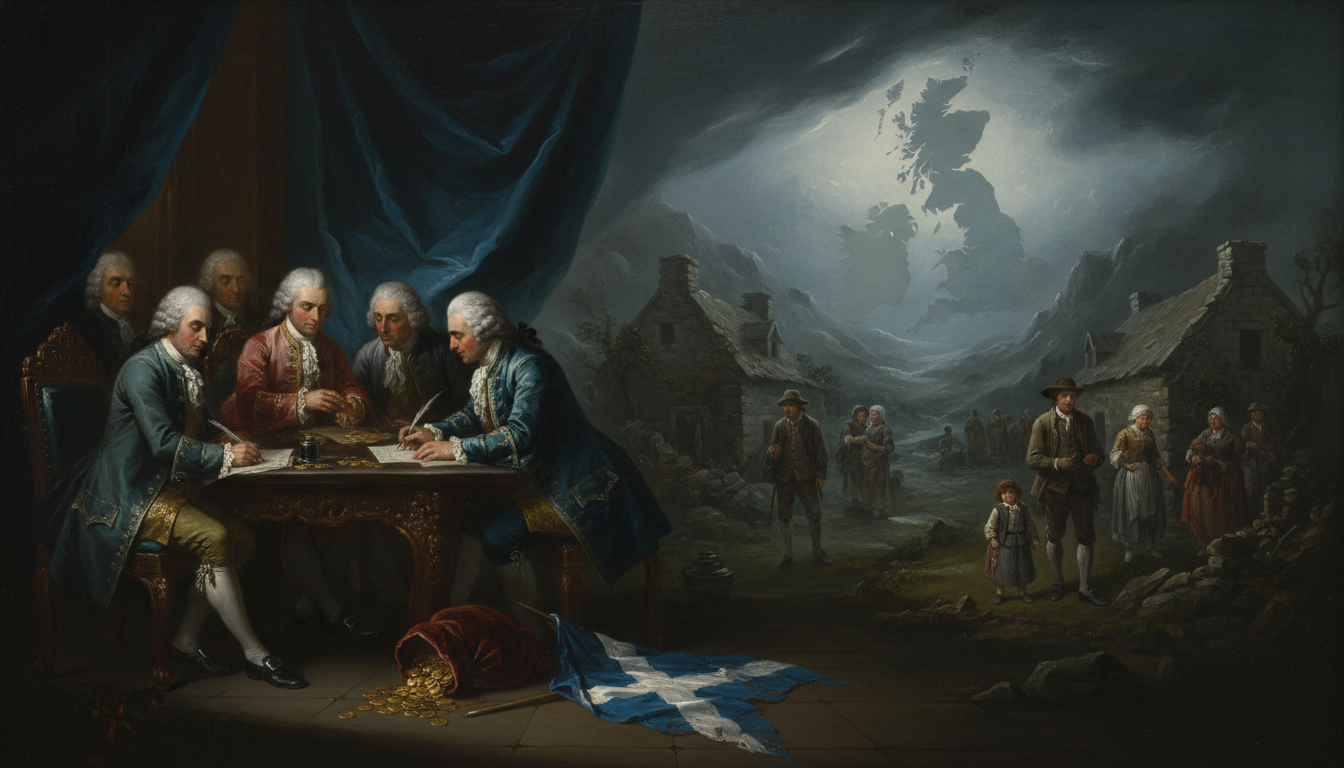
The argument within the song is blunt. Through the lens of this work, usually attributed to Robert Burns, the Union of 1707 was not an act of necessity. Instead, it was an act of political treachery. Burns suggests that Scotland was not conquered by force but sold by its own elite for financial gain. However, that accusation only makes full sense when you understand the national disaster that preceded it: the Darien Scheme.
The Darien Scheme: Scotland’s failed empire
Before the Treaty of Union, Scotland made one bold attempt to become a global trading power. In 1698, the Company of Scotland launched the Darien Scheme, an effort to establish a colony on the Isthmus of Panama. The goal was ambitious. Scotland aimed to create a trading hub between the Atlantic and Pacific, controlling a key route of global commerce.
At first, the plan drew extraordinary support. Around a quarter of all the capital circulating in Scotland was invested. Nobles, merchants, and ordinary citizens all bought in. It was not just an economic venture. It was a national project.
However, the reality was catastrophic. The chosen site, at Darien, was swampy, disease-ridden, and poorly understood. Tropical illness, including malaria and dysentery, tore through the settlers. Supplies ran short. Leadership was weak. Crucially, English support never materialised. In fact, under pressure from the English East India Company and to avoid conflict with Spain, English and Dutch investors withdrew. The colony was left isolated.
Then came the final blow. Spain, which claimed the territory, attacked. By 1700, the colony had collapsed. Most of the settlers were dead.
The financial impact on Scotland was devastating. Investors lost vast sums. Confidence in the Scottish economy collapsed. Many among the political elite were personally ruined.
This matters because it reshaped the debate about Union. For some Scottish politicians, Union offered a way out of economic disaster. The Treaty’s financial compensation, known as the Equivalent, was partly used to repay Darien investors. To critics, that looked like a payoff. To supporters, it looked like recovery.
This is the context behind Burns’s anger. When he writes of Scotland being “bought and sold for English gold”, he is drawing directly on the memory of Darien.
Why the Treaty of Union happened
The Treaty did not arise suddenly. Since 1603, Scotland and England had shared a monarch: James VI of Scotland became James I of England. However, both countries remained separate states. By the early eighteenth century, this arrangement was unstable. Scotland faced famine and economic hardship, while England feared Scotland might align with France.
Therefore, both sides moved towards union from different positions. Scotland needed access to trade, while England wanted political security. The Treaty eventually created the Kingdom of Great Britain on 1 May 1707. Scotland sent representatives to a single parliament at Westminster, though it retained its own legal system and church.
Economically, Scotland gained access to vast colonial markets. The “Equivalent” payment of nearly £400,000 helped offset the Darien losses. Over time, Scottish merchants thrived across the empire. Politically, Britain became a global superpower, and Scotland played a central role in the Enlightenment.
A Legacy of Sovereignty: From Darien to the Modern Day
Sovereignty remains the spectral question haunting every discussion of the 1707 Treaty. While the Equivalent solved the immediate debts of the Darien Scheme, critics argue it traded away the long-term right to manage Scotland’s future windfalls. Logically, the Union was a restructuring of assets where Scotland exchanged independence for institutional stability.
Consequently, modern discoveries like North Sea oil are often viewed through this lens of lost control. The “Rogues” addressed 18th-century poverty, but they did so by locking Scotland into a fiscal framework managed by a distant treasury. Therefore, the “pittance” mentioned by Burns is not just the 1707 buyout. It is the ongoing price of not having a sovereign hand on the tiller of the nation’s wealth.
Today, this question has changed its shape but not its nature. Scotland produces vast amounts of renewable energy, yet pricing remains tied to a wider British system. As a result, communities closest to the wind farms often pay the highest prices. The grievance Burns voiced was not simply about gold; it was about control.
Cultural Hauntings and Unanswered Questions
Then there are the cultural questions that still haunt us. Would the Clan system have been dismantled so brutally in the aftermath of Culloden if Scotland had remained independent? Would the Highland Clearances have occurred with such cold efficiency?
We must also consider the linguistic cost. While Gaelic was historically treated as a foreign threat to be suppressed, the Scots language suffered a more insidious erasure. Reclassified as a “failed” version of English, the educational establishment often dismissed it as the language of the uneducated. Consequently, generations of children were taught that their own mother tongue was something to be ashamed of. Would this institutional shame have flourished if Scotland had maintained its own state and its own legal standing for the language?
Conversely, we must weigh these losses against the gains. Would the Scottish Enlightenment have flourished without academic and imperial links to the south? Could Scotland lay claim to so many world-changing inventions without that rich background? The answers are rarely simple.
The Treaty of Union remains controversial because it is a story of both gain and loss. Through the voice of the Parcel of Rogues, it reads as betrayal. Through history, it appears as a calculated response to a crisis. Scotland certainly benefited, yet for many, those gains never erased the sense that something fundamental was surrendered.
The Price of Progress: Who Really Benefited?
We must also acknowledge that the “benefits” of the Union were not shared equally. While the Scottish elite gained access to imperial governance and global wealth, the working man was often the one who bore the cost of integration. For many, the Union did not bring prosperity; instead, it brought the dismantling of their way of life.
The Highland Clearances and the institutional suppression of the Scots and Gaelic languages were experienced most brutally by the common people. While merchants in Glasgow grew rich on colonial trade, the working classes saw their traditions and tongues reclassified as “backward” or “uncouth.” Therefore, the very people who “sold” Scotland according to the song were often the only ones to truly profit from the transaction. The common man had no vote in 1707, yet he was the one who lost his sovereignty in the fields and the classrooms.
Final thoughts
The Treaty of Union remains controversial because it is both a story of elite gain and communal loss. Through the voice of the Parcel of Rogues, it reads as the ultimate betrayal of the people by their leaders. Through historical analysis, it appears as a calculated survival strategy for a bankrupt ruling class.
The Darien Scheme sits at the heart of this tension because it explains why the elite were so desperate for a payoff. However, for many Scots today, those imperial gains never erased the sense that the nation’s soul was sacrificed for the benefit of a few. The song endures because it speaks to a fundamental truth: Scotland was bought and sold, but the common people never saw the gold.