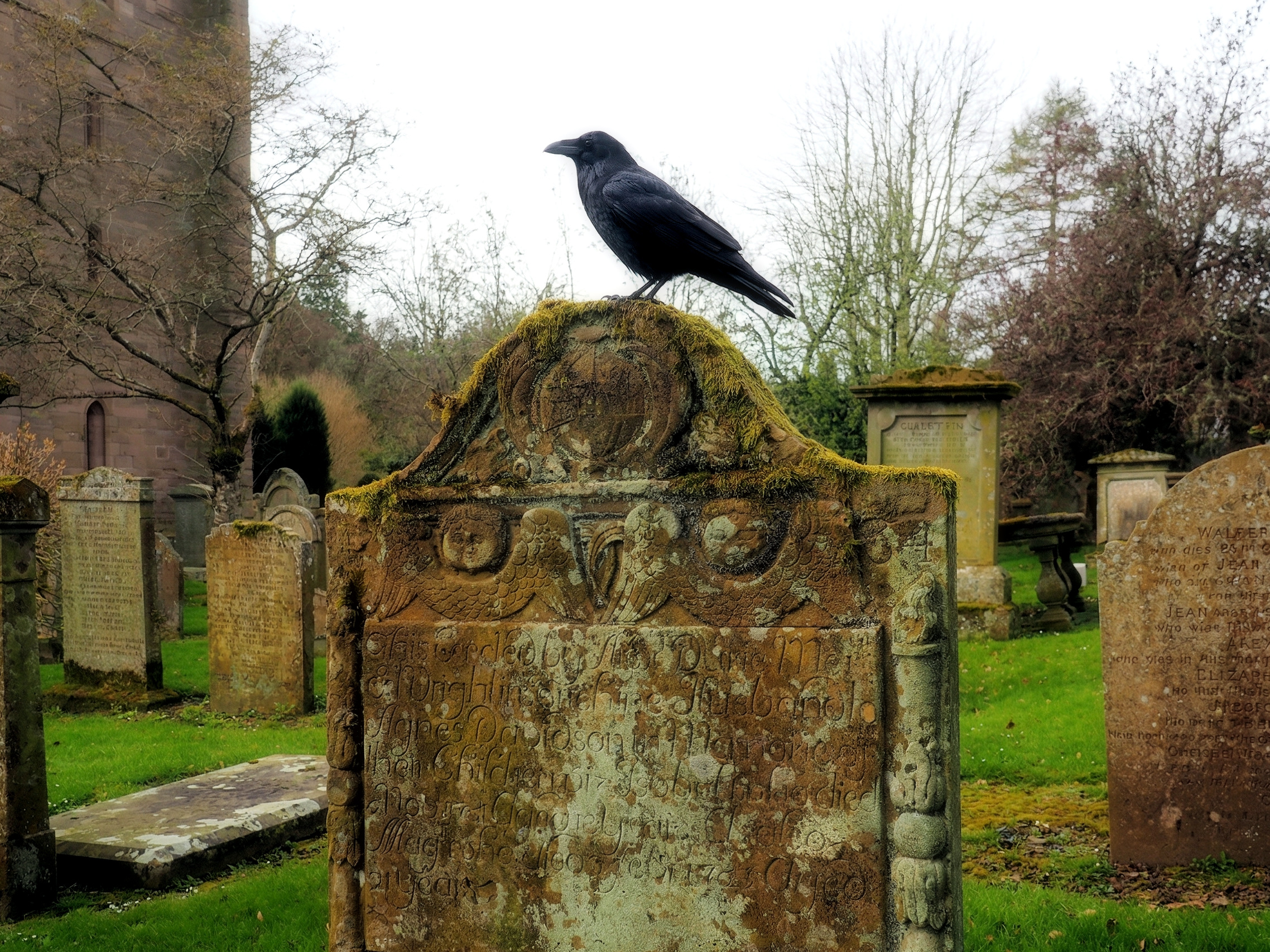
Ravens and crows are the primary “Birds of Battle” in Scottish folklore, a role most chillingly depicted in the ballad of The Twa Corbies. This traditional poem features two carrion birds sitting upon a “fail” (turf) dyke, discussing their next meal with a cold, domestic indifference. They set their sights on a “new slain knight” who lies abandoned behind a wall. Because his hawk, his hound, and his lady have all forsaken him, the knight is left utterly alone. This betrayal is the true horror of the ballad. The corbies do not merely scavenge; they fill the void left by human loyalty.
The Desecration of the Fallen
The emotional weight of the poem lies in the systematic dismantling of the knight’s dignity. One bird proposes to “pike oot his bonnie blue e’en,” while the other intends to use his golden hair to “theak” or thatch their nest. Consequently, the warrior is reduced to raw materials for the birds’ survival. There is no ceremony and no mourning. Instead, there is only the “wind shall blaw for evermair” over his bare bones. This imagery reinforces the idea that ravens are the “High Priests” of the battlefield. They wait for the living to depart so they can claim the dead as their own.
The Cailleach and the Hooded Crow
This sinister aversion is further rooted in the ancient associations between corvids and the Cailleach. As the Goddess of Winter and the shaper of the Scottish landscape, she frequently appears in the mortal realm in the form of a hooded crow, or Feannag. In the Highlands, the “Hoodie” is rarely seen as a mere natural encounter. Instead, it is often interpreted as a watchful manifestation of the winter spirit herself. Because the Cailleach rules the dark half of the year, her bird is a harbinger of the cold that kills. Consequently, the sight of a lone crow against a grey sky is a visible prophecy of the coming hardship.
The hooded crow, or Feannag, carries a name that translates directly to “The Flayer.” This grim etymology refers to the bird’s habit of attacking the soft tissues of weakened livestock, a trait that solidified its reputation as a beast of darkness. Because the Cailleach could shift her shape into that of a crow, the bird became a scout for her icy reign. In the Gaelic west, these birds were not just scavengers but were considered transformed witches or spirits. This connection to the “black airt” meant that a crow perching on a house was a persistent omen that death would soon take an inmate.
Ravens and Crows and the ‘Black Airts’
Walter Gregor recounts the following story which likely refers to Robert Gordon, the Wizard of Gordonstoun:
The crow was a bird of darkness. He was always associated with the man skilled in ” black airt.” A Morayshire laird had gone to Italy to study ” black airt,” and had returned master of it. A night’s frost came, and he wished to try his power. He ordered his coachman to yoke his carriage. The coachman obeyed, and brought the carriage. The laird ordered the coachman to drive to a lock near the mansion, and cross it on the ice, with the strict injunction not to look behind him. He then entered the carriage, and the coachman knowing his master’s power obeyed, made for the loch, entered on the ice, and drove with fury over it.
When the horses’ forefeet touched the opposite bank, curiosity overcame command and caution, and the coachman looked behind him, and saw a large crow perched on the roof of the carriage. In the twinkling of an eye the black bird had vanished, and crash went the hind wheels of the carriage through the ice ; but the coachman urged on the horses, and the horses pulled stoutly, and the laird was landed safely.
Ravens and Crows: Omens of Life and Death
Scottish bird lore provides a complex system of augury based on the behaviour and number of corvids encountered. While seeing a single crow is traditionally considered bad luck, the presence of two flying above a house is a positive sign of an impending marriage or birth. Conversely, it is a terrible omen for a crow to perch on the mast of a ship. This cast a shadow of certain disaster over the voyage. These birds acted as messengers of fate, bridging the gap between the mundane world and the inevitable mysteries of the Otherworld.
The Brahan Seer and the Raven’s Bonnet
The most chilling intersection of ravens and prophecy lies with Coinneach Odhar, the legendary Brahan Seer. While he famously used an Adder Stone to glimpse the future, his visions of the “Birds of Battle” were visceral and bloody. He foretold a day when a raven, attired in a plaid and a bonnet, would drink its fill of human blood on Fionn-bheinn. This bird would feast on the “Blood of the Gael” from the Stone of Fionn three times a day for three successive days. This surreal image of a raven wearing the clothes of a man underscores the bird’s role as a witness to the total collapse of the clans.
James I and the Speywife
As James I of Scotland rode into Perth in 1437, a Highland woman predicted his assassination. When asked how she knew this, she replied that ‘Huthart’ told her. The spirit Huthart seems to have been a Hoodie Crow and it is thought this is where the Scots name for a Hoodie Crow, Huddy, is derived.
The Washer at the Ford
The Banshee is dreaded by dogs and scan appear during the day as. According to Donald A. Mackenzie she is a “fairy woman who washes white sheets in a ford by night” when a local death is imminent. Crucially, Mackenzie notes that she can appear during the day as a black dog, a raven, or a hooded crow. This shape-shifting ability elevates the crow from a mere scavenger to a sentient manifestation of fate. Consequently, a lone “Hoodie” seen near a stream is often viewed as the Washerwoman in her daylight disguise.
The Omen of the “Bean-Nighe”
In the Gaelic west, this figure is more specifically known as the Bean-Nighe or the “Washer of the Slain.” She is often described as having webbed feet and a single nostril, traits that mirror the avian features of the birds she inhabits. Because she haunts the “dead and living fords” where spirits cross between worlds, her presence as a raven is a final warning. If a traveller can seize her before she finishes her washing, she may grant three wishes or reveal the names of those destined to die. However, failing to show her proper respect usually results in the traveller’s own shroud being added to her pile.
Macha’s Fruit and the Mol-macha
In the Scottish cultural context, the crow was often called Badb or badh-catha, a term synonymous with a witch-form. These birds represented rage, fury, and the lunacy of the battlefield. A flock of crows was known as a Mol-macha, a name derived from the war goddess Macha. To the ancient Gael, the bodies of the slain were “Macha’s fruit crop,” left for the birds to harvest. This overlap between fairies, witches, and goddesses suggests that the crow was never merely a bird. Instead, it was a “transformed being of superior power” that ruled over carnage.
The Doiteagan and the Tempest
In the lore of Mull, the witches known as the Doiteagan were said to assume raven form to execute their maledictions. These “Raven-Witches” famously raised a tempest to destroy the Spanish Armada, croaking curses from the masts as the ships went down. This ability to command the weather links the raven to the most destructive aspects of Scottish witchcraft. Furthermore, the transition from bird to human was fluid. Stories tell of witches on the gallows disappearing, only for a coal-black raven to take their place. Consequently, the raven became a symbol of the Devil himself, retrieving souls at the moment of death.
The Raven Witch and the Snare of Fate
In Caithness, legends tell of a raven witch named Fitheach (the Gaelic for Raven) who possessed the ability to transform herself into a hare. This “a-haring” was a common trope in Scottish witchcraft, representing a subversion of the natural order. Unfortunately, Fitheach ran into a snare while in her animal form. She was found dead the next morning in her human shape. Such tales reinforce the idea that the corvid family is inextricably linked to the “black airt” and the shifting boundaries of life and death. Whether as a battle standard or a witch’s familiar, the raven remains Scotland’s most mystical harbinger.
The Raven Standard and the Viking Legacy
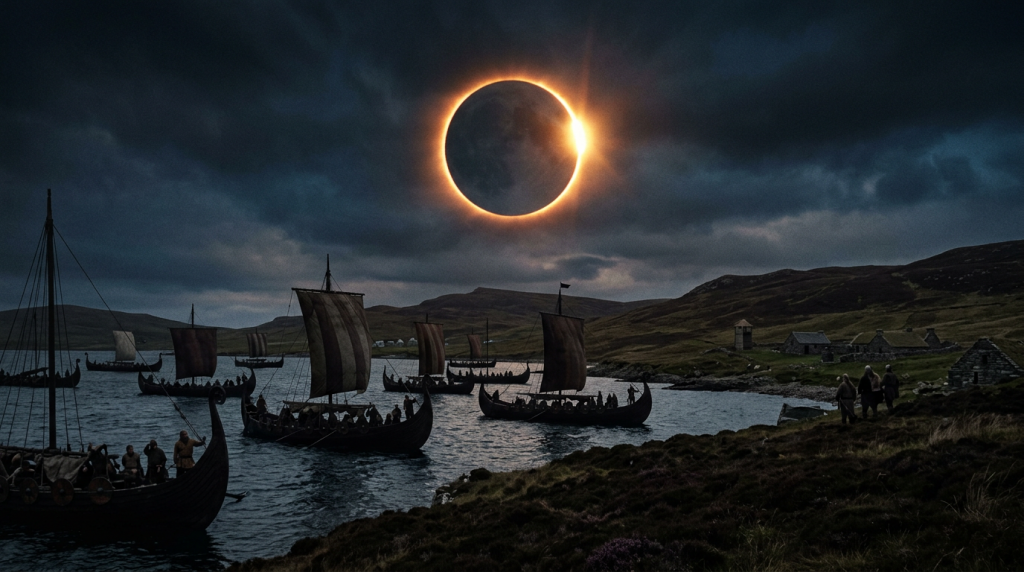
The raven was the special familiar of Odin, the Norse “Raven-God,” and was deeply honoured by the Vikings. Because the Vikings were enemies of the Gaels, the raven became a symbol of impending doom to the native population. In the ninth century, Norse leaders carried a battle standard featuring a raven, a tale famously recorded in the Orkneyinga Saga.
The Raven Banner was a supernatural standard woven by the mother of Earl Sigurd the Stout, a powerful Norse-Gaelic ruler of Orkney. Sigurd’s mother was a renowned seeress and weaver of “black airt” who possessed the ability to bind fate into fabric. When Sigurd was challenged to battle by the Mormaer of Moray (often identified as Findláech, the father of the historical Macbeth), he sought his mother’s counsel. She presented him with a banner of finest silk, exquisitely embroidered with the image of a raven. She prophesied that the banner would bring certain victory to the army that followed it, but certain death to the man who carried it.
The Battle of Moray and the Weaver’s Curse
The conflict in Moray serves as the primary Scottish anchor for the raven’s lethal reputation. According to the Orkneyinga Saga, the Mormaer of Moray challenged Sigurd to a pitched battle at Skitten (Skidmoor) in Caithness, outnumbering the Earl’s forces seven to one. Sigurd, bolstered by his mother’s sorcery, unfurled the Raven Banner for the first time. As the wind caught the silk, the embroidered bird appeared to flutter and take flight, as if the spirit of Odin himself were leading the charge. Consequently, the Norsemen fought with a supernatural fury that shattered the Scottish lines.
The Price of the Raven’s Favour
The victory at Moray was absolute, yet the weaver’s grim prophecy was fulfilled with terrifying precision. During the height of the slaughter, Sigurd’s standard-bearer was struck down, just as his mother had foretold. This established the “Raven’s Price”—a recurring motif where the bird demands a blood sacrifice in exchange for triumph. Because the banner was “woven with mighty spells,” it functioned as a sentient omen.
From the Highlands to the Fields of Clontarf
The Raven Banner eventually travelled from the Scottish Highlands to Ireland for the Battle of Clontarf in 1014. By this time, its reputation as a “death-token” was so great that no warrior would agree to carry it. After two standard-bearers were killed in quick succession, Sigurd called upon his men to take up the staff. One warrior famously replied, “Bear thine own devil thyself.” In a final act of desperation, Sigurd ripped the banner from its staff and wrapped it around his own body. He was pierced by a spear moments later, proving that even an Earl could not escape the raven’s lethal bargain. It is said that when Sigurd was buried, the banner was wrapped around him and with it its black magic.
The Mystery of the Raven Pebble
Long after the Viking age, a belief persisted across Scotland regarding the “Raven Pebble,” known by various regional names. On the mainland, it was the “Victory Stone.” Meanwhile, on Shetland it was the Seringsten, and on St Kilda, the Clach Dotaig or “Stone of Virtue.” To obtain this treasure, a seeker had to rob a raven’s nest and boil the eggs before replacing them. The raven, realising the eggs were cold, would search for a transparent stone to rub on them to restore their fertility. These stones were highly coveted; mainlanders believed they granted invisibility, while Shetlanders used them for protection against trolls.
Ravens and Crows as Wisdom, Cures, and Dark Riddles
Despite their lethal reputation, ravens were also respected for their “Raven-knowledge.” The Carmina Gadelica preserves incantations such as “Wisdom of the raven be thine,” acknowledging the bird’s superior intelligence. In a more practical sense, the ashes of a burnt crow were even used as a cure for gout. However, the dark riddles of the Highlands always returned to the grave. When asked “What is blacker than a raven?”, the traditional folk answer was simple: “There is Death.” Whether acting as Odin’s messengers or the “Watcher at the Ford,” ravens and crows remain the ultimate symbols of the unknown.
Sources:
- Malcolm Archibald: Scottish Animal and Bird Folklore (1996)
- Walter Gregor: Notes on the Folk-Lore of the North-East of Scotland (1881 Republished 2007)
- George Henderson: Survival in Belief among the Celts (1911 Republished 2020)
- Robin Hull: Scottish Birds: Culture and Tradition (2001)
- David R. Kelday: Scotland’s Birds and Folklore (2018)
- Donald A. Mackenzie: Wonder tales from Scottish Myth and Legend (1917)