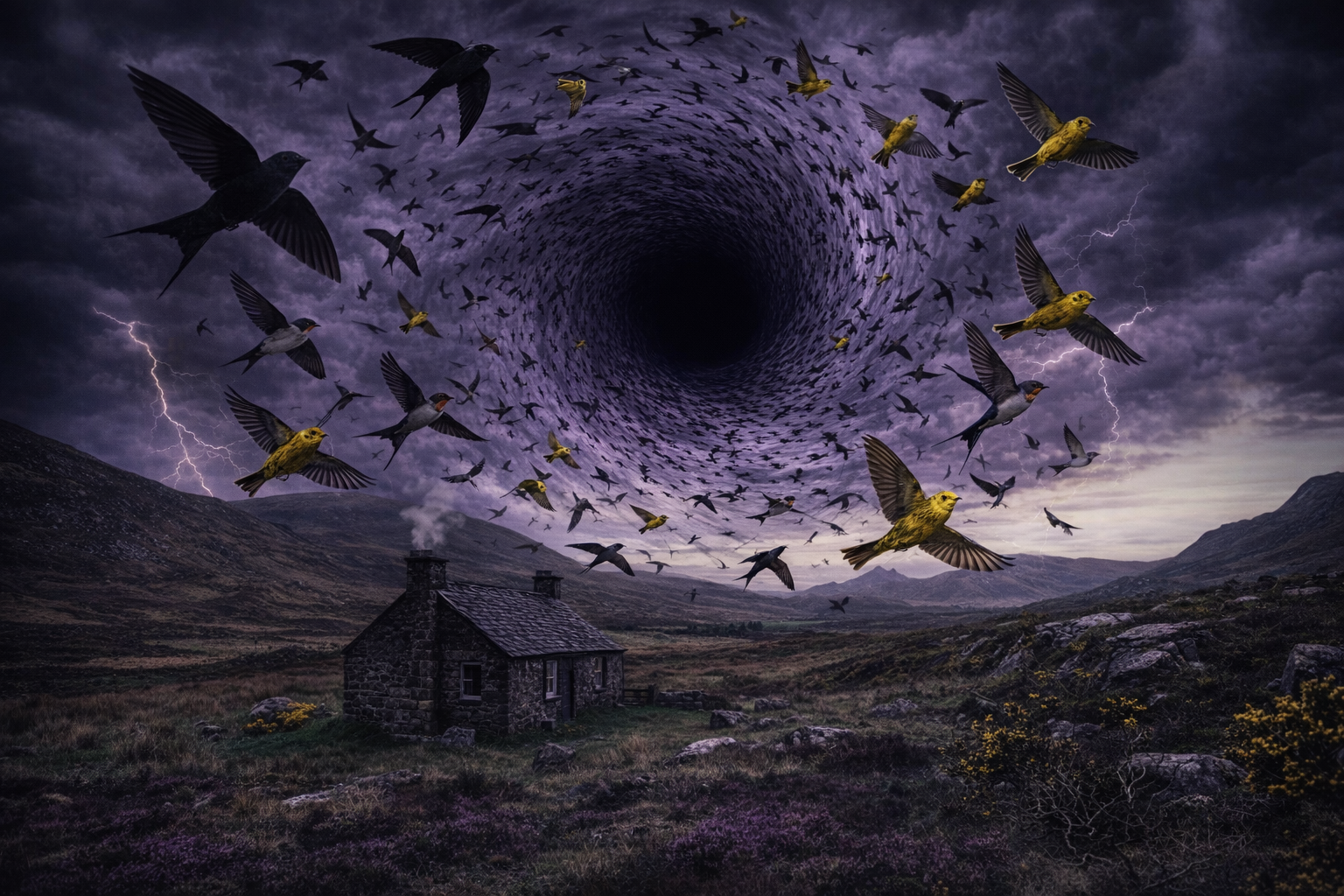
Scottish birds of the Devil feature prominently in folklore where nature and the infernal blur. While many species were cast as divine messengers, others were marked by a darker inheritance. Across the landscape, these creatures were believed to carry a drop of infernal blood, often hidden beneath the tongue. Consequently, they were judged not only by appearance but by behaviour, song, and omen. In a world where the supernatural pressed close, even familiar wildlife could be feared as vessels of the De’il.
The Yellowhammer and the De’il’s Note
The yellowhammer (Sìteag, or yorlin) is perhaps the most notorious of the Scottish birds of the Devil. According to tradition, this bird drank a drop of Old Nick’s blood every May morning, leaving its eggs “gouted with the De’il’s blood.” These intricate markings were often called “the De’il’s note,” as though the shell carried a written curse from the pit itself.
Moreover, the call of the yorlin reinforced its sinister reputation. In Scots, its song was commonly interpreted as: “De’il, De’il, De’il tak ye.” This made the bird more than symbolic; instead, it became a vocal omen heard across the fields. Some traditions also claimed it was hatched from toads and kept company with snakes, as captured in this old Scottish verse:
“Half a paddock, half a toad,
Half a yellow yoldrin’s blood,
Drips for a drink to the de’il,
Every May morning.”
Therefore, among the various avian omens in Scotland, the yellowhammer was undoubtedly the most openly feared.
Swallows, Swifts, and the Souls of the Damned
The swallow (Gobhlan-gaoith) occupies a contradictory place in belief, feared despite its closeness to human homes. It was believed to carry a hidden mark of infernal blood beneath its tongue, which explained its restless, flickering flight. Furthermore, this species was linked to a specific domestic omen. If a swallow fell down a chimney in a shower of soot, it might spit out that blood — an event taken as a stark warning of misfortune.
Similarly, the swift (or ‘Develin’) occupies a dark position in the sky. Rather than simply carrying blood, these birds were believed to embody the actual souls of the damned. Their constant motion and sharp, piercing cries were thought to reflect a state of eternal unrest. Consequently, their presence was read as a reminder that some spirits were denied peace.
The Magpie and the Stonechat
The magpie (Pioghaid) is frequently counted among the Devil’s brood due to its legendary lack of empathy. It was said to have refused entry to Noah’s Ark and, more significantly, refused to mourn at the Crucifixion. As a result, the bird became a magnet for suspicion. During the Scottish Reformation, this association was weaponised by the people, who mockingly called bishops “magpies” to link them to the infernal.
The stonechat likewise carries a surprisingly dark reputation on the moor. This suspicion was likely tied to its sharp, clicking call, which sounds like stones struck together. Because of this, its voice was heard as something dry and unnatural. In addition, a disturbing tradition claims its eggs were hatched by toads. Since the toad is strongly linked to witchcraft, this association places the bird firmly within a darker symbolic world.
Transformation and Lesser Omens
Several other Scottish birds of the Devil appear in scattered traditions throughout the country. The wheatear, for instance, was thought to signal imminent death, while the blackbird carried a specific transformation tale. It was said to have once been white, but after sheltering in a chimney, it emerged blackened, having mistaken it for the “Devil’s lum.” In conclusion, these beliefs reveal a broader system in which ordinary wildlife carried unsettling meanings, linking the everyday landscape to the eternal struggle between heaven and hell.