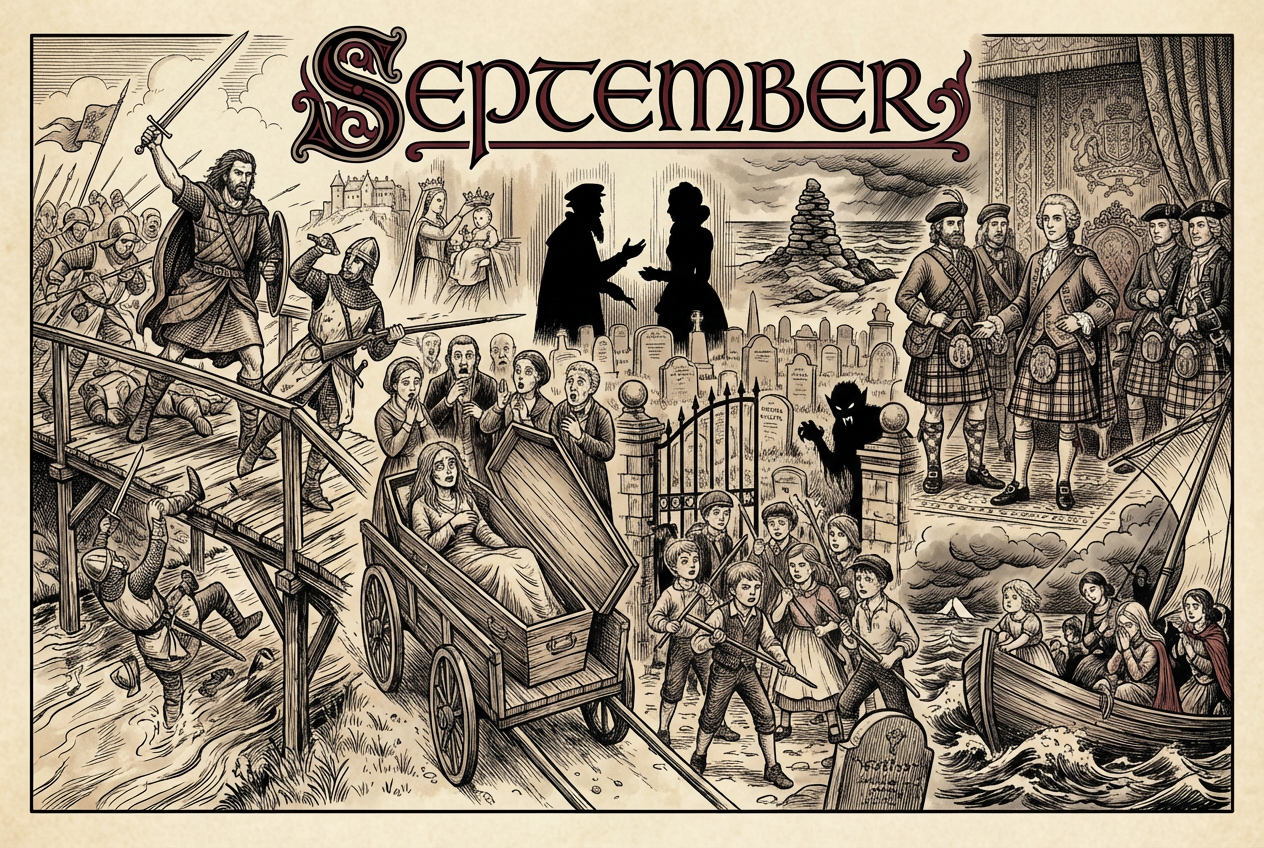
September is a month of crownings and collapses, victories and vanishings. It opens in the medieval period with the coronation of a nine-month-old queen and closes with Cromwell’s forces besieging the last Scottish stronghold to hold out against them.
William Wallace dominates the early part of the month. His stunning victory at Stirling Bridge on the 11th proved the English could be beaten — but his co-commander Andrew Murray died of his wounds shortly after, leaving Wallace to carry the cause alone. The Wars of Independence cast a long shadow here: Margaret, Maid of Norway, died in Orkney on the 26th of September 1290, and her death set the whole catastrophe in motion.
Mary Queen of Scots appears repeatedly. She was crowned at Stirling at nine months old, met John Knox at Holyroodhouse in a clash that settled nothing, and returned to Dunnottar twice. The Jacobite rising of 1745 also peaks in September — Perth falls on the 4th, Edinburgh on the 16th, and Bonnie Prince Charlie holds court at Holyroodhouse in a brief, brilliant moment before everything unravels.
September also holds some of Scotland’s stranger stories. Half-Hangit Maggie survived her own execution in 1724. And in 1954, hundreds of Glasgow children stormed the Southern Necropolis with sharpened sticks, hunting a vampire.
1 September 1644: The Battle of Tippermuir. Montrose’s first victory under the royal standard, fought near Perth with a ragged army of Irish troops and Highland levies. It announces him as a commander to be feared.
2 September 1724: The execution of Maggie Dickson goes wrong — or right, depending on your view. Convicted of killing her newborn baby, she was hanged in Edinburgh but woke up in her coffin on the way to the graveyard. She lived for many years afterwards and became a local legend known as “Half-Hangit Maggie.”
3 September 1535: Alison Rough is executed in Edinburgh for the murder of her son-in-law. Her case gripped the city — a story of family betrayal and a violent end. It remains a grim reminder of domestic tragedy in 16th-century Scotland.
4 September 1241: The future King Alexander III is born. His reign would come to be remembered as a golden age for Scotland, a period of relative peace and prosperity. It ended in a tragic accident that plunged the nation into chaos — but on this day, there was only hope.
4 September 1561: Mary Queen of Scots meets John Knox at the Palace of Holyroodhouse, hoping to find some common ground. They find none. The tension between the Catholic queen and the Protestant reformer continues to simmer.
4 September 1745: The Jacobite army takes Perth in the early stages of the final rising. It is a significant boost to Charles Edward Stuart’s campaign. The momentum is building as the Highland army turns south.
5 and 7 September 1564: Mary Queen of Scots returns to Dunnottar Castle for a second royal visit, staying across two separate dates. These visits deepen the bond between the crown and the Earls Marischal who held the fortress. The castle’s history is woven tightly into the story of the Stuart queen.
6 September 1661: King Charles II restores episcopal government to Scotland by royal decree. In response, Presbyterians begin holding open-air “conventicles” to worship outside the new laws. When those too are made illegal, a period of intense religious persecution follows.
8 September 1057: Lulach mac Gilla Comgáin, stepson of Macbeth, is crowned King of Scots. His reign is brief and troubled — he struggles to hold the authority his stepfather had built. History remembers him as “Lulach the Unfortunate,” and the name fits.
9 September 1513: The Battle of Flodden saw the defeat of the Scottish Army at the hands of the English Billmen. James IV would lose his life and the paranoia that followed would result in Edinburgh’s Flodden Wall.
9 September 1543: Mary is crowned Queen of Scots at Stirling Castle. She is nine months old. The weight of a kingdom settles on an infant’s shoulders, and Scotland enters a long and difficult regency.
11 September 1297: William Wallace and Andrew Murray defeat the English army at the Battle of Stirling Bridge in one of the most decisive victories of the Wars of Independence. The English, it turned out, were not invincible on Scottish soil. Murray died of his wounds not long after, leaving Wallace to lead alone.
13 September 1644: The Battle of Aberdeen. Montrose takes the city after a brutal engagement. The sack that follows blackens his reputation, though the extent of his personal responsibility remains disputed.
13 September 1645: The Battle of Philiphaugh. Leslie’s Covenanting cavalry destroys Montrose’s army in a surprise attack. The Highland campaign is over.
15 September 1860: Marischal College and King’s College in Aberdeen merge to form a single University of Aberdeen. Two distinct academic traditions come together under one banner. The city’s intellectual landscape is permanently reshaped.
16 September 1745: The Jacobites take Edinburgh without a fight. The city gates are opened and the Highland army marches into the capital. Bonnie Prince Charlie holds court at Holyroodhouse — a brief, dazzling moment of triumph.
20 September 1319: The Battle of Myton, fought on 20 September 1319, was a decisive Scottish victory over an English force largely composed of clergy and untrained militia, earning it the nickname “Chapter of Myton.” It was led by Sir James Douglas and Thomas Randolph, Earl of Moray.
20 September 1746: Bonnie Prince Charlie sails for France from Loch nan Uamh, departing from almost the same spot where he first landed. The rebellion is over. The Prince’s Cairn now stands there as a lonely monument to everything that was lost.
23 September 704: Adomnán of Iona dies — abbot, lawmaker, and author of the Life of Columba. He promoted the Law of Adomnán, one of the earliest attempts to protect non-combatants in warfare. His hagiography of Columba remains his most enduring legacy.
23 September 1954: Hundreds of Glasgow children swarm the Southern Necropolis armed with sharpened sticks, hunting a fanged monster they believe has killed two local boys. No vampire is found. The Gorbals Vampire remains one of Scotland’s strangest and most vivid modern urban legends.
26-29th September 1290: Margaret, the Maid of Norway, dies at St Margaret’s Hope in Orkney. She is seven years old. Her death leaves the Scottish throne vacant, triggers the Great Cause, and sets in motion the Wars of Independence.
September 1651: Cromwell’s forces begin the siege of Dunnottar Castle. Governor Ogilvy and a garrison of sixty-nine men hold out against the English troops for months. It is the last major Scottish stronghold to resist the Cromwellian conquest.
.