Maggie Dickson is one of Edinburgh’s most enduring legends, a woman who survived her own public execution and lived, improbably, to tell the tale. Known ever after as “Half-Hangit Maggie,” her story combines tragedy, injustice and a near-miraculous survival that has fascinated people for three centuries. The historical record is incomplete and several versions of her story exist; where accounts differ, this article flags the key variations.
Who Was Maggie Dickson?
Maggie Dickson was born around 1702 in or near Musselburgh, a fishing town east of Edinburgh. She married a local fisherman and supported their household by selling fish and salt. Life was hard for ordinary people in early eighteenth-century Scotland, and it grew harder still around 1722 or 1723 when her husband disappeared. Most accounts suggest he was press-ganged into the Royal Navy, though some say he left to work the fishing fleet in Newcastle. Either way, Maggie was left alone and struggling.
Eventually, she found work at an inn near Kelso in the Scottish Borders.
Pregnancy, Concealment and Arrest
While working at the inn, Maggie began a relationship with the innkeeper’s son and became pregnant. Scottish law imposed significant public shame on unchaste women, including formal rebuke by a church minister on three consecutive Sundays. Fearing dismissal and humiliation, Maggie concealed the pregnancy for as long as she could.
The baby was born prematurely and died. Whether the child was stillborn or survived briefly is unclear, and the circumstances were never conclusively established. Maggie placed the body on the banks of the River Tweed. It was discovered the same day and traced back to her. She was arrested and taken to Edinburgh to stand trial.
The Trial
In 1724, Maggie was tried at the High Court of Justiciary in Edinburgh. She was charged under a Scottish infanticide statute of 1690, sometimes referred to as the Concealment of Pregnancy Act, though some sources indicate the charge was the more serious one of causing the death of her child. Throughout, she maintained her innocence.
No evidence of violence was found on the baby’s body. However, a doctor testified that the infant’s lungs floated in water, a test then used to indicate the child had been born alive. This test, known as the hydrostatic or lung flotation test, was standard practice in infanticide cases during the period. It is now regarded as unreliable, since lungs can float for other reasons entirely. Nevertheless, the evidence proved decisive. Maggie was found unanimously guilty and sentenced to hang publicly in Edinburgh’s Grassmarket.
The Hanging
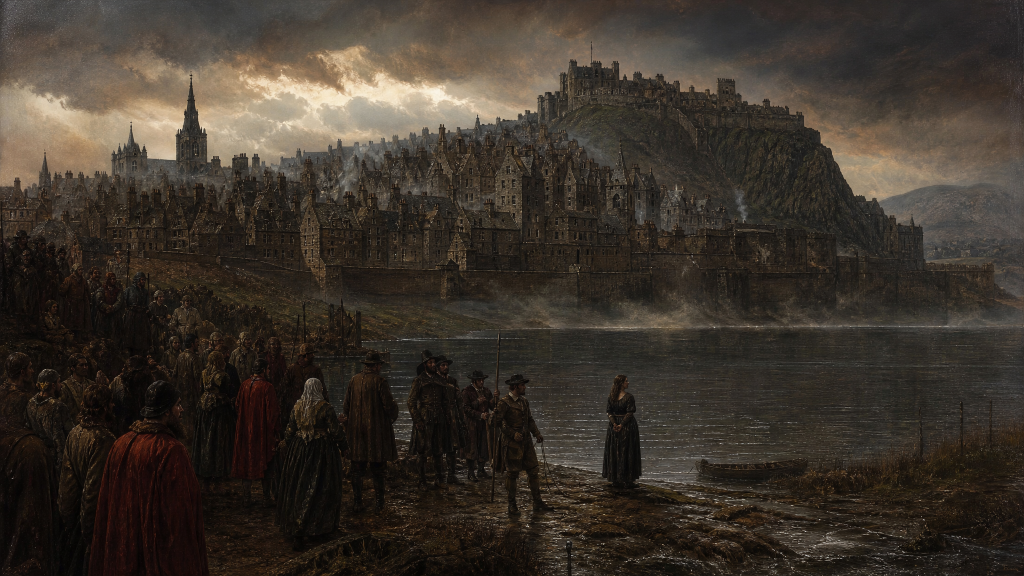
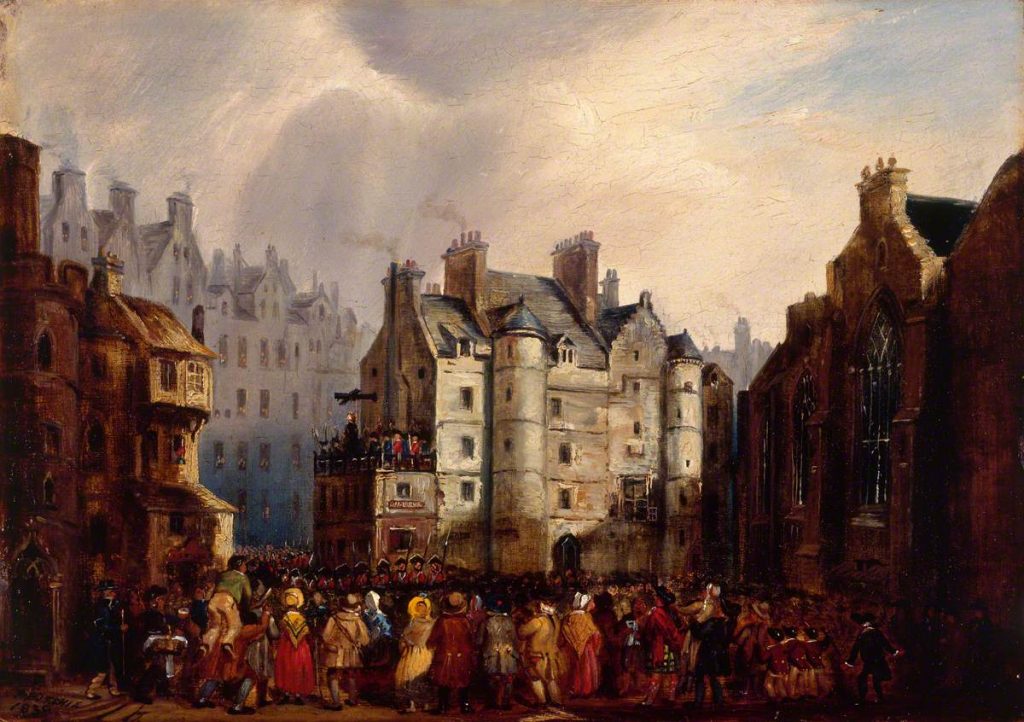
The Grassmarket, a broad square beneath Edinburgh Castle, was the city’s principal execution site. Crowds of up to 20,000 people would gather there.
On 2 September 1724, Maggie Dickson was hanged. The executioner named in some accounts is John Dalgleish. After she was pronounced dead, a scuffle broke out between her family and medical students seeking her body for dissection, a practice then legal and increasingly common as Edinburgh’s anatomy schools expanded. Her family prevailed. Maggie was placed in a coffin and transported back towards Musselburgh for burial.
The Revival
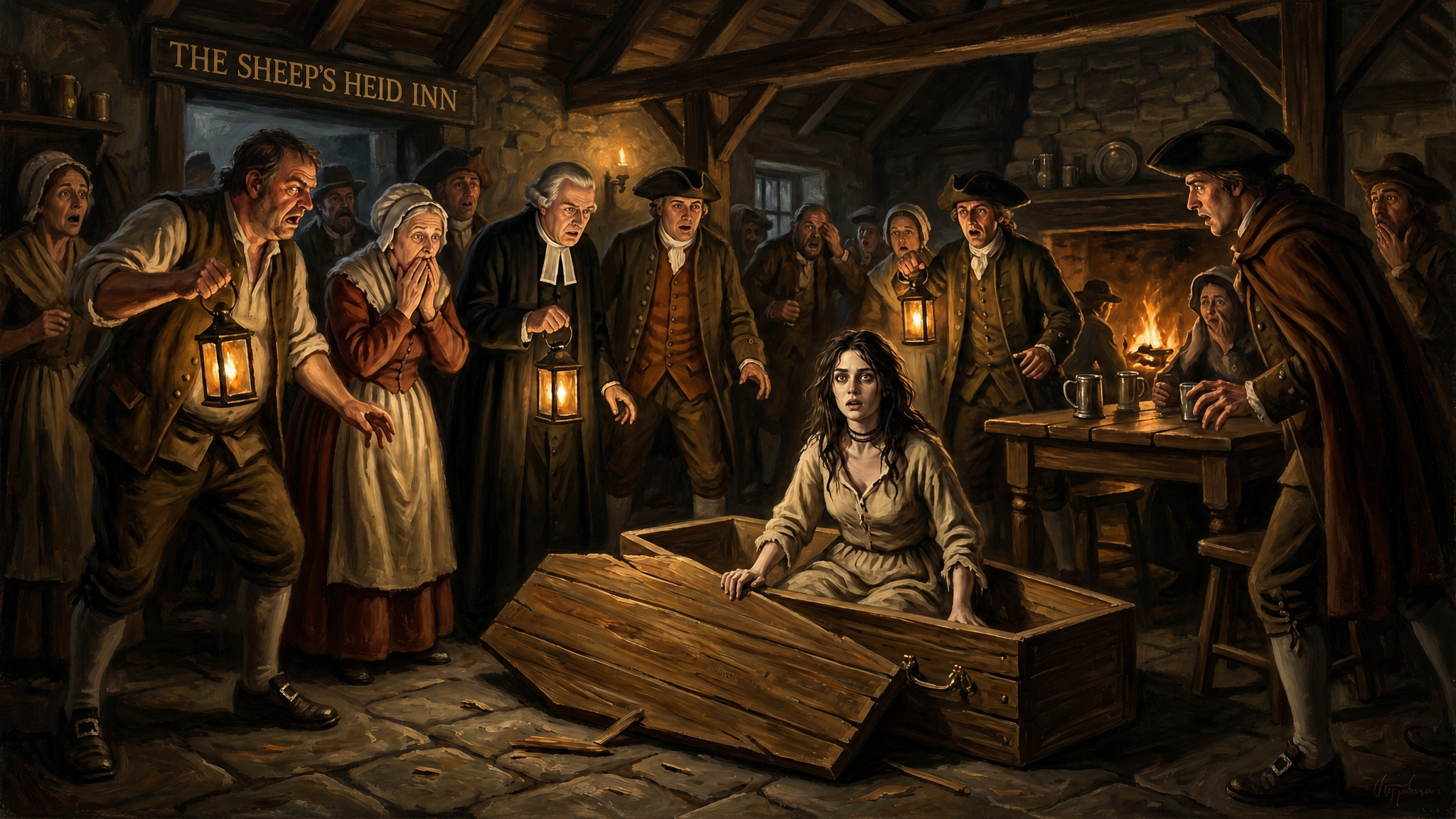
Somewhere between Edinburgh and Musselburgh, the party stopped to rest. Most sources place this at Peffermill; one account names the Sheep Heid Inn at Duddingston, which still stands today. While the travellers paused, noises were heard from inside the coffin.
When the lid was opened, Maggie Dickson sat up.
She was alive. She complained of a sore neck and a dry mouth, and recovered well enough to walk the rest of the way to Musselburgh the following day.
How Did She Survive?
Several theories have circulated, then as now. Some attributed her survival to divine intervention. A popular rumour held that she had befriended the ropemaker, who deliberately supplied a weak rope; a related variant claimed she had seduced the hangman the night before. One account notes that Dalgleish may have forgotten to tie her hands, potentially allowing her to take some of her own weight and avoid a broken neck.
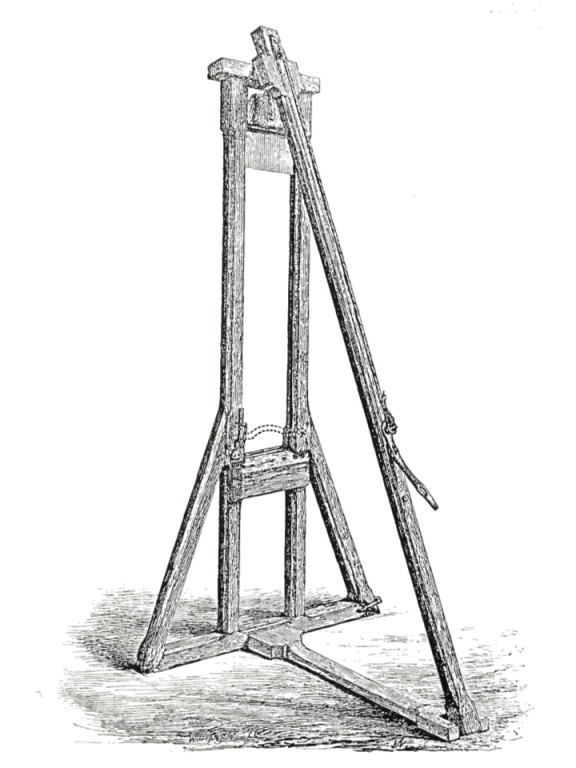
The most credible explanation, however, is physiological. The method used at Grassmarket executions was short-drop hanging, in which the condemned fell only a short distance and death came not from a broken neck but from gradual compression of the airways and blood vessels. Crucially, the vertebral arteries, which run through the bones of the spine, remain protected during hanging and can continue supplying blood to the brain even when the carotid arteries and jugular veins are compressed. Whole-body death by this method could take up to thirty minutes. It is therefore entirely plausible that Maggie lost consciousness but did not die before she was cut down. The disturbance of the coffin during the scuffle with the medical students may also have admitted enough air to assist her survival.
As with much of Maggie’s story, the truth is unknown. The variations are themselves part of the legend.
Life After the Gallows
Under Scottish law, Maggie’s sentence had been carried out. She had legally died and could not be executed again. This protection would not have applied under English law. Some accounts suggest the judges subsequently amended the wording of future death sentences to read “hanged until dead,” though this detail appears in fewer sources and should be treated with caution.
Maggie remarried her husband shortly afterwards, their marriage having been legally dissolved by her declared death. She had more children, and reportedly dedicated every Wednesday to fasting and prayer in gratitude for her survival. She lived for approximately another forty years. The Newgate Calendar records her still alive in 1753, selling salt in Edinburgh.
She became known universally as “Half-Hangit Maggie,” a nickname that has outlasted her by more than two and a half centuries.
Legacy
Today, Maggie Dickson’s Pub stands in the Grassmarket, close to the site of her execution, and the anniversary of her survival is marked by the distribution of free beer.
Maggie’s case had consequences beyond the personal. The public discontent sparked by her hanging drew attention to the treatment of infanticidal mothers in Scotland. These were women whose poverty and desperation were rarely factored into the legal proceedings against them. Her story may also have contributed to violent protests against grave robbery and bodysnatching in 1725, driven by widespread public anger at the treatment of the dead by anatomy schools. That anger would not be formally resolved until the Anatomy Act of 1832, more than a century later.
Maggie Dickson remains one of very few people in recorded history to have survived their own execution. She was, in every sense of the word, only half-hangit.