Loch Ness Monster sightings have captivated the world for a century, transforming Loch Ness into a place of global mystery. While the legend is often associated with modern tourism, the roots of the “water beast” stretch back to the very dawn of Scottish history. Consequently, the creature occupies a unique space between ancient folklore and modern cryptozoology.
General Information
Nessie is the name given to the elusive inhabitant of Loch Ness, a body of water containing more fresh water than all the lakes in England and Wales combined. Although the modern craze began in 1933, the first recorded encounter dates back to 565 AD. Saint Columba, the Irish monk who brought Christianity to Scotland, reportedly encountered a “water beast” in the River Ness. According to Adomnán, Columba used the sign of the cross to banish the creature after it attacked a local swimmer. However, modern scientific efforts, such as the 2018 eDNA survey, suggest that sightings might actually be giant eels.
Appearance
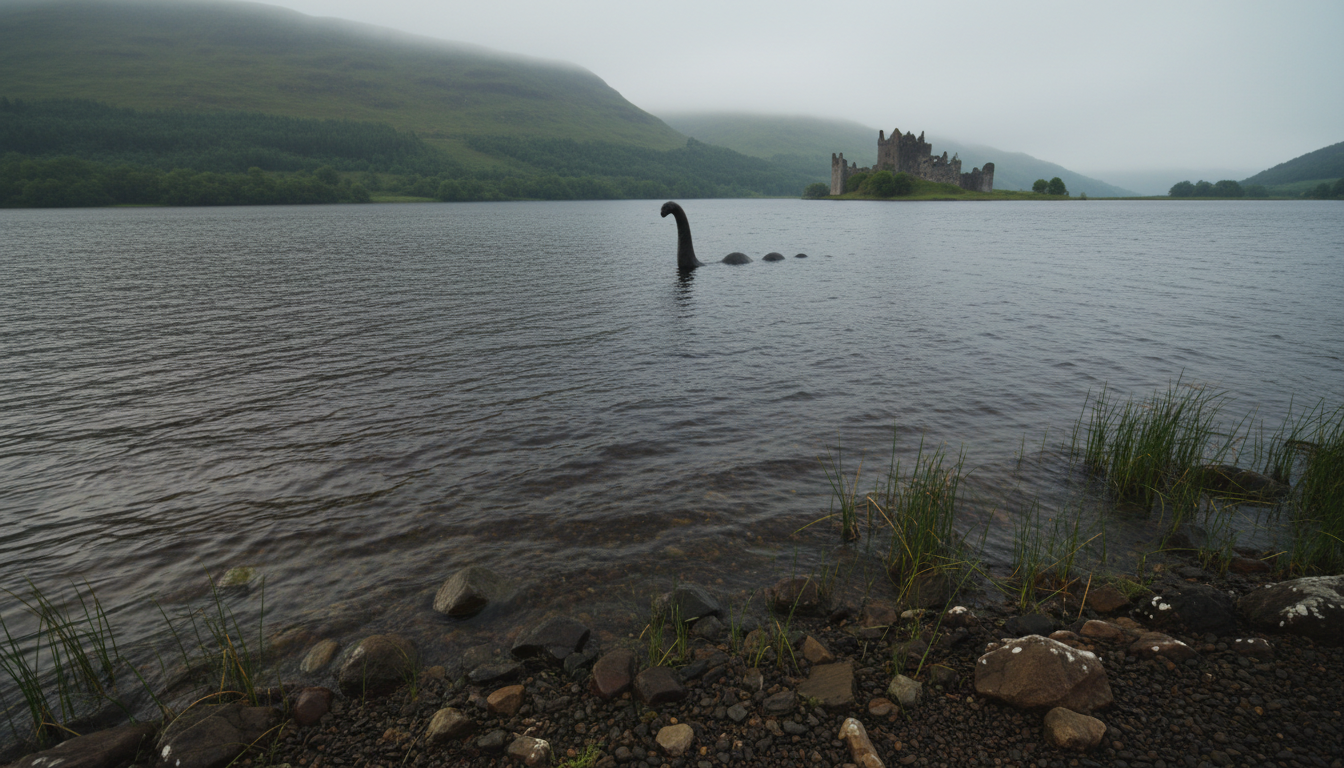
Descriptions of the monster vary, yet most witnesses agree on a few specific physical traits. It is typically described as having a long, graceful neck and a relatively small head. Its head is often compared to a horse’s or a snake’s. Additionally, many reports mention one or more dark humps protruding from the water. However, it has been suggested that logs or boat wakes could account for this. The skin is usually described as dark, slimy, or elephant-like in texture. While some believe it resembles a prehistoric plesiosaur, others describe a more fish-like or serpentine form that moves with surprising speed.
Habitat
Loch Ness provides a perfect, albeit challenging, home for such a creature. Because the water is peaty, visibility is extremely poor, allowing a large animal to remain hidden. The loch is over 20 miles long and reaches depths of nearly 800 feet, offering vast, unexplored spaces. Moreover, with a chilly water temperature of 5°C, it would require any resident creature to have a highly specialised metabolism.
Behaviour
Witnesses often describe the creature as being shy and easily startled by the sound of engines or human activity. It typically surfaces for only a few moments, creating a distinct V-shaped wake before diving back into the depths. Interestingly, some of the most famous reports describe the monster venturing onto land. For instance, the Spicer family famously claimed to see a prehistoric-looking beast lurching across the road in 1933. These land sightings suggest a creature that is at least partially amphibious. However, such reports are much rarer than those of it swimming.
Stories and Experiences
The Miracle of Saint Columba (565 AD)
The earliest and most famous primary source for a monster in the area comes from the Life of Saint Columba, written by the Abbot Adomnán in the 7th century. While travelling through the land of the Picts, Columba came across a group of locals burying a man by the River Ness. They explained that a “water beast” had snatched the man and mauled him while he was swimming. Despite the danger, Columba ordered one of his companions, Luigne moccu Min, to swim across the river to fetch a boat. When the beast surfaced to attack the new swimmer, Columba raised his hand, formed the sign of the cross, and commanded: “Go no further. Do not touch the man. Go back at once.” Witnesses claimed the beast fled as if pulled back by ropes, leading many to believe this was the first recorded encounter with Nessie.
The Spicer Encounter (1933)
Modern interest in the monster was truly ignited by a dramatic land sighting on 22 July 1933. George Spicer and his wife were driving along the loch’s northern shore when they witnessed a huge animal lurching across the road. They described a creature roughly 25 feet long with a high back and a long, wavy neck that moved like a scenic railway. Spicer noted that it appeared to be carrying a smaller animal in its mouth. It disappeared into the undergrowth toward the water. This account shifted the narrative from a simple “monster fish” to a prehistoric beast, sparking a media frenzy.
The Surgeon’s Photograph (1934)
Perhaps the most iconic image of the 20th century, the “Surgeon’s Photograph” was published by the Daily Mail on 21 April 1934. Attributed to Robert Kenneth Wilson, a respected London gynaecologist, the grainy image showed a long-necked silhouette rising from the ripples. For sixty years, it served as the primary proof for believers. However, in 1994, a deathbed confession by Christian Spurling revealed the truth. The monster was actually a toy submarine outfitted with a plastic-wood head. The hoax was orchestrated by Marmaduke Wetherell, a big-game hunter who sought revenge on the newspaper after they had publicly humiliated him.
The Arthur Grant Sighting (1934)
In the early hours of 5 January 1934, a young veterinary student named Arthur Grant claimed to have nearly struck a creature with his motorcycle near Abriachan. He described a beast with a small head, a long neck, and large flippers, which he estimated to be about 15 to 20 feet long. Grant followed the creature as it bounded toward the loch, noting that its movement was clumsy on land. As a student of anatomy, his detailed description of a plesiosaur-like animal added a layer of perceived scientific credibility to the sightings at the time.
The C.B. Farrel Sighting (1943)
During the height of the Second World War, a Royal Navy officer named C.B. Farrel was stationed at the loch. He claimed to see a large, dark shape with a long neck and two humps moving through the water at a distance of about 250 yards. Farrel was particularly struck by the creature’s eyes, which he described as large and glowing. Because he was a trained observer for the military, his report was taken very seriously by local authorities.
Operation Deepscan (1987)
One Scientific investigation, Operation Deepscan deployed a fleet of 24 boats equipped with advanced sonar equipment. While the expedition did not find a definitive monster, it recorded three unexplained sonar targets that were larger than any known fish in the loch. These targets were located in deep water near Urquhart Castle, a traditional hotspot for sightings. While skeptics argued the readings could be seals or debris, the results provided enough ambiguity to keep the mystery alive for a new generation.
Purpose of the Myth
The legend of the Loch Ness Monster serves several roles in Scottish culture and beyond. Historically, it may have served as a “water kelpie” story, warning children away from the loch’s dangerous waters. Today, it represents the human desire for mystery in an age where most of the world can be explained. Ultimately, Nessie remains a symbol of the enduring power of Scottish folklore.