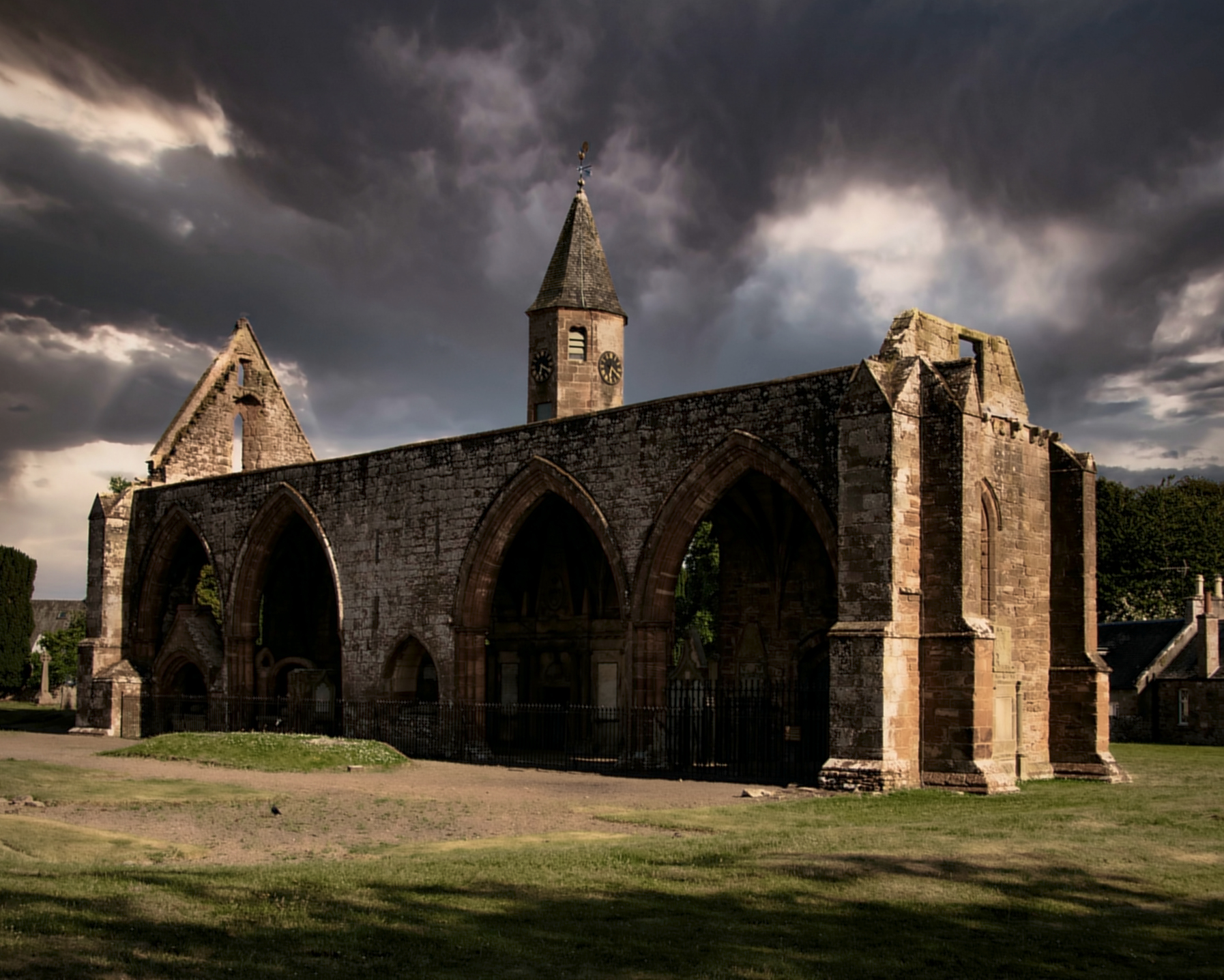
Fortrose Cathedral now stands in ruins. However, according to local folklore a different cathedral once stoon in its place. Fortrose lies on the northern side of the Moray Firth, while the county of Moray lies to the south. The main administrative town of Moray is Elgin, which also has a Cathedral that lies in ruins—a once very grand and magnificent cathedral. But, in the folk tales of Fortrose the grander cathedral was built in Fortrose. The Elgin faeries were jealous.
One night, they built a causeway across the Moray Firth, stretching from Ardersier in the South to Chanonry Point on the Black Isle. The cathedrals were swapped round and most of the causeway destroyed when the sun rose, leaving behind two jutting pieces of causeway. These are the promontories at Ardersier and Chanonry Point. The Gaelic word for a headland is ros hence the names Fortrose and also nearby Rosemarkie.
The legend of Fortrose and Elgin Cathedral
Another version links myth to the landforms of Chanonry Point and Ardersier. The scholar and magician Michael Scot, so the story says, summoned fairies and struggled to send them away. They were a hardworking group and demented Scot with their pleas for work. Unable to tolerate their demands any longer, he set them a task that was sure to occupy a lot of time. Therefore, he set them to build a causeway across the Firth.
The fairies worked through the night with tiny spades and carts. However, a man from Rosemarkie saw their labour and called, ‘That’s a grand job you’re doing. God bless ye, little men!’. At the mention of God’s name, the spell broke at once. The fairies fled, leaving the bridge unfinished. In some tales, it is said that the faeries now hide in Rosemarkie’s Fairy Glen.
Fortrose, Rosemarkie and an older sacred landscape
Fortrose’s origins are closely tied to Rosemarkie, a place with a much older Christian identity.
Archaeological work near Fortrose has identified domestic activity from the Neolithic to the Early Bronze Age, including evidence of cereal production, wild-resource gathering and changing burial customs.
Recent reviews of historical documents have altered the location of the Pictish Kingdom of Fortrui. It is now thought to have centred on the low-lying and fertile areas of the Moray Firth along both the Southern and Northern Seaboards. It is important to remember that Scotland was a very different place in the past. Forests have been cut, sea lochs have silted over, boggy ground has been drained, roads and rivers have been built. The East coast of Scotland is cut by huge inlets of sea known as firths. The largest of these is the Moray Firth, which in turn is further divided into the Beauly, Cromarty and Dornoch Firths. Imagine a time with little or no bridges. Travel by boat was one of the quickest ways of transport. Naturally, settlements grew up where sea passages were narrowest. The early Christians established many of their monasteries along these sea routes.
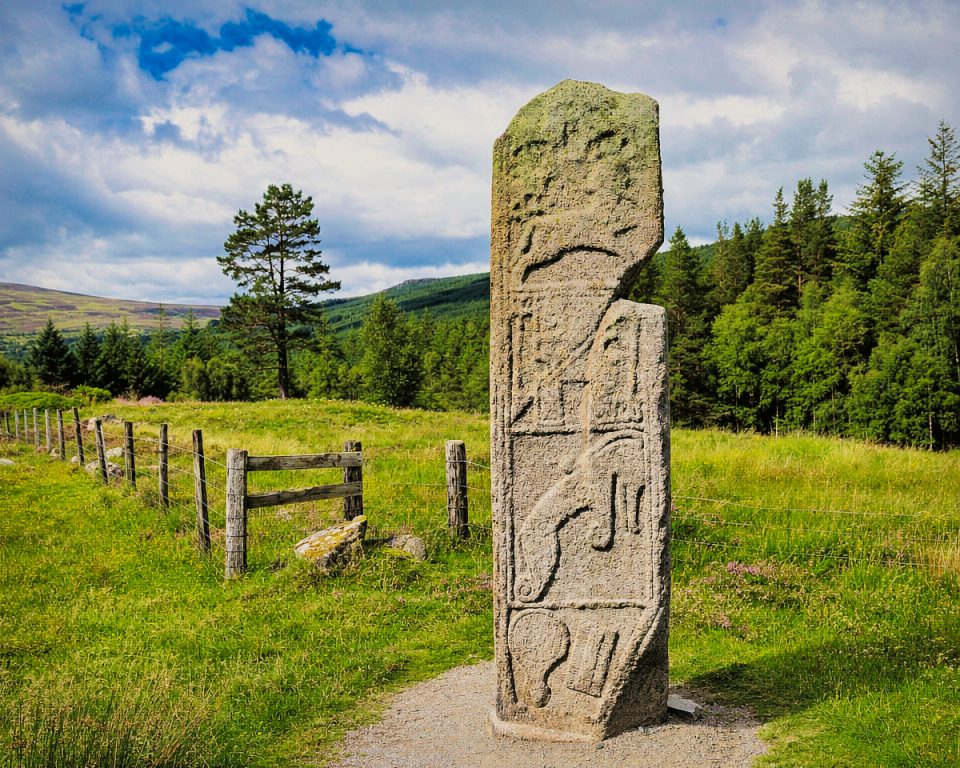
Thus, early Christian saints established communities in Rosemarkie. St Moluag of Lismore is said to have brought Christianity to the area in the sixth century. St Boniface, also known as Curetan or Curadan, is traditionally associated with a church or monastery at Rosemarkie in the early eighth century. A collection of Class II Pictish stones shows that there was an extensive Christian presence in the area around Rosemarkie.
By the early twelfth century, Rosemarkie appears to have been the cathedral centre of the diocese of Ross. The see later moved to Fortrose, then known as Chanonry.
Chanonry: the town of the canons
Before it became widely known as Fortrose, the settlement was called Chanonry of Ross. Its Gaelic name, A’ Chananaich, means “place of the canons”.
The name came from the secular canons who served the cathedral. However, these were clergy, unlike the monks of the early Christian church, and they lived in manses around the Cathedral Green. Their presence would shape the town’s identity for centuries.
Bishop Robert of Ross, who held office from 1214 to 1249, is associated with moving the cathedral from Rosemarkie to Fortrose. The thirteenth-century cathedral became the centre of a small but significant diocese.
At its height, the cathedral chapter included 21 canons. It also had vicars, chaplains, clerks and the wider household of a bishopric. Fortrose was never one of Scotland’s wealthiest cathedral towns. Nevertheless, its church was built with exceptional ambition.
The original cathedral included a nave, choir, aisles and a two-storey chapter-house range. Much of the building survives only as buried foundations. These are now marked out in the cathedral grounds.
However, the Bishop’s Palace, the canons’ manses and the streets of medieval Fortrose have largely disappeared.
Euphemia of Ross and Walter Leslie’s chapel
The finest surviving part of Fortrose Cathedral is its south aisle and chantry chapel. This elegant late medieval extension is traditionally linked to Euphemia, Countess of Ross. It is likely that Euphemia had this built in memory of her first husband Walter Leslie. Eupmemia was a powerful woman in Medieval Scotland.
She was the daughter and heir of Uilleam III, the last O’Beolan Mormaer of Ross. Alas, this made her a political pawn. King David II wished to reward Walter de Leslie with an earldom. To secure this, the king compelled him to wed Euphemia.
They married by papal dispensation in 1366 or 1367. This was required because Leslie had previously had an illicit relationship with a woman related to Euphemia within the prohibited degree of kinship. After her father’s death, the Earldom passed to Euphemia and Walter. Then Walter Leslie died in 1382.
It is interesting that Euphemia had the chapel built in memory of her husband, given the background of their marriage. Perhaps the couple were able to find love in their relationship. The Chapel was probably intended to be a place where prayers could be said for their souls.
Unhappy Second Marriage
One thing is certain: Euphemia’s second marriage was unhappy. Within months of Leslie’s death, she was wed to Alexander Stewart, the notorious Wolf of Badenoch. Stewart had been continually expanding his territories in the north. The Earldom of Ross would have been the jewel in his crown. However, when Euphemia bore him no children, he promptly installed his mistress into his lair at Lochindorb. The marriage was dissolved by papal authority in 1392.
The chapel is remarkably refined for a relatively modest diocese. Its stone vaulting, window tracery and sculptural detail have long attracted attention. Historic Environment Scotland notes similarities with Elgin Cathedral and considers it possible that the same masons worked at both sites.
Inside the south aisle are three impressive canopied tombs. One belongs to Euphemia. The other two are traditionally associated with the bishops John Fraser and Robert Cairncross.
Later, the aisle became a burial place for the Mackenzies of Seaforth. Their memorials connect the ruined cathedral to the family who dominated the area after the Reformation.
The Reformation and the ruin of Fortrose Cathedral
The Scottish Reformation of 1560 changed Fortrose permanently. The cathedral declined through a long process of religious change, removal of materials and neglect.
The building remained partly in use for worship after 1560. However, in 1572 Lord Ruthven received a grant of the lead from the cathedral roof. Without its protective covering, the medieval fabric became increasingly vulnerable to weather.
Charles I later urged repairs in 1626. By then, the cathedral had already suffered serious damage.
Local tradition often blames Cromwell’s soldiers for carrying away stone to build the citadel at Inverness. This may contain some truth, but it cannot explain everything. Historic Environment Scotland treats Cromwell’s removal of masonry as tradition rather than certain fact.
The cathedral’s destruction was likely more gradual. Roof lead was removed. Stone was reused. Weather damaged the exposed walls. Local people also took masonry from the decaying building for their own houses.
The Community Council records further local stories, including Mackenzies camping in the steeple and a fire caused by the third Earl of Seaforth while shooting pigeons.
After the Reformation
The chapter-house was turned into a tolbooth. Its ground floor was used as a prison, while the upper level served as a council chamber and courthouse. Over the centuries, it also functioned as a chapel, school and Freemasons’ Lodge.
Chanonry Point: pilgrims, ferries and dolphins
A mile beyond Fortrose, Chanonry Ness reaches into the Moray Firth. It shelters Fortrose and Rosemarkie while facing the headland of Ardersier and Fort George.
For centuries, this was a place of crossings. Pilgrims, clergy, merchants, soldiers and local people travelled across the Firth by ferry. The route was especially important for those travelling towards Tain and the shrine of St Duthac.
Tradition holds that King James IV used this route during his repeated pilgrimages to Tain. He is said to have crossed the Firth and paused at Fortrose Cathedral and Rosemarkie’s shrine of St Boniface.
The Point also supported salmon fishing. The eighteenth-century Statistical Account described salmon caught at Chanonry as fresh from the sea and in “their highest perfection”. Fishing families and ferrymen lived near the Ness, while an ice house preserved the catch.
The ferry remained important into the twentieth century. It carried passengers, goods and soldiers from Fort George. During the First World War, it even transported laundry from the garrison for washing at Rosemarkie.
Chanonry Lighthouse was built in 1846 by Alan Stevenson, part of the famous Stevenson lighthouse family, related to the author Robert Louis Stevenson. It still stands near the end of the Point.
Today, Chanonry Point is best known for wildlife. It is one of the most popular places in Scotland to watch bottlenose dolphins from shore. Sightings are never guaranteed, but a rising tide often brings dolphins closer as they follow fish through the current.
The Brahan Seer and the Mackenzie prophecy
Fortrose is closely tied to the legend of the Brahan Seer, Coinneach Odhar Fiosaiche, or “Brown Kenneth the Seer”.
According to Highland tradition, Coinneach Odhar served Kenneth Mackenzie, third Earl of Seaforth, at Brahan Castle. His gift of second sight made him respected, but it also made him dangerous.
The best-known story claims that the Countess of Seaforth asked him why her husband remained so long in France. Coinneach Odhar allegedly described the Earl kneeling before a French woman. Humiliated, the Countess had him accused of witchcraft.
The story says that he was tried at Fortrose and burned on Chanonry Ness in a barrel of tar studded with spikes. A memorial stone near the lighthouse commemorates the alleged execution.
However, there is no contemporary documentary evidence that confirms the standard seventeenth-century account of the Seer’s life or death. There is evidence of a Coinneach Odhar accused of witchcraft in 1577, but it is unclear whether he was the same man later remembered in legend.
The last witch allegedly executed in Fortrose was Epach of Drunderfit. Folklore suggests she held the parish of Munlochy in a state of terror, reportedly traversing the bay in nothing more than a ‘lippie measure’—a small wooden basin typically used to hold a quarter-peck of grain.
The Black Isle Combination Poorhouse
The darker side of Victorian Fortrose survives at the Ness in the former Black Isle Combination Poorhouse.
The Poorhouse opened in 1861, following the Scottish Poor Law reforms of 1845. “Combination” meant that the institution brought together a poorhouse, hospital and asylum-related functions.
Its residents included people described at the time as destitute, unemployed, elderly, ill or mentally unwell. The building was run by a governor and matron, under the authority of the Inspector of the Poor.
It is hard to imagine the conditions of the Poorhouse or how destitute people became before taking up residence there. The regime was strict. Families were separated into male and female wards. Residents could not leave without permission. Conversation in the dining hall was forbidden. Punishments included solitary confinement on bread and water.
Entering the Poorhouse carried deep social shame. Local tradition says that some new residents were brought by cart beneath straw, hidden from the eyes of neighbours.
The final governor and matron left in 1939. During the Second World War, the remaining residents were moved to Easter Ross and the building was taken over by the military.
The former Poorhouse is now converted into flats known as Ness House. Its present appearance is calm and dignified. However, its history reveals the hard realities faced by people with no other means of support.
Fortrose: a cathedral town in the shadow of the Firth
Fortrose is now a small, picturesque village on the edge of the Black Isle. However, it was once an important religious and political hub. It serves as a reminder that much of Scotland’s history took place beyond Edinburgh and the Central Belt and that once, the north had a thriving population.
Sources and further reading
- Fortrose and Rosemarkie Community Council: Fortrose
- Historic Environment Scotland: Fortrose Cathedral
- Gazetteer for Scotland: Fortrose
- Michael Barrett, Footprints of the Ancient Scottish Church (1914)