December in Scotland is where politics, prophecy, and midwinter ritual collide. To begin with, the month opens on the brutality of the North Berwick Witch Trials, with Geillis Duncan’s execution in Edinburgh. Meanwhile, Mary, Queen of Scots dominates the early winter timeline, from her birth at Linlithgow to the Craigmillar Bond and the shadow of Darnley, where court politics starts to look like premeditation.
However, December is not only about crowns and courts. The Jacobite drama peaks at Derby and then snaps into retreat, while the Covenanter shipwreck off Orkney turns imprisonment into mass death. Later, the season shifts into older patterns as well, because the Winter Solstice, the Daft Days, and Hogmanay pull the calendar toward fire, inversion, and survival. Finally, December ends in modern unease: the Stone of Destiny theft, the Flannan Isles mystery, and the Tay Bridge disaster, all of which prove that Scotland’s winter stories do not need embellishment to feel haunted.
4 December 1591: Geillis Duncan is executed as a witch at Castlehill in Edinburgh. Her death closes a long, harrowing passage through the Scottish legal system, and she remains central to the North Berwick Witch Trials.
4 December 1745: Charles Edward Stuart and the Jacobite army reach Derby. In London, only about 150 miles south, panic spreads and George II is said to be preparing to flee. What looks like a breakthrough will soon become retreat.
5 December 1560: King Francis II of France dies from an infected ear. He was Mary, Queen of Scots’ husband, and is succeeded by his brother Charles IX. Mary’s position in France weakens at exactly the wrong moment.
7 December 521: Saint Columba is born in what is now County Donegal, Ireland. His later influence on Iona and early Scottish Christianity is hard to overstate.
7 December 1545: Henry Stuart, Lord Darnley, is born at Temple Newsam in Yorkshire. He will become Mary, Queen of Scots’ second husband, and his presence in Scotland will bring instability rather than strength.
7 December 1566: Mary, Queen of Scots leaves Craigmillar Castle after her advisers agree the Craigmillar Bond. The plan targets Lord Darnley, who has become politically impossible. From here, the path to murder starts to look organised.
8 December 1542: Marie de Guise gives birth at Linlithgow Palace to Mary, Queen of Scots. Scotland is already divided by power and faith, so Mary’s life begins under threat.
10 December 1679: The ship carrying Covenanter prisoners sinks off the coast of Orkney. Only 48 survive, and the rest are lost to sea and winter. The disaster becomes one of the bleakest episodes after Bothwell Brig.
20 December 1745: After reaching Derby, the Jacobite army retreats into Scotland. The decision fractures confidence and exposes the limits of the rising.
20 December 1862: Robert Knox dies in London. He was the Edinburgh surgeon and anatomist whose name was ruined by his links to Burke and Hare. His reputation never truly recovers.
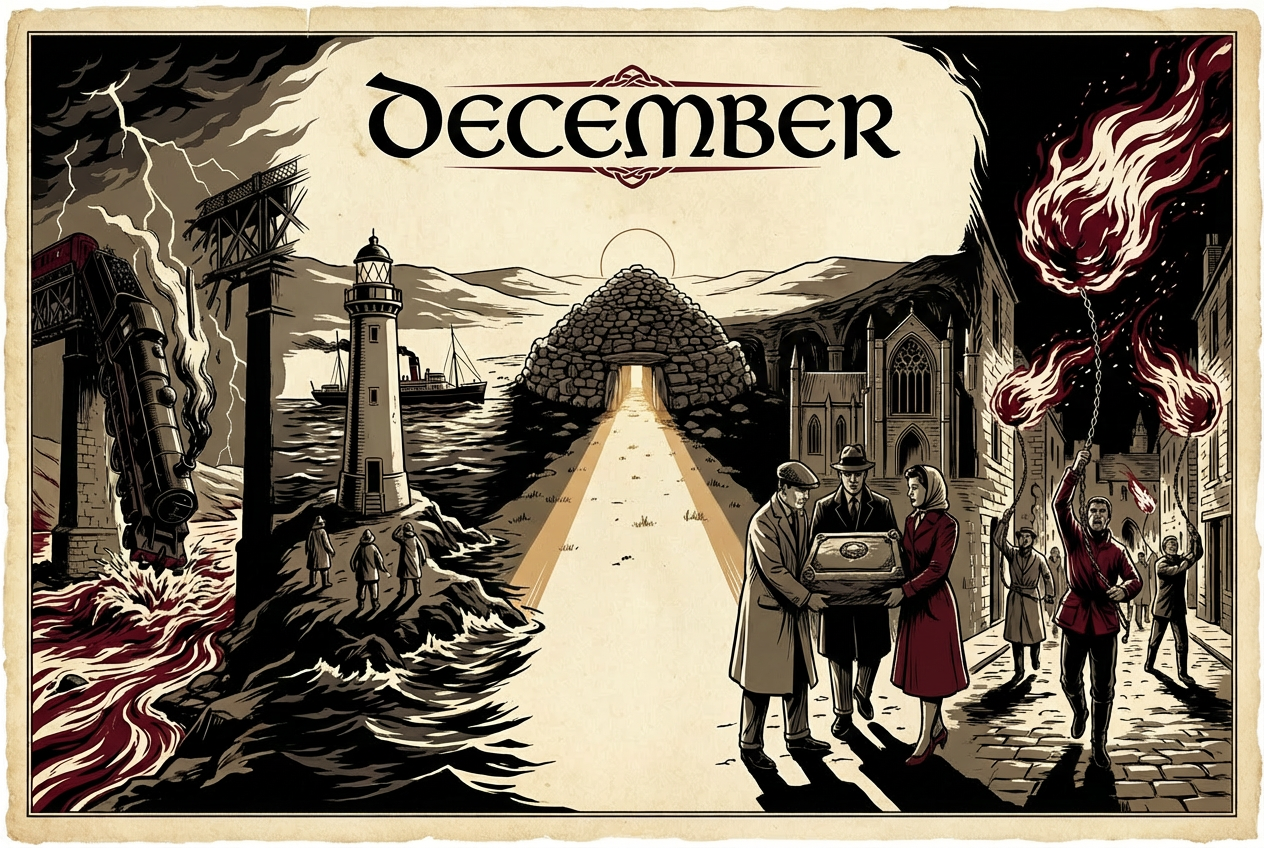
21 December 2026 @ 20:50 GMT: Winter Solstice, the year’s longest night. Sites such as the Clava Cairns and Maeshowe are aligned to midwinter light, which keeps the focus on prehistoric skill and seasonal ritual.
22 December: St Maik’s Day is associated with a Nine Maidens motif. The detail sits neatly beside other “nine” patterns in Scottish sacred landscape and folklore.
25 December 1950: The Stone of Destiny is stolen from Westminster Abbey by Scottish Nationalists. The theft happens on Christmas Day, turning a holy date into a political stage.
25 December–6 January: The Daft Days, or the twelve days of Yule, run through to Epiphany. Traditionally, this is a time for merriment, misrule, and sanctioned excess.
26 December 1251: Ten-year-old Alexander III marries Princess Margaret, daughter of Henry III of England, in York. It is a political marriage, binding two kingdoms through child royalty.
26 December 1900: The Hesperus reaches Eilean Mòr on the Flannan Isles. The lighthouse keepers have vanished, leaving a mystery that still chills the imagination.
28 December 1734: Rob Roy MacGregor dies at his home in Balquhidder Glen. His legend settles into that uneasy space between outlaw and folk hero.
28 December 1879: A passenger train from Burntisland to Dundee starts crossing the first Tay Rail Bridge during a storm. Within minutes the central high-girder section collapses, and everyone aboard is lost. The Tay becomes a site of national mourning.
31 December: Hogmanay is celebrated across Scotland with street parties, ceilidhs, and torchlit processions. Edinburgh’s torchlight parade and Stonehaven’s fireballs are among the most iconic images of the night.
Christmas 1644: The plague arrives at Leith, likely brought in by ship. It soon spreads to Edinburgh.