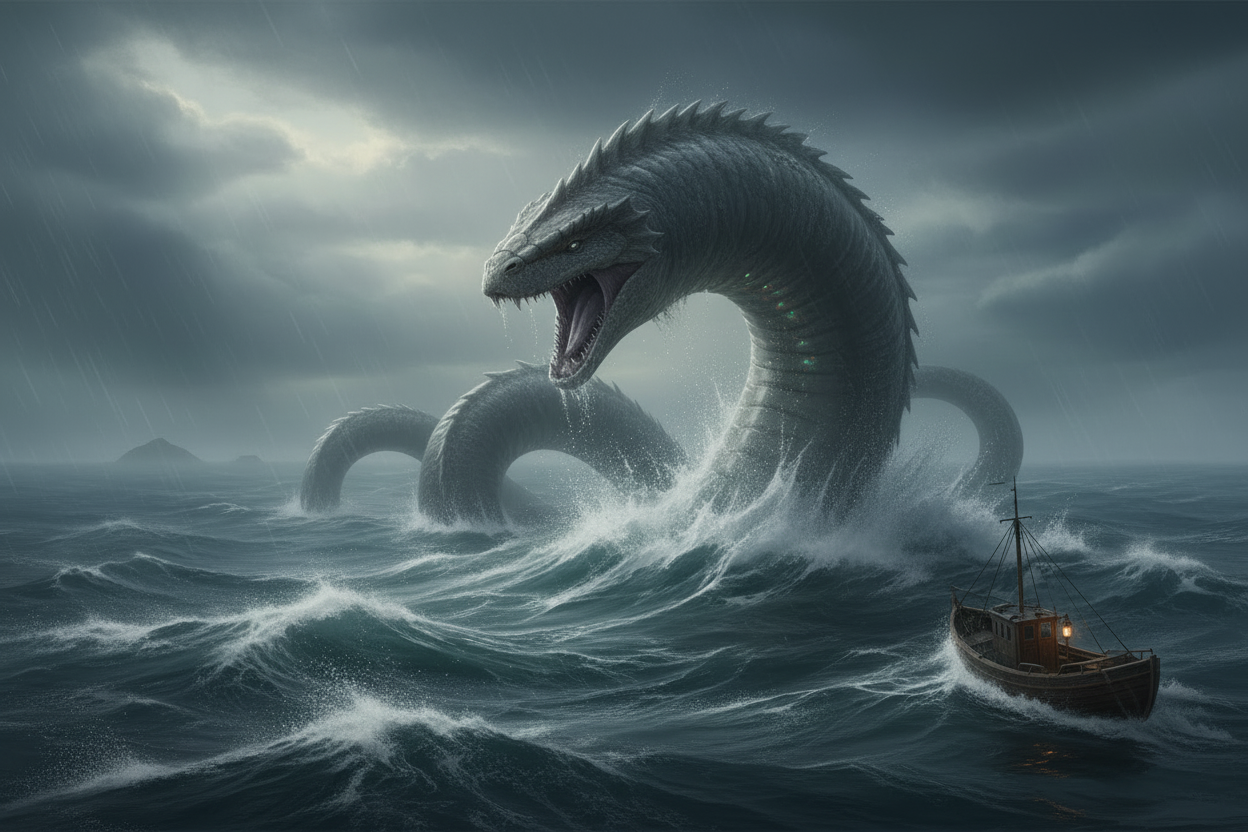
Cireinn-croin is widely considered the largest animal to have ever existed in the world according to Scottish Gaelic folklore. Consequently, its name has become synonymous with the terrifying and untamable power of the North Atlantic. While many cultures have legends of sea serpents, the Gaels believed this specific monster was so vast that it could encircle the entire globe. Because it represents the ultimate predator, it remains a central figure in the maritime mythology of the Highlands and Islands.
Name:
Cireinn-croin
Also known as: Ceirean, Cionarain-crò, Mial mhòr a’ chuain (Great beast of the ocean), Cuartag mhòr a’ chuain (Great whirlpool of the ocean), or Uile-bhéisd a’ chuain (Monster of the ocean).
Name pronunciation:
The name is generally pronounced as keer-en krown in Scottish Gaelic.
General Information:
This legendary creature is a massive sea monster that appears frequently in the oral traditions of the Scottish Highlands and the Hebrides. According to popular rhymes, the beast was so immense that it required seven whales to satisfy its hunger. Therefore, it sits at the very top of the ocean’s food chain, surpassed only by the devil himself in some Caithness traditions. Some scholars connect its origins to the Midgard Serpent of Norse mythology, suggesting it was once a force that encircled the world.
Appearance:
Most accounts describe the animal as a giant sea serpent or a dragon-like creature of staggering proportions. Alexander Robert Forbes once suggested that the monster might actually be a prehistoric dinosaur, specifically comparing it to the hundred-foot-long Atlantosaurus. It possesses an “awful aspect” that strikes terror into any sailor who glimpses its true form through the mist. However, it often hides its terrifying appearance behind a clever magical mask to lure its prey.
Habitat:
The monster lives in the cold, dark depths of the sea off the coast of Scotland. It specifically haunts the treacherous waters where fishermen cast their nets, such as the Minch or the stormy Atlantic reaches. Since it requires such a vast amount of food, it likely stays in areas where whales and seals are plentiful. The deep, lightless trenches of the ocean provide the perfect hiding place for such a gargantuan predator.
Behaviour:
The creature is a cunning and patient predator that uses trickery to hunt its meals. Although it can easily devour seven whales, it also enjoys the sport of hunting humans. It waits silently for unsuspecting boats to cross its path before striking. Because it is so large, it must consume massive quantities of life to maintain its energy, making it a constant threat to all marine creatures.
Shape-shifting Ability:
Cireinn-croin can disguise itself as a small, silver fish to deceive local fishermen. It takes this diminutive form to tempt sailors into bringing it aboard their vessels. Once the fisherman catches the silver fish and pulls it onto the deck, the monster reverts to its true, massive form. It then destroys the boat and devours the crew in a single, violent moment.
Variant:
Different regions use various names for the beast, and some versions rank it differently in the hierarchy of monsters. In Caithness, a variation of the famous rhyme claims that seven Cireinn-croin are required to fill the “big devil himself.” Other accounts suggest it may have originally been a sentient whirlpool, a “cuartag mhòr,” that swallowed ships whole.
Location in Scotland:
The Isle of Skye and the coast of Caithness are primary locations for these legends. Specifically, a man named Kenneth Morrison from Trithion on Skye shared detailed accounts of the beast in the mid-19th century. The waters around the Hebrides remain the most common setting for these terrifying encounters with the “great beast of the ocean.”
Stories/ Sightings or Experiences:
The Fatal Silver Prize
A common story tells of a lone fisherman who spotted a beautiful, shimmering silver fish in his nets. He believed he had found a rare prize and quickly pulled it onto his wooden deck. Suddenly, the tiny fish began to grow at an impossible speed, its scales turning into dark, leathery hide. Before the man could scream, the monster crushed the boat and swallowed him whole, leaving only splinters on the waves.
The Measure of the Beast
An old Gaelic rhyme was used to describe the terrifying scale of the Cireinn-croin’s appetite. The verse builds in careful stages, moving from the smallest fish to the greatest monster of the sea. In doing so, it places the Cireinn-croin at the very peak of the natural and supernatural order.
Gaelic:
Seachd sgadain, sàth bradain;
Seachd bradain, sàth ròin;
Seachd ròin, sàth muc-mhara;
Seachd muc-mhara, sàth Cìrein Cròin.
English:
Seven herrings are a salmon’s fill;
Seven salmon are a seal’s fill;
Seven seals are a whale’s fill;
Seven whales are a Cireinn-croin’s fill.
In some traditions, particularly those recorded in Caithness, the rhyme continues further. It claims that even the Cireinn-croin is not the final measure of appetite, stating that seven of these monsters would be required to fill the Devil himself. This addition reinforces the creature’s near-cosmic scale and its role as a symbol of the sea’s limitless and devouring power.
Purpose of the myth or Legend:
The legend likely served as a vital warning about the unpredictable and deceptive dangers of the sea. It taught fishermen that even a small, harmless-looking catch could lead to total disaster. Additionally, it provided a mythological explanation for the mysterious disappearances of boats during sudden storms or whirlpools. By personifying the ocean’s dual nature, the Gaels could better respect the beautiful yet deadly waters that sustained their lives.