Name pronunciation:
Khoo-nyak (Scottish Gaelic: [ˈkʰɯːɲak])
General Information:
Caoineag is a Highland death-omen spirit in Scottish folklore, often described as a type of banshee. Her name means “weeper”, and it links to Gaelic words for weeping and mourning. Moreover, she is usually invisible, so people know her by sound rather than sight.
Traditionally, each clan had its own Caoineag. If you heard her keening at night, you might ask, “Co tha siad?” (“Who is that?”). The reply, in tradition, is “Co ach Caoineachag, co ach Caoineachag bheag a bhroin” (“Who but Caoineag, who but little Caoineag of the sorrow”).
In several accounts, the Caoineag belongs to the Fuath, a class of hostile Highland spirits linked to water places. However, she does not bargain like some other death portents. Unlike the bean nighe, the Caoineag cannot be approached, questioned, or made to grant wishes.
Key sources include Alexander Carmichael’s Carmina Gadelica (late 19th century collecting) and Edward Dwelly’s Gaelic dictionary, which discusses related spellings and meanings.
Appearance:
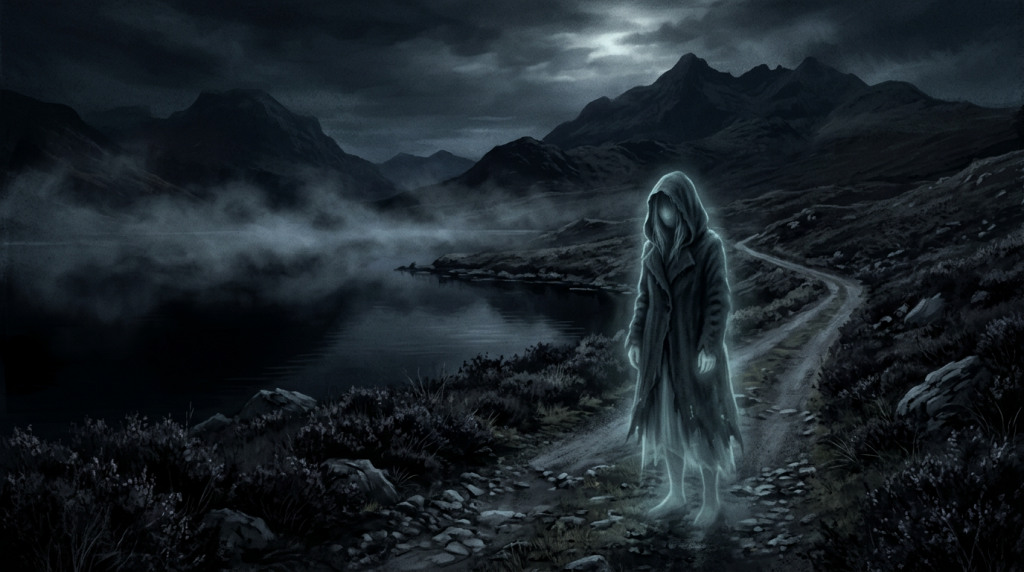
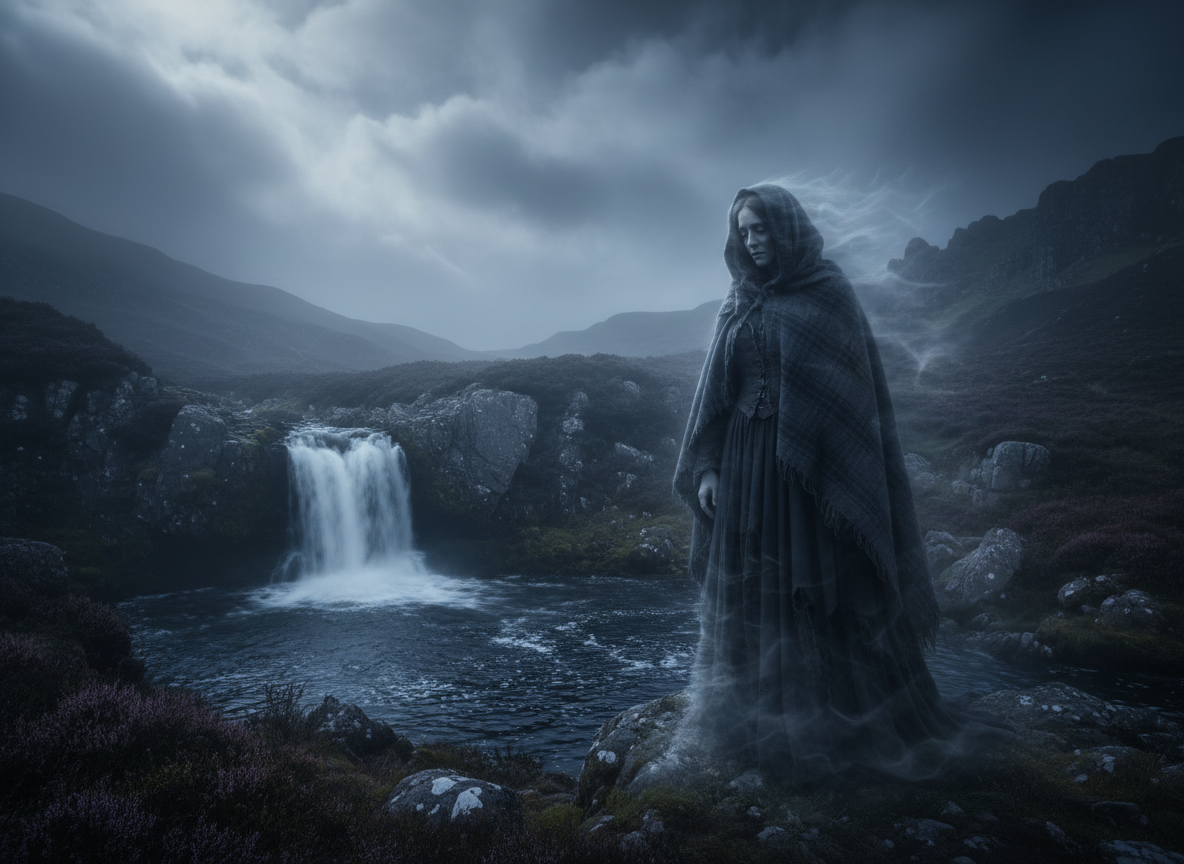
Most often, the Caoineag is described as invisible. Therefore, she is “heard” more than “seen”. Still, some tellings allow a fleeting, mist-like figure, as if made from fog and dim light. In any case, she is not presented as a detailed, bodily creature with fixed features.
Habitat:
The Caoineag manifests near natural features. For example, she may cry at a waterfall, stream, lochside, in a glen, or on a mountainside. As a result, she feels tied to Highland landscapes, especially places where water carries sound.
Behaviour:
The Caoineag foretells death by lamenting at night. Her keening functions as a warning, yet it does not offer a way to prevent what is coming. Additionally, Carmichael reports that her mourning especially presaged deaths in battle, which increased fear among families with sons going to war.
Her cry is not framed as an attack. Instead, it is a grief-signal that tragedy is close.
Shape-shifting Ability:
No clear shape-shifting ability is consistently reported. However, her invisibility and occasional mist-like descriptions can make her seem changeable. Even so, the tradition emphasises her role as an omen rather than a transformer.
Variant:
The Caointeach is a closely related death spirit, especially in Islay traditions. Unlike the usually unseen Caoineag, the Caointeach may appear outside a sick person’s home wearing a green shawl and lamenting at the door.
Some stories say she can be banished if given clothing, which resembles “gift-banishment” tales found in brownie folklore. Edward Dwelly also lists caointeach as a spelling alternative and defines it as a “female fairy or water-kelpie”, which shows how these terms blur across regions and sources.
Location in Scotland:
- The Highlands in general, especially near lochs, burns, and waterfalls
- Glencoe, through the MacDonald tradition linked to the 1692 massacre
- Islay, particularly the Rinns of Islay, through MacKay clan folktales and the Caointeach variant
Stories/ Sightings or Experiences:
1) The Keening Before the Massacre of Glencoe
In accounts recorded by Alexander Carmichael, the Caoineag of Clan MacDonald was heard night after night before the Massacre of Glencoe in 1692. Consequently, fear spread through the glen. Some people, stirred by the sound, left Glencoe before the soldiers arrived and so escaped.
Carmichael also collected fragments of the dirges attributed to the Caoineag, including:
“Little caoineachag of the sorrow
Is pouring the tears of her eyes
Weeping and wailing the fate of Clan Donald
Alas my grief that ye did not heed her cries”
“There is gloom and grief in the mount of mist
There is weeping and calling in the mount of mist
There is death and danger, there is maul and murder
There is blood spilling in the mount of mist”
2) The MacKay Caoineag at the Windward Door (Rinns of Islay)
A MacKay tradition from the Rinns of Islay says the Caoineag would stand outside the door of a seriously ill person and shriek her wail. Therefore, the household understood death was near, and they should make peace while they could.
In one telling, a family member felt pity for the mournful spirit. So he went out by the leeward side, laid down a plaid for shelter, and then called to her to come to the sheltered side and cover herself. At once, the weeping stopped. After that night, the Caoineag was not heard again in the Rinns, as if the offered clothing ended her connection to the place.
3) The Caointeach in Green, and the Danger of Interruption
In some Islay accounts, the Caointeach appears in a green shawl and laments outside a sick person’s house. However, she is not always harmless. If someone interrupts her, some versions warn she may strike at a person’s legs with wet linen, and the victim may lose the use of them. This detail makes her feel more forceful than a simple warning voice, even though her main role remains a death portent.
Purpose of the myth or Legend:
The Caoineag legend gives shape to grief, risk, and uncertainty, especially in a clan society marked by illness and warfare. Furthermore, it provides a cultural language for dread that families could not otherwise control.
It also reinforces the idea of place. Since the Caoineag cries at burns, lochs, and glens, the landscape becomes part of how people interpret fate. Finally, the Glencoe tradition shows how the myth can attach itself to historical trauma, preserving communal memory through story as well as through record.