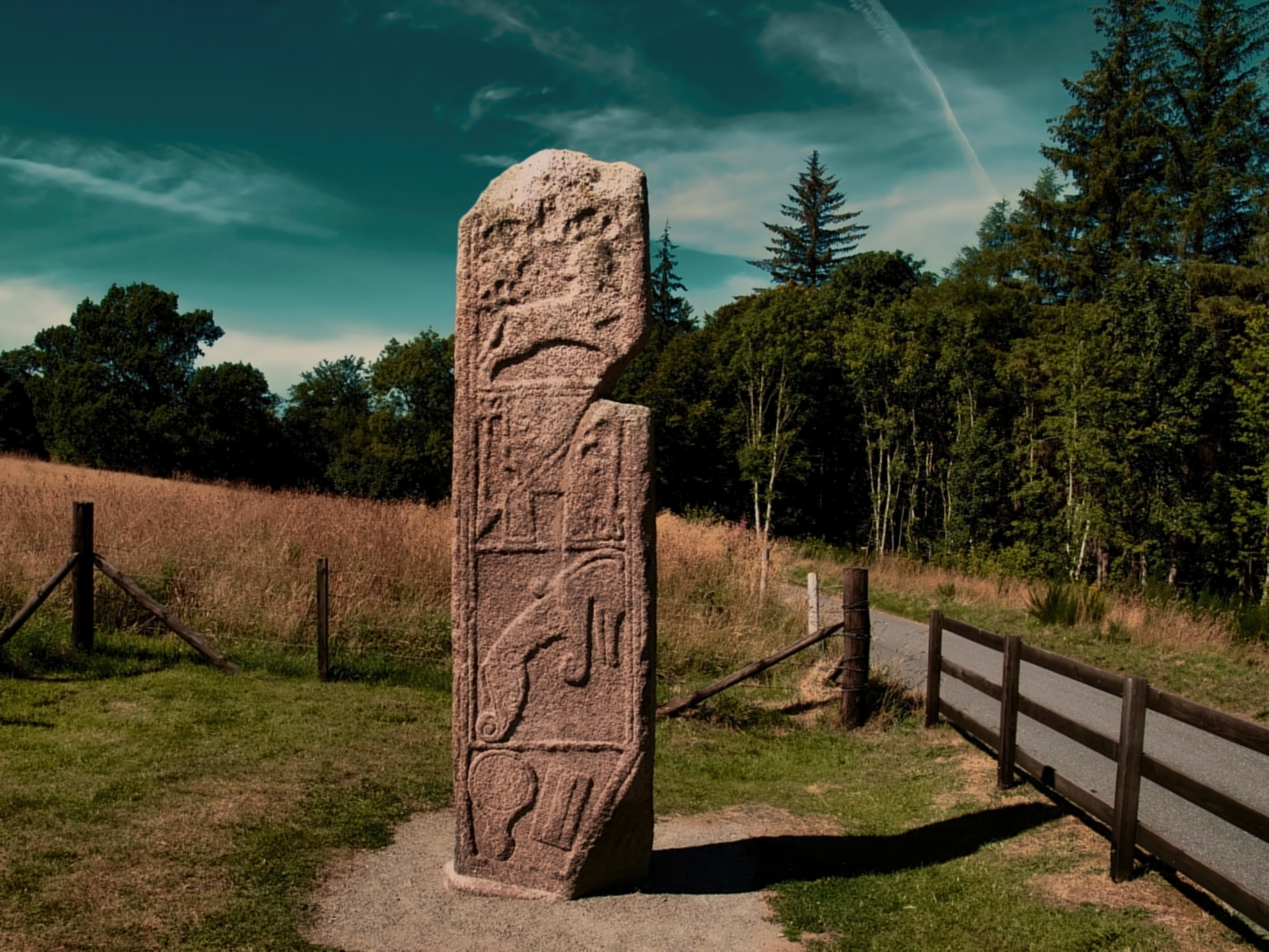
Picts in Scotland remain one of the most mysterious peoples in early British history. My first encounter with them came in childhood, when I visited Sueno’s Stone on the outskirts of Forres. Nowadays, it is protected in a glass case, but back then, it was exposed to all the elements. I didn’t know it then, but that carved pillar would become my doorway into the mysterious and fragmentary world of the Picts. There is an element of mystery surrounding the Picts. They have left no written records of their own. They have left carved stones with symbols whose meanings have long been lost. Recently, archaeology has made substantial advances in the art, settlement and material culture of the Picts. However, there are still vast gaps in our knowledge about their lives. This makes the Picts absolutely fascinating to study.
Sueno’s Stone
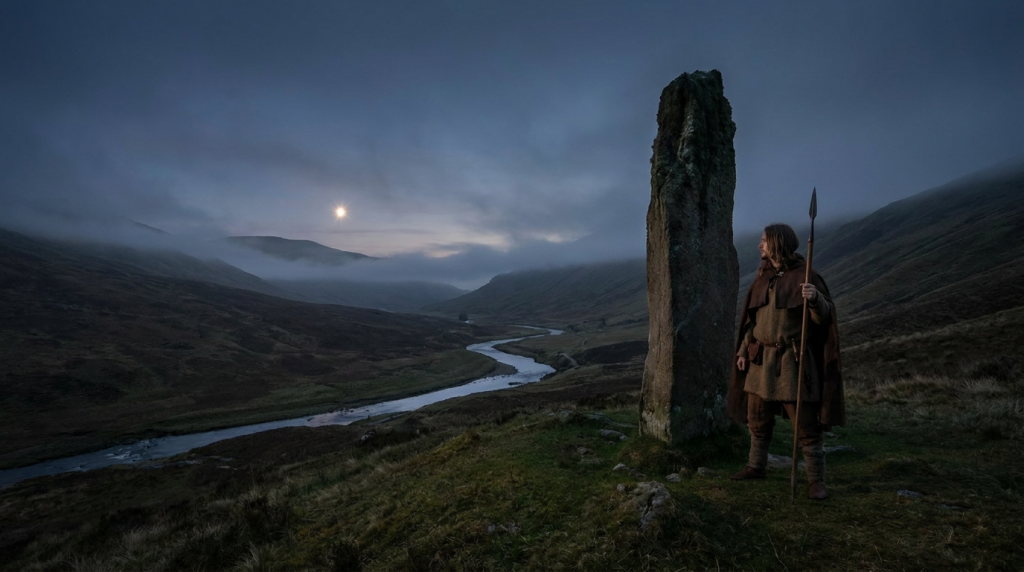
Sueno’s Stone is the largest of the surviving Pictish Stones, standing at 6.5 metres high. It is a cross slab. On one side, there is a cross, while on the other is a battle scene, including mass decapitations. There have been many suggestions about who is depicted in the battle scene. Some say it is Kenneth MacAlpin, the first King of both Picts and Scots, others that was raised to commemorate Dubh or Dub mac Malcolm of the House of Alpin, who is said to have been murdered in Forres. Other suggestions have included that it could be Maelbrigte the Tooth, which has to be one of the most brilliant tales of karma from Scotland. The Stone takes its name from Sweyn Forkbeard, although it seems unlikely that he had any connection with the stone.
Some people also say that this is the stone is on the site where Macbeth met the three witches. But then Forres has a rich association with witches in the past; from the witching stone at the foot of Cluny Hill to the women who had the misfortune to encounter the witch pricker Christian Caddell.
In many ways, the mystery surrounding Sueno’s Stone mirrors how people see the Picts. To many, mention the Picts, and they immediately conjure up images of naked, tattooed savages that took on the might of Rome.
Who Were the Picts?
The Picts were the descendants of earlier Iron Age communities in northern and eastern Scotland, not a people who appeared out of nowhere in the third or fourth century. Roman writers describe tribes such as the Caledonii raiding beyond the frontier, and many historians see the later Pictish kingdoms as political heirs to these groups. Archaeology supports this continuity, showing how Iron Age societies gradually reorganised into the early medieval kingdoms we call Pictland. A later Pictish origin legend claims they came by sea from distant Scythia in Eastern Europe or Central Asia, echoing Herodotus’s “painted” peoples, but modern scholarship treats this as royal propaganda designed to place Pictish kings within a prestigious classical landscape rather than as literal history.
The name “Pict” itself comes from the Latin Picti, usually translated as “painted people”. It first appears in a Roman speech of 297 CE, used to label hostile groups north of the imperial frontier. Later writers linked the term to body painting or tattooing, and it has sometimes been suggested that the Picts tattooed themselves with woad, although woad is caustic and unsuitable for safe tattooing. No Pictish source confirms exactly what they did to their skin. Two major early medieval churchmen, Adomnán of Iona in his Life of Columba (c. 697) and Bede in his Ecclesiastical History of the English People (731), both adopted the Latin term Picti for the peoples north of the Firth of Forth. They give us royal names, glimpses of politics and stories of conversion to Christianity, but they wrote as outsiders and missionaries, not as Picts describing themselves.
The Timeframe of the Picts
Historians usually define the Pictish period as running from about 300 to 900 CE. Around 300 CE the name Picti appears in the written record and Pictish symbols and elite sites show up archaeologically. By around 900, references to Pictish kings disappear and rulers of Alba take their place; the Annals of Ulster, for example, record the killing of Áed, rex Pictorum (king of the Picts), in 878, after which kings are no longer called Pictish. During these centuries, Pictland stretched north from the Firth of Forth, across much of eastern and northern Scotland and at times out to Orkney, Shetland and the Outer Hebrides.
Early medieval tradition divides this territory into regions such as Fortriu, Ce, Circin, Fib, Fidach, Fotla and Cait, with boundaries constantly reshaped by warfare and alliances. Recent work at Tap O’ Noth, with around 800 surrounding platforms dated between the second and sixth centuries CE, suggests a dense population and a high level of organisation that earlier scholars did not always credit to Pictish society, even though we still do not know what the Picts called themselves in their own language.
A Lack of Written Evidence
For a people who helped shape early medieval Scotland, the Picts left surprisingly few words in their own voice. No Pictish chronicles survive. Gone are their epic poems, origin tales, folk tales or law codes. Like other Celtic peoples, they would have had a strong oral culture. No doubt with the coming of Christianity, they would have had written records, stored in monasteries across Pictland.
But Scotland’s past is dark and muddied by several bloody events, which stripped Scotland of its rich written record. Firstly, Viking raids targeted churches and monasteries as they were repositories for some of Scotland’s greatest riches. Then, as the Dal riatan Kings came to power, there was a gradual linguistic assimilation of Gaelic and the Pictish language was lost. Books written in Pictish may have ben seen as worthless and discarded. Also, the Gaelic-speaking Scots had been a driving force in spreading Christianity, so the church possibly was already leaning towards a more Gaelic-rich language. Any records surviving from the Gaelic switch would have been subsequently lost during the Scottish Wars of Independence and the Protestant Reformation.
What we do have is more fragmentary and more mysterious: carved stones in kirkyards and symbols hewn into sea caves, silver hoards buried in the ground, traces of houses on hilltops, and a scattering of comments from Roman officials and early medieval monks. These different witnesses overlap, contradict one another and leave large gaps.
It is important to remember that Scotland did not exist at this time and that the Picts are only one group that existed north of Hadrian’s Wall.
Pictish Myths and Folk‑Tales
Perhaps it is little wonder that myths and folk tales have grown around the Picts. Their symbol stones, in particular, have attracted a web of stories: that the carvings are secret alphabets, maps of lost treasure, star‑charts, even encoded prophecies. In truth, we do not yet know exactly what the symbols mean, although patterns of pairing and repetition suggest they marked names, lineages or social groups. What is certain is that people living beside these stones in later centuries felt their strangeness. Folk traditions grew up that the stones were raised by giants, or by an older, vanished race with uncanny skills, and that they should be treated with caution or respect.
Some stones have gathered their own, very local myths. The Maiden Stone in Aberdeenshire, a tall cross slab with a ring‑chain and beast symbols, is said in one story to be a girl turned to stone after losing a wager with a stranger who was really the Devil in disguise. A notch on the side of the stone is pointed out as the mark where he grabbed her shoulder as she fled. The Strathmartine Dragon legend, told around a Pictish stone near Dundee, claims that a local hero slew a man‑eating dragon on the Law and that the stone records his feat. In some versions the dragon is a symbol of the old, wild powers of the land, in others it is almost a stand‑in for the Picts themselves, tamed or destroyed by later kings.
Mythical Disappearances and Heather Ale
Other myths are used to explain their disappearance. In one myth, Kenneth MacAlpin was said to have invited the Pictish elite to a feast at Scone. Once the Picts were drunk, the Dal riatans pulled the bolts from the benches they were sitting on. The Picts fell into the pit below and then the killing began.
In other Scottish tales that “older race” becomes a people of small, underground dwellers – not quite fairies, not quite human – sometimes identified with the Picts. They are said to live in mounds or under the heather, emerging at night to work wonders, brew strong drink or mislead travellers. The story of heather ale, best known from Robert Louis Stevenson’s retelling, tells how a father and son of these secretive people are captured by a king who wants the recipe for their powerful brew. Rather than betray their lore, the father tricks the king into killing the son, then throws himself into the sea, taking the secret with him.
It is not history, but it is revealing: by the time these stories were told, the Picts had become, in the popular imagination, a lost people whose knowledge and language had sunk beneath the surface of Scotland, leaving only hard stones and haunting tales behind.
Language and Oral Tradition of the Picts
The Picts spoke Pictish, which most linguists now regard as a Brittonic Celtic language. It probably developed from the same family as early Welsh and Cumbric. The evidence comes mainly from:
- Place names in former Pictish regions
- Personal names preserved in king lists and annals
- Inscriptions in ogham and Roman letters on some stones
Pictish culture probably relied heavily on oral tradition. History, law, folklore and cosmology were likely passed on through formal storytelling, repeated turns of phrase and memorised genealogies rather than in books. That makes the Picts particularly vulnerable to being silenced in the record, because when those chains of memory broke under political and cultural changes, there were no Pictish texts left to speak for them.
However, early Pictish symbols at Dunnicaer and Rhynie in Aberdeenshire, and carved into the Wemyss Caves in Fife, show that a shared symbol system was in use about 1,700 years ago. Nobody knows what these symbols mean. They are found mostly on the carved stones that are found throughout Northern Scotland and on metal artefacts.
Pictish Houses and Buildings
For a long time, archaeologists struggled to say what a “typical” Pictish house looked like. That picture is now changing. Excavations across Pictland, especially in the Northern Isles, the north‑east and parts of Perthshire, reveal a varied and detailed range of domestic architecture.
One of the clearest findings is architectural diversity. There was no single Pictish house type. Building traditions differed from region to region and even within the same valley or coastline. Communities chose different materials and layouts depending on local resources, status and custom. What is apparent is that the Picts abandoned the roundhouses favoured by their Iron Age ancestors. It appears that they were influenced by the Romans when they arrived in Britain. Rectilinear buildings were now in vogue.
Diversity in the Buildings of the Picts
The vast majority of people would have lived in Cruck-style houses made from non-earth-fast timber and turf walls. These materials decay almost completely, leaving only faint archaeological traces. Some of these houses have been identified as byre houses, where people and animals shared a single long building, often in separate but connected zones. At sites such as Lair in Perthshire, long rectangular structures combine living space with an area for cattle, reflecting the central importance of livestock in daily life.
In Caithness, we find Wag houses. At Wag of Forse, these longhouses are pillared and made of stone. Meanwhile, in Buckquoy, Orkney, there are examples of cellular houses made of stone. These comprise a central rectangular area with rectangular cells extending from the central area.
We also see clusters of buildings, rather than isolated farmsteads in the landscape. Groups of structures of different sizes often stand together, hinting at social and economic differences within the same settlement. Larger houses may have been the homes of higher‑status families, with smaller dwellings or outbuildings used by poorer, dependent or specialist workers.
Houses were the centre of Pictish lifeways. Cooking, tool making, weaving, child rearing and the repeated routines of tending hearth and animals all took place there. It was also in and around ordinary dwellings that we find some of the most direct traces of belief: foundation burials, carefully placed animal bones and occasional human remains used to mark the start or end of a building’s life.
Agriculture among the Picts
Agriculture lay at the core of Pictish life. However warlike their neighbours thought them to be, most people in Pictland were farmers, and their ability to grow crops and keep animals underpinned everything else – from local craft production to the power of kings.
Across much of Pictland, the landscape was managed as a patchwork of fields, grazing and rough ground. Communities practised mixed farming, combining small arable plots with pastoralism. Barley and oats were likely the primary cereals, well-suited to the cool, damp climate. Cattle, sheep and pigs made up the bulk of the livestock. Cattle were especially important: they provided meat, milk and traction, but also acted as a key measure of wealth and status, much as in contemporary Gaelic Ireland. To own and control herds was to control one of the main “currencies” of the time.
Agriculture was not limited to fields beside the home settlement. In some regions, people practised transhumance, moving animals seasonally between low‑lying farmland and upland summer pastures. This pattern of movement helped to protect grazing, manage manure and make use of marginal land. It also shaped social life, with part of the community spending weeks or months at seasonal shieling sites, while others remained in more permanent farmsteads or village clusters.
Supplementing Agriculture
Beyond crops and herds, Pictish communities supplemented their diet and economy through foraging, hunting, fishing and the use of woodland. Shellfish, river and sea fish, wild plants and timber all played a role. Yet these activities seem to have complemented, rather than replaced, the central importance of farming. Agricultural surplus gave elites something to demand, store, redistribute and display.
This makes agriculture crucial to understanding Pictish social hierarchy. Rents, tribute and hospitality were likely paid largely in food, animals and labour. Local lords and royal centres depended on the capacity of farming households to produce more than they needed for themselves. In return, those households looked to powerful patrons for protection, judgment and support in bad years. Control over fertile land, grazing rights and access to key resources, therefore, translated directly into political power.
In short, agriculture was not just an economic activity. It shaped the Pictish year and structured movement through the landscape.It framed obligations between people of different ranks, and gave physical substance to ideas of wealth and authority. Without the daily work of tilling, sowing, herding and harvesting, there could have been no Pictish kings, no great forts, and no society for their carved stones to commemorate.
Wealth, Trade and Craft
Elite Pictish centres were not poor hill-forts clinging on at the edge of the world. Archaeology has revealed imported glass and pottery from the Mediterranean and North Africa at high‑status sites. This shows that Pictish rulers’ households were part of long‑distance trade networks that stretched far beyond Britain.
At the same time, Pictish artisans were highly accomplished metalworkers. The brooches, pins and fittings now in museums show complex techniques in silver and bronze, with fine engraving and inlay. These objects are not crude local copies of foreign fashions. They are part of a sophisticated, shared Insular style in which Pictish artists were full participants.
The Picts did not mint their own coins. Wealth and transactions seem to have relied on barter, obligations and livestock, with cattle especially important. Cows were wealth on the hoof, central to farming, feasting and law. At Burghead in Moray there is evidence that cattle were being brought in from considerable distances. They may have been levies or tribute, paid in animals to an over‑king’s centre where they could be slaughtered, feasted on and redistributed.
These were not a backwards or isolated people. It was a set of complex societies where imported luxuries, fine craftsmanship and local agricultural production all supported powerful elites.
Pictish Stones
Carved Pictish stones are the most recognisable legacy of Pictish society and still one of its greatest mysteries. Scattered across eastern and northern Scotland, they range from rough boulders with lightly incised designs to carefully shaped slabs carrying complex scenes. They were clearly meant to be seen in the landscape. Perhaps their purpose was to mark important routes, boundaries, burial sites or places of assembly. Yet the Picts left no explanation of what their carvings meant. Thus, we are left to piece together their purpose from style, context and comparison.
The stones are usually divided into three broad classes. Class 1 stones are unshaped boulders or slabs bearing incised symbols. These symbols frequently occur in pairs. Among the most common are the crescent and V‑rod, the double disc and Z‑rod, and the distinctive Pictish beast. This consistent pairing suggests a structured visual language, though its precise meaning remains elusive.
Class 2 stones typically feature a carved cross on one face. On the other, they carry a combination of symbols, figures and scenes. Pictish symbols, still often arranged in pairs, sit alongside Christian imagery, hunting scenes, processions and sometimes biblical narratives. Together, these show a society expressing new religious ideas while still using its older symbolic language.
Class 3 stones are Christian monuments without the classic Pictish symbols. They are decorated instead with crosses, interlace and figural scenes in line with wider early medieval styles. Taken together, these three classes trace a long arc. We move from a distinctive paired symbol system that we still cannot fully read, through a period of fusion between old symbols and new faith, to a more conventional Christian monument tradition in which the Pictish codes have largely fallen silent.
Belief Before Christianity
Reconstructing pre-Christian Pictish belief is challenging, as no pagan doctrines survive and Christian accounts are inherently biased. However, combining textual and archaeological evidence reveals consistent patterns. Religion appears to have been vernacular, woven into daily life rather than centred on temples. Certain places held strong spiritual significance: rivers, wells, caves, groves, prominent hills and ancient monuments. There were likely ritual specialists, with Adomnán mentioning “magi” at Pictish courts, paralleling druids and seers in Ireland and Britain.
Wells, Caves and Bulls
Several types of sites and objects highlight these beliefs. Sacred water, such as wells and rivers, was often seen as divine or dangerous. Adomnán’s Vita Columbae records Columba blessing such a well and changing it from poisonous to healing. River names like the Don and Dee preserve Celtic elements, meaning “goddess”. This suggests long‑lived river deities.
Caves such as Sculptor’s Cave at Covesea, and the Rosemarkie and Wemyss Caves, contain Pictish symbols and human remains. This indicates that they were charged places, perhaps mediating between different worlds. Human and animal deposits, including skull fragments and infant burials, were sometimes incorporated into houses and brochs in Atlantic Pictland. These may have served as foundation deposits.
Painted pebbles from the Northern Isles may have acted as charm stones. Adomnán’s account of Columba blessing a white stone used for healing at King Bridei’s court hints at similar practices. Bull carvings from Burghead, East Lomond and Inverness, together with the Rhynie Man stone, point to the importance of cattle in ritual and political symbolism. They may be linked to cultic sacrifice and elite ideology. While this evidence does not give us a neat “Pictish religion”, it reveals a world in which landscape, ancestors, animals and powerful individuals all helped to structure belief.
Christianity and the Picts
The adoption of Christianity profoundly transformed Pictland. In particular, it integrated its rulers and communities into international Christian networks across Britain, Ireland and mainland Europe. This led to increased literacy and the use of Latin. It also led to new ways of organising land and resources for churches and monasteries. In the past, scholars thought that Pictish Christianisation was late or half-hearted. Recent work, however, suggests an earlier and more thorough spread of the faith.
Evidence for Christian presence in southern Scotland dates to the fifth century, with Patrick’s Letter to the soldiers of Coroticus even referring to “apostate Picts.” In Northern Pictland, Columba of Iona and his successors were influential missionaries from 563 AD. Other clerics and saints, some probably of Pictish origin, also played major roles. These include Drostan, Talorcan, Gartnait, Serf, Ternan, Máel Ruba, Curetán and others whose cults are preserved in place names and dedications. By the late seventh century, Bede described the Picts as Christian neighbours, with no hint of large, pagan communities.
However, Christianity did not erase older beliefs overnight. Wells, caves and ancient monuments continued to be used in ritualised ways, often within a new Christian framework. This can be seen in early medieval deposits placed into prehistoric monuments at Forteviot and Clava. Pictish Christian sculpture reflects this blending. Cross slabs combine elaborate crosses and biblical scenes with Pictish symbols, hunting scenes, animals and riders. Sites such as Portmahomack, Rosemarkie, Nigg and Shandwick demonstrate that Pictish artists made a distinctive contribution to Insular Christian art, creating stones that were active parts of Christian practice and public memory.
Evidence and Mystery
What we know about the Picts comes from overlapping strands of evidence. Archaeology gives us forts and hilltops such as Burghead and Tap O’ Noth. We have archaeological evidence of barrow cemeteries at Tarradale, Garbeg and elsewhere, symbol stones, churches and monastic enclosures. Recently, the Northern Picts project at the University of Aberdeen has transformed our understanding of how Pictish communities lived. Artefacts add further detail. Silver hoards, brooches and pins, imported glass and pottery from the Mediterranean and North Africa turn up at elite sites. Metalworking debris that shows advanced craft skills. Then there are plough pebbles, pollen and charred seeds, and occasional human remains. Written sources, such as Adomnán’s Vita Columbae, Bede’s Historia Ecclesiastica, Irish annals such as the Annals of Ulster, and later king lists and genealogies, give us names, events and glimpses of politics and belief.
Set against this are deep silences. We still do not know what the Picts called themselves in their own language, or how they described their own kingdoms and people. Their language survives only in scraps of names and a handful of inscriptions. We can place it in the Brittonic Celtic family, but we do not know what everyday spoken Pictish sounded like. The famous symbols carved on stones and into cave walls follow clear patterns and pairs. Many scholars think they formed some kind of emblematic or naming system, yet their precise meaning remains unknown. Many Pictish forts show evidence of burning, but sometimes, we cannot say who set the fires or why. Were they destroyed by rival Picts, by Britons or Northumbrians or by Vikings? Could their own communities have deliberately burned them, to mark an ending?
Conclusion
These gaps are part of the fascination. Every new excavation at places like Rhynie, Portmahomack, Burghead and Tap O’ Noth sharpens a once shadowy picture. But with every question answered comes a host of new questions. The Picts have not vanished. They are present in roadside and kirk‑yard stones, in reworked prehistoric monuments, in the reused occupation layers around former hill-forts, and in the place names still spoken across the north and east. What now emerges is not a marginal, declining people, but a set of organised societies with complex beliefs, rich artistic traditions, international contacts and a lasting contribution to the making of Scotland.