The Battle of Glenlivet has a visitor who is said to appear only once a year. On the anniversary of the fighting, a headless horseman called MacAllister reportedly rides across the battlefield. According to the story, a cannon shot took his head as the battle began.
The battle itself took place on 3 October 1594, high in the hills near Ben Rinnes. George Gordon, Earl of Huntly, and Francis Hay, Earl of Erroll, led a Catholic force against a larger army commanded by Archibald Campbell, Earl of Argyll. Huntly and Erroll won, but their victory did not settle the struggle with King James VI.
Religion, rivalry and the march north
Scotland was officially Protestant after the Reformation, but Catholicism remained strong in parts of the north-east. Huntly protected Catholic worship in his territories. He and other Catholic earls were also linked to approaches to Spain, raising fears about their loyalty to the crown.
James VI had long been reluctant to move decisively against Huntly. However, the discovery of the so-called Spanish Blanks, documents associated with the Catholic earls, increased pressure from the Protestant Kirk. Religion was not the only issue. Feuds involving the Gordons, Forbeses and other northern families also shaped the alliances that formed against Huntly.
In 1594, James authorised a campaign led by Argyll, who was about 19 years old. Argyll’s army drew men from several clans and families, including the Campbells, Macleans, Mackintoshes and Grants. It also included Irish arquebusiers and men from Atholl.
Argyll entered Badenoch and laid siege to Ruthven Castle on 27 September. The castle held out, so he abandoned the siege and marched through Strathspey. By 2 October, he was expecting further reinforcements. Huntly and Erroll knew that waiting would make their position more dangerous. Therefore, they moved to confront him before those additional forces arrived.
The Battle on the slopes of Ben Rinnes
The armies met in a high pass about five kilometres east of Glenlivet. At roughly 410 metres above sea level, it is one of Britain’s highest historic battlefields. The open ground of the pass still gives a sense of the restricted space in which the armies fought.
Argyll had the advantage in numbers. Historic Environment Scotland estimates that his force numbered around 6,000 to 7,000 men. Estimates of Huntly’s army vary, but it was substantially smaller and had a stronger cavalry contingent.
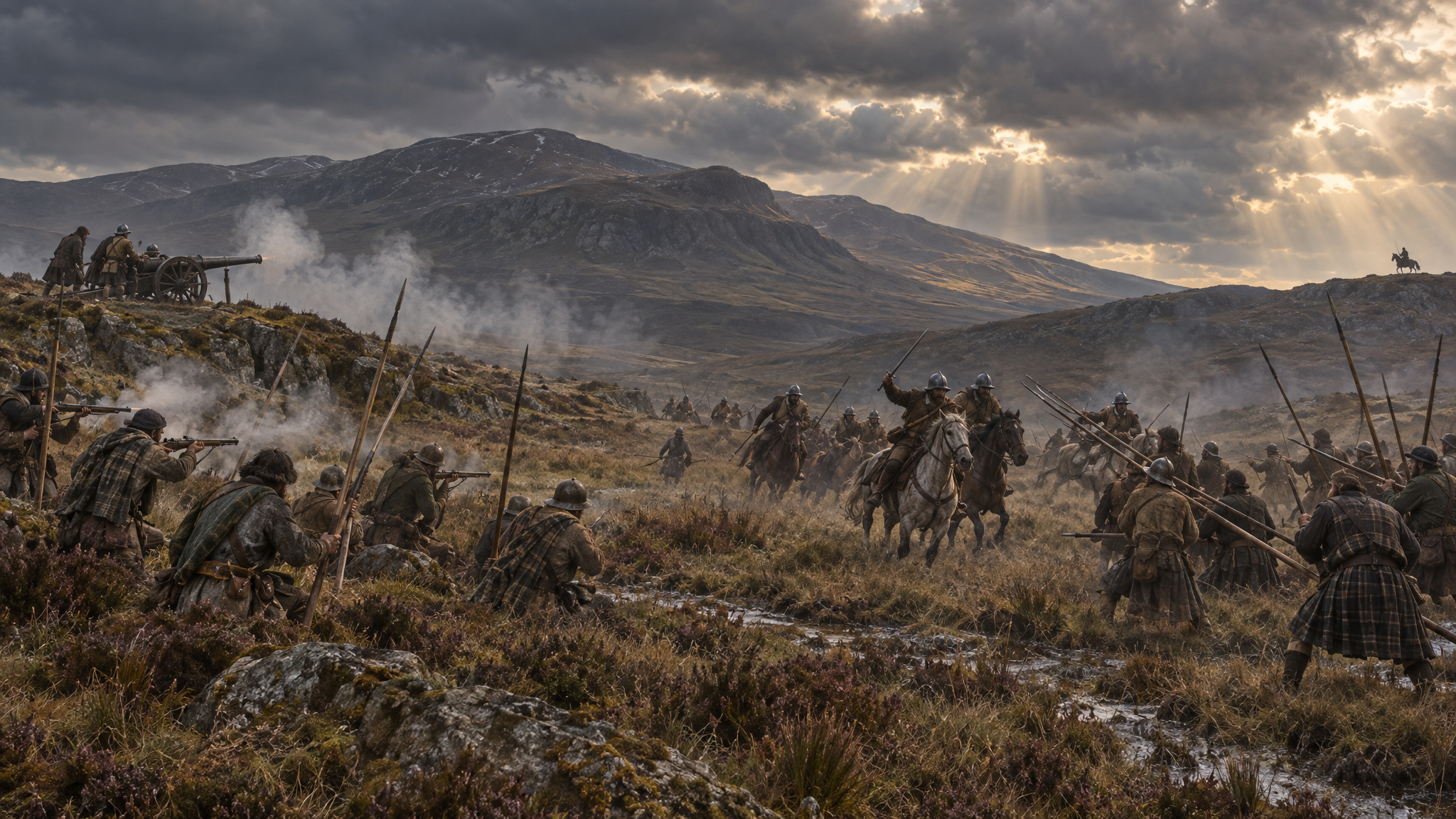
As Argyll’s men advanced, their archers and arquebusiers were near the front. The pikemen, who could have resisted cavalry, were further back with the baggage. Huntly’s horsemen attacked the exposed missile troops, while his field guns added to the disorder. If the reports of artillery are accurate, Glenlivet was the first Highland battle in which it played a significant part.
The fighting was not a simple rout from the first charge. Erroll and Sir Patrick Gordon of Auchindoun attacked Argyll’s forward troops, but met fierce resistance. Auchindoun was killed. Maclean’s men held their ground against repeated assaults and, for a time, threatened to separate Erroll from Huntly. Huntly then moved to support him.
Meanwhile, Argyll’s position weakened elsewhere. Campbell of Lochnell was killed early in the battle, and his men fled. Some accounts say Lochnell had intended to change sides; Grant of Gartinbeg also reportedly withdrew. These claims matter because the army’s cohesion was as important as its size. With cavalry pressing its front and flanks, Argyll’s force eventually broke.
Victory at Glenlivet, uncertainty at Elgin
The casualty figures remain disputed. Historic Environment Scotland estimates that 300 to 400 of Argyll’s men were killed; Argyll’s own report gave a much lower number. Huntly lost around 70 men according to the same account, including Auchindoun. Erroll was wounded, while Maclean and Donald Campbell captured cavalry standards, one belonging to Erroll.
For Huntly and Erroll, the victory created an immediate question: what could they do with it? A later official guide to Elgin Cathedral says that the two earls gathered there with their supporters on 4 October, the day after the battle. The guide also describes a celebration of Mass and identifies it as the last public Mass held in the cathedral.
The meeting brings the limits of their victory into focus. They had defeated Argyll, not James VI. The king continued his campaign in the north, and the earls did not try to defeat his army in the field.
James ordered the demolition of strongholds associated with them, including Huntly’s Strathbogie Castle and Erroll’s Old Slains Castle. The extent of the damage varied: Historic Environment Scotland notes that relatively little was inflicted on Strathbogie despite the order. Eventually, Huntly and Erroll agreed to leave Scotland. They travelled on the Continent before returning to royal favour. Huntly was made Marquess of Huntly in 1599.
What Glenlivet left behind
Glenlivet cannot be explained as a straightforward battle between two uniform religious camps. Catholic faith was central to Huntly’s cause, yet clan feuds, family interests and royal politics also determined who fought. Argyll himself had been Catholic, despite leading the campaign against the Catholic earls.
The battle also survived in song and story. The Ballad of Balrinnes celebrated Huntly’s victory, while other traditions associated the fighting with the Highland harp. The connection sometimes made between Glenlivet and “Bonnie James Campbell” is less certain.
Today, the battlefield remains an open pass below the hills near Ben Rinnes. Huntly’s cavalry victory is the central historical event. Yet the journey from that pass to Elgin Cathedral, and then to exile, tells the fuller story: the earls won their battle but could not dictate what followed. On each anniversary, the tale of MacAllister brings the story back to the place where it began.
Sources:
Martin Coventry, Haunted Places of Scotland (2009)