The Darien Scheme offered one ruined laird a way out.
In the autumn of 1694, sand overwhelmed Culbin on the Moray Firth. The Great Sand-Drift came from the west with little warning. According to the Culbin account, a man abandoned his plough in the middle of a furrow. Reapers left late barley uncut. Within hours, sand had buried both the plough and the crop.
The storm spared neither cottar nor laird. Its gusts drove sand through the settlement, across orchards, fields and homes. Families moved their cattle to safety. Then, as the storm returned with renewed force, they fled with what they could carry. When they came back, the account records, “Not a vestige, not a trace, of their houses was to be seen.”
Alexander Kinnaird, the last laird of Culbin, was among those left with an estate in ruins. The loss left him burdened by debt and creditors. When his son William secured an ensign’s commission for the Darien expedition, Alexander joined him. He took an overseer’s commission and sailed with the fleet in 1698.
For Kinnaird, the Darien Scheme was more than a national enterprise. It was a final attempt to recover a home, a fortune and a future. Like many who sailed from Leith, he had already seen his old life collapse. Scotland’s colonial dream offered escape. Instead, it carried him towards another landscape of ruin.
The Darien Scheme: Hope in a time of famine
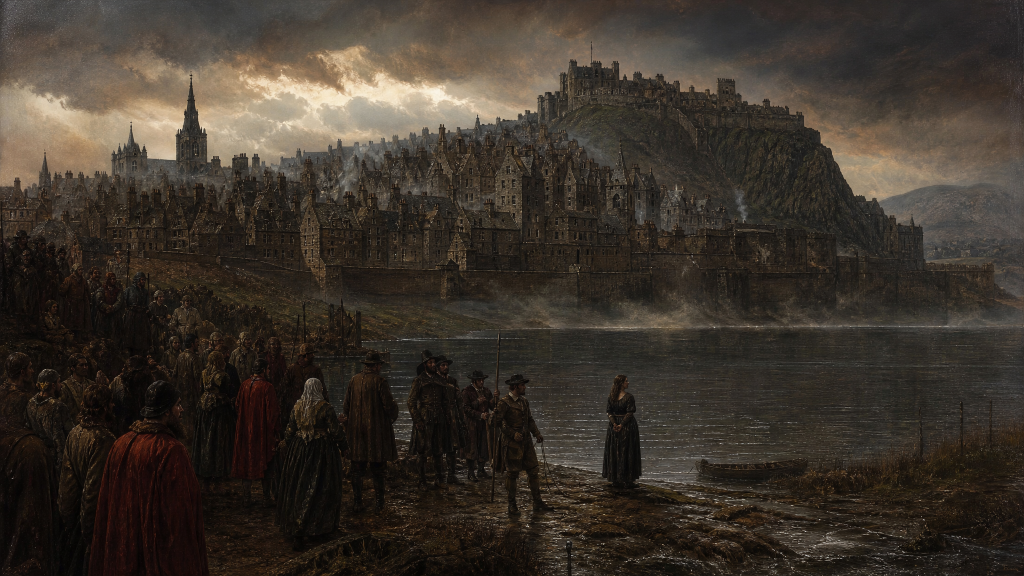
On 14 July 1698, that promise of escape drew twelve hundred people to Leith. The city of Edinburgh emptied its streets as twelve hundred souls boarded five stout ships—the St Andrew, Unicorn, Caledonia, Endeavour, and Dolphin—believing they were the vanguard of a Scottish empire. Sir John Dalrymple famously recorded the scene, noting that “the whole city of Edinburgh poured down upon Leith to see the Colony depart, amidst the tears and prayers and praises of relations and friends.” Such was the desperation to join this “noble undertaking” that soldiers whose services had been refused were found hiding in the ships’ holds, “clinging to the ropes and timbers, imploring to go, without reward.”
Why They Left: Famine, War and the Wider Crisis
The Darien Scheme was born from the wreckage of a nation pushed to the absolute brink of survival. Throughout the 1690s, Scotland endured the “Seven Ill Years” — a sequence of failed harvests that produced widespread hunger, rising rents and the collapse of smallholdings. Crop failures were not a Scottish oddity but part of a wider European crisis after a decade of poor weather; harvests in Ireland, England, France and the Low Countries also failed, forcing grain prices up and migration pressures across the continent. For many tenants and cottars in Scotland, the choice was stark: stay and face eviction, starvation or forced enlistment, or take whatever chance a colonial venture promised. Paterson’s rhetoric of establishing a trading emporium that would revive Scottish commerce, therefore, read less as grandiloquence and more as a lifeline.
The situation was compounded by political and commercial pressures. England’s Navigation Acts and the concentration of imperial favour on English ports choked Scottish trade routes. Meanwhile, the cost of King William’s continental wars and the integration pressures of the Union debates left the Scottish economy taxed, precarious and politically sidelined. Veterans and rejected recruits — men with no prospect of regular pay — crowded the lists of volunteers; ambitious merchants and indebted lairds saw the colony as a chance to clear debts or secure a new estate. When twelve hundred souls boarded the five ships at Leith in July 1698, many were not dreamers of empire but refugees from daily hunger and economic ruin, boarding in the hope of food, work and a future for their families.
The First Betrayal: Damnified Wheat and Rotten Trust
The Darien Scheme faced its first true betrayal not from Spanish steel or tropical storms, but from the ledger books of Edinburgh. Only four days into the voyage, the romantic image of a national crusade was shattered by a clinical inspection of the ships’ holds. While the Company Directors had publicly promised nine months of provisions to sustain the settlers until the first harvest, the reality was a logistical death sentence. The Council discovered that the fleet carried stores for only six months, meaning the colony was mathematically destined to starve before reinforcements could even be requested. Furthermore, the quality of the food was an insult to the lives of the volunteers; the official journal of the expedition secretary, Mr. Rose, reveals that “a large quantity of the bread was made of ‘damnified’ wheat, and that some of the other provisions were rendered unusable through bad packing.”
Institutional Negligence and the Short Allowance
This discovery of “damnified” or rotten wheat was the result of unforgivable institutional negligence. The Directors had prioritised the optics of a grand departure over the survival of the people, leaving the ships to lie idle in Leith Roads. At the same time, a third of the provisions were consumed before they even weighed anchor. Consequently, the Council was forced to place the twelve hundred exuberant souls on “short allowance” almost immediately. This meant that the men and women who had fled famine in Scotland were now sailing toward a new one, trapped on the Atlantic with maggot-ridden flour and carrion-like beef. The arrogance of the leadership was personified by Commodore Pennicuik, who, when warned by William Paterson about the looming shortage, sneered that he “knew his own business best.”
The Landing at Golden Island: A Grave in the Jungle
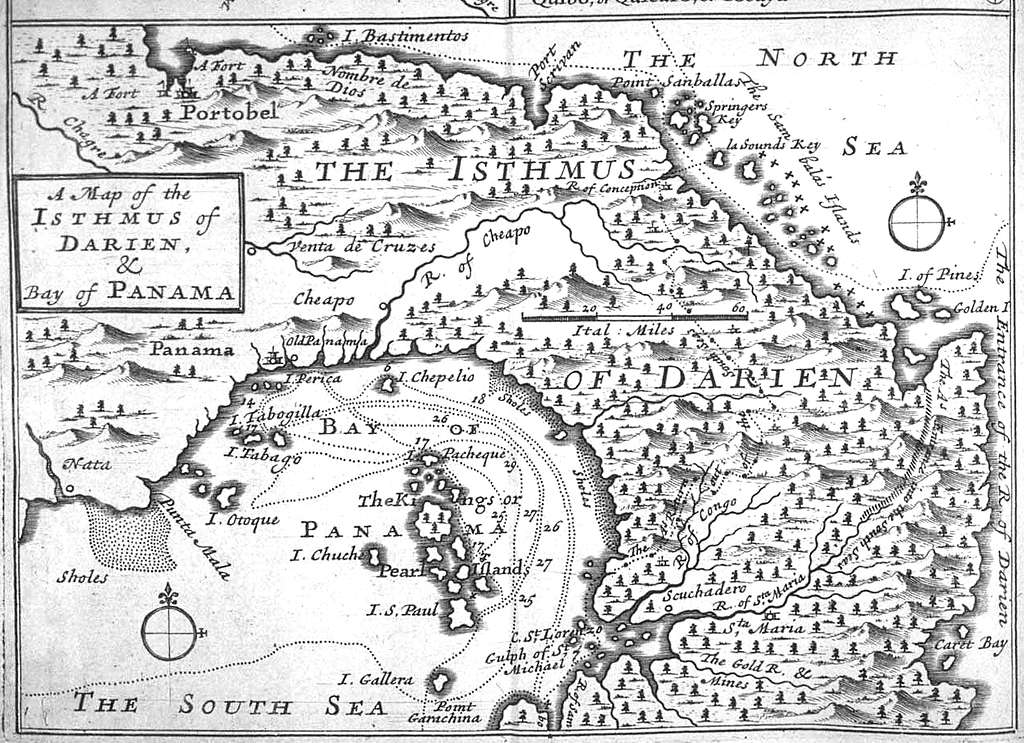
The Darien Scheme reached its grim destination on the 3rd of November, 1698, when the fleet cast anchor in a natural harbour four miles east of Golden Island. The initial landing was marked by an unsettling quiet; the settlers stepped onto the white sands of the Isthmus believing they had found a “Golden Island” that would provide wealth and sanctuary. However, the tropical environment of the Bay of Caledonia quickly transformed from a promised paradise into a suffocating trap. While the Council’s official letters to Edinburgh initially claimed the country was “healthful” and the soil “fertile,” the reality of the rainy season soon made work impossible. The men and women, already weakened by months of short allowances and “damnified” bread, were now forced to clear jungle and build Fort Saint Andrew under a relentless deluge.
Graves in the Coral: The Collapse of Fort Saint Andrew
The human cost of the occupation was immediate and unrelenting, as the “Golden Island” was revealed to be a graveyard. Sickness took hold of the colony almost immediately, beginning with the loss of the fleet’s two ministers and soon spreading to the highest ranks of the Council. One of the most haunting primary accounts from a survivor notes that “the mortality increased to that degree that we buried commonly 10, 12, and 14 in a day.” This was not a dignified end for Scotland’s brave adventurers; instead, the record laments that “the living were hardly able to bury the dead.” The tropical fever, likely a combination of yellow fever and malaria, hollowed out the colony until the survivors were too weak to defend the fort or even dig deep enough graves to prevent the sea from reclaiming the bodies.
By December, the despair within the colony was absolute. William Paterson, the very man who had inspired the expedition, suffered the “great grief” of losing his wife to the fever. She was buried with solemn honours among the coral-choked dunes, a symbol of the domestic dreams that died in the Darien mud. Consequently, the silence from Scotland became a psychological weight as heavy as the humidity. The supply ships promised by the Directors never appeared on the horizon, leaving the starving survivors to watch their companions waste away. Ultimately, the settlers realised their leaders had abandoned them at home and were being hunted by the Spanish from the south, trapped between a silent sea and a lethal jungle.
Second Expedition: Sailing Blind, Reinforcements Too Late
The Darien Scheme’s second expedition sailed before reliable news of the first disaster reached Scotland. The directors had only patchy dispatches and hopeful journals. They believed the colony was secure and merely needed more men and stores. Orders were therefore issued to fit out more ships in early 1699. The second fleet left Clyde and Leith in haste. It carried fresh volunteers, supplies and the expectation of rescue.
That haste became fatal. News of the first expedition’s devastation arrived piecemeal and too late. The reinforcements sailed into sickness and short rations. Ships disembarked men who were already weakened by the voyage. Command disputes among councillors further fractured their effectiveness. The Spanish pressure and English non‑assistance had already begun to bite. Instead of a timely bolstering, the second expedition added numbers to the death toll.
The Last of Culbin
After the final abandonment of Darien in April 1700, the survivors sailed north towards Jamaica. The journey became another ordeal. Disease continued through the crowded ships. Food, credit and help were scarce. Many of those who had survived Darien died before they reached safety.
Alexander Kinnaird, the last laird of Culbin, was among the dead. The man who had left Scotland after the sands consumed his estate did not return to reclaim it. He died in the aftermath of the colony’s collapse, far from the Moray coast.
William Kinnaird’s fate is less certain. One later account lists Ensign William among the dead. Another states that he survived the expedition, reached America and never returned to Scotland. Either way, the Darien Scheme ended the Culbin line’s final gamble.
When the two expeditions finally realised the true scale of the disaster, coordination had collapsed. The Council attempted limited relief measures and dispatches home. But the ships that might have carried urgent supplies were absent or seized. Reinforcements could not be rerouted in time. In effect, the Company doubled the number of victims by sending more people into an already catastrophic situation.
The Final Betrayal: Spanish Guns and English Silence
The Darien Scheme faced its most lethal opposition not from the jungle, but from London. William III declined to risk war with Spain. His ministers feared continental and colonial consequences. Spain claimed the Isthmus and threatened reprisals. England would not provoke a new continental dispute over a Scottish colony. For realpolitik reasons, the Crown put imperial diplomacy above relief. Secret instructions were sent to colonial governors to deny aid. Governors in Jamaica and Barbados thus refused supplies, water and shelter. The colonists watched the horizon for help that would not come.
The physical collapse began with the wreck of the Dolphin. The vessel struck rocks near Cartagena and was “all to peeces” within half an hour. Captain Pincarton and his crew were seized by the Spanish. He later reported the “hollow wasting away” of his men. Some sailors drowned weighted down by gold taken in panic.
Nor was the issue only fear of war. The East India Company and leading English merchants opposed the Darien venture. They feared a Scottish free port on the Isthmus would pierce English mercantile monopolies. The company’s shareholders lobbied ministers and colonial governors to block assistance. Legal claims and seizures — like the Annandale incident — were used to choke the Scots. In short, English commercial greed joined royal caution. The poor paid for both.
English proclamations then blocked rescue and eased Spanish pressure. Admiral Benbow received orders not to relieve the Scots. The council at New Edinburgh faced starvation and disease. By May 1699 the first expedition abandoned Fort Saint Andrew. They left hundreds of shallow graves. Survivors returned to a Scotland full of anger and ruin.
Aftermath, Revenge and Judicial Murder
The Company tried to recoup capital at sea. It sent the Speedy Return and the Continent to the Guinea coast. Captain Robert Drummond commanded the Speedy Return. His brother Thomas sailed as supercargo. Instead of trading for gold, they fell into the slave and pirate trades. Contemporary Company minutes report that the Drummonds “have not returned to give an account of their trust.” John Bowen, a notorious pirate, seized the vessels. The ships were lost and their cargo vanished. The Company’s creditors grew desperate.
Scapegoating followed. Roderick Mackenzie, the Company’s secretary, led an inflammatory campaign. He accused English sailors of complicity in the Drummonds’ fate. The arrest of the English ship Worcester crystallised the fury. Captain Thomas Green and two crewmen were tried in Edinburgh for piracy. The trial was chaotic. The indictment used Latin and obscure legal phrases. The accused could not follow the proceedings. Witnesses contradicted one another. Key affidavits proving innocence arrived from London, but public anger overruled them. Nineteen councillors absented themselves rather than face the mob. Green, John Madden and James Simpson were convicted and hanged. Thomas Green is said to have expected reprieve as the hood was placed over his head.
After the Union of the Crowns, when James VI became James I of England, Scotland was still an independent country. The Darien Scheme had left Scotland and some of its more wealthy citizens massively in debt. There was a solution- become part of the United Kingdom, and the Darien investors could recoup some of their lost money through the Equivalent Payment. However, it also showed the Scottish people where the Crown’s loyalty lay. It was not with the people of Scotland. Small wonder that Jacobitism would grow in the years that followed.
Why the Crown’s refusal mattered then and later
William’s refusal to intervene mattered for three reasons. First, it left the colony without relief and exposed it to Spanish action. Second, it signalled to Scots that the Crown would put English commercial and diplomatic aims first. Third, the government’s stance deepened domestic rage. That rage fed into opportunism and lawlessness. It created the conditions in which the Drummonds’ disappearance became a national obsession. It also made murderous scapegoating politically possible.
Legacy: Debt, Compensation and the Road to Union
The Darien Scheme failed for many reasons. However, the decisive betrayals were political and commercial. England’s non‑assistance and the protection of English mercantile monopoly destroyed the colony’s last chance. The loss of ships and cargo pushed the Company toward insolvency. Investors and poor families were ruined. The financial hole in the Scottish economy was prodigious. In 1707, the Treaty of Union offered an Equivalent payment to compensate Darien investors. Many Scots saw this as a sale of sovereignty. They believed their independence had been bartered to cover corporate failure. The Darien Scheme is therefore a story of national aspiration turned into betrayal by money and power.