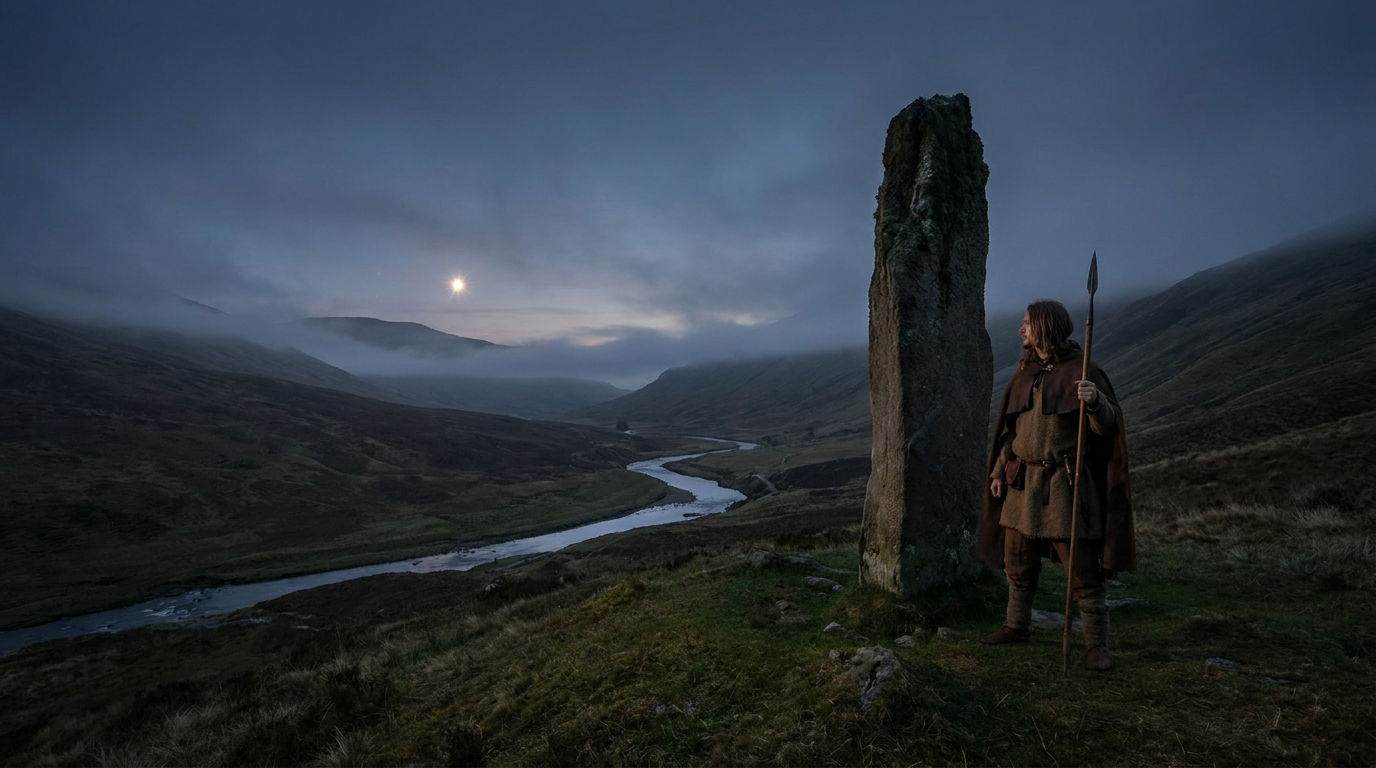
Imagine a warrior so fierce that he was considered the champion of a goddess. He became her mortal lover, protector, and living symbol of the land’s fertility. Now imagine that his reign always ended the same way: tied to a standing stone on a dark November night, and dispatched by his successor with a sacred spear. This was the Cuckoo King: a sacred ruler whose title, power, and death were all bound to the common cuckoo and the planet Venus.
The term might sound whimsical, even comical. But research by David Alexander Nance of the University of Aberdeen, published across a series of peer-reviewed papers between 2019 and 2024, reveals that the Cuckoo King tradition was deadly serious and that it possibly survived in Scotland longer than anywhere else in Europe.
Why the Cuckoo?
To understand the Cuckoo King, you first need to understand how our ancestors saw the cuckoo itself.
The common cuckoo (Cuculus canorus) is a brood parasite — it lays eggs in other birds’ nests. But ancient peoples didn’t know this. Instead, they saw a mysterious bird whose song heralded spring, whose females were never spotted, and whose single chick appeared in the nests of smaller species across one male’s territory. The conclusion seemed obvious: the male cuckoo mated directly with multiple host females. From Denmark to China, the cuckoo became the ultimate symbol of virile masculinity (Armstrong, 1958).
The Cuckoo and the Sparrowhawk
There was another layer. The cuckoo’s plumage closely mimics the sparrowhawk (Accipiter nisus). For centuries people believed the hawk transformed into the cuckoo each spring. Aristotle and Pliny both claimed the cuckoo was an immature hawk. Anglo-Saxons and Baltic tribes shared this belief, and it persisted in parts of Germany into the 1930s. A fierce hunter by winter, a gentle lover by summer — warrior and seducer. This dual nature became the defining trait of the Cuckoo King archetype.
The Cuckoo, the Pleiades, and Cosmic Time
There was a celestial dimension, too. Across central and northern Europe, the Pleiades star cluster was understood as the celestial symbol of the cuckoo (Méchin, 2000). Both were perceived as keepers of cosmic time: the Pleiades’ risings and settings regulated agricultural calendars and festivals, just as the cuckoo’s arrival and departure marked the turning of the seasons. And the cuckoo was sacred. In Finland, it was believed to fertilise the Earth with its song. In Scotland, it was eun sith — the “bird of the Otherworld” — thought to overwinter not in Africa, but in the fairy bowers beneath the ground (Gubernatis, 1872).
Gouk Stones and Cuckoo Place-Names
Scattered across Britain are standing stones bearing names derived from the cuckoo in four different languages: gouk and gowk (Old English), cuckoo (Modern English), cog (Brittonic Welsh), and cuthaig (Scottish Gaelic, pronounced “kewag”). Nance’s research identified 132 cuckoo place-names across Great Britain, of which at least 25 have a standing stone directly named after the bird, with a further seven having unnamed standing stones nearby — probable “lost” or “forgotten” cuckoo stones (Nance, 2019a).
These aren’t random names. Careful geographical analysis using mapping software revealed a remarkably consistent pattern: cuckoo stones are overwhelmingly found on promontories, near springs, beside running water, and in steep-sided valleys — and this pattern holds true across all four languages. The implication is profound: the association predates the arrival of English, Gaelic, and Welsh, stretching back to the Early Bronze Age, around 2500 BC.
The Gouk Stone at Hatton of Fintray
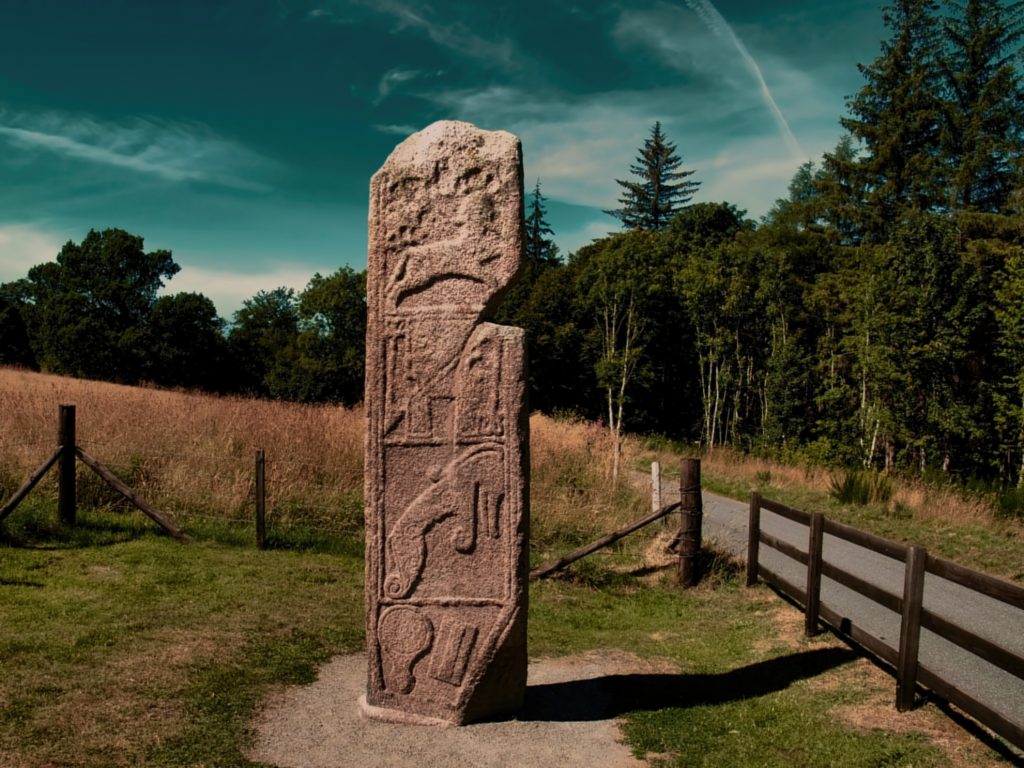
The Gouk Stone at Hatton of Fintray in Aberdeenshire is perhaps the most chilling example. This three-metre granite monolith stands at the centre of a previously unrecognised ritual landscape, surrounded by cairns and ancient assembly sites. Local legend says a “general” of the same name was slain there. Not a general at all, Nance argues — but a Cuckoo King, sacrificed at his appointed hour. The Gouk Stone is situated where three parishes — Dyce, Fintray, and Kinellar — meet at the confluence of the Blackburn with the River Don, a location type associated with religious significance in Pictish areas (Nicolaisen, 1976).
The Sacred Rivers of Pictland
The River Don itself deepens the sacred resonance of this landscape. The second-century AD geographer Ptolemy of Alexandria recorded the river as Devona — a name meaning “goddess.” Both the Don and its sister river the Dee share this divine etymology, suggesting that the ancient peoples of the region regarded these waterways as living manifestations of a goddess. Thus , it is no concidence that the Gouk Stone, a probable site of sacrifice to a sovereignty goddess, stands at the confluence of streams flowing into a river literally named after a goddess. It hints at a sacred landscape where every element — stone, water, and sky — was woven into a single cosmological tapestry.
Written in the Stars: A Cosmic Clock of Stone and Light
The timing of the Cuckoo King’s death was not arbitrary. It was written in the sky. And the sophistication of the astronomical knowledge embedded in Britain’s stone monuments is one of the most remarkable aspects of Nance’s research.
Venus follows an astonishing eight-year rhythm. If you stand in the same spot and watch Venus set on the same date each year, it will wander along the horizon — but after exactly eight years (plus just two days), it returns to almost precisely the same position. This celestial cycle was known in the ancient world: the Babylonians tracked it from at least the third millennium BC, and the Greeks later adopted their observations to calibrate their own calendars (Webb, 1921; Tiede, 2018).
During each eight-year cycle, Venus appears to travel slowly along the horizon in a wide arc, reaching its most extreme position — its furthest point from the Sun as seen at sunset — before swinging back. And here is the critical finding: over 80% of the times Venus reached this extreme evening position between 2000 BC and AD 2000 fell during the week spanning late October to early November (Šprajc, 2015) — the very days of Samhain, the ancient Celtic festival of the dead on 1 November. The Samhain feasts at Tara, where Irish kings were sacrificed down to AD 560, were held during exactly this same week, between 29 October and 4 November (Ginnell, 1894).
The Cuckoo King ruled for eight years. Then, when Venus blazed at its furthest point along the horizon at Samhain, his time was up.
The Gouk Stone as an Astronomical Marker
At the Gouk Stone, Nance discovered a precise astronomical alignment using satellite mapping and planetarium software that draws on NASA’s calculations of celestial movements. The ritual landscape at Hatton of Fintray comprises six mutually visible prehistoric monuments — four cairns, a standing stone, and a recumbent stone circle — each positioned so that, when you stand at one and look toward another, the distant monument sits on the horizon at a point where a significant celestial event occurs.
The results are remarkable. Of the twelve sight-lines between these monuments, a third align precisely with the extreme rising or setting positions of the Moon or Sun — far more than chance would predict. Two-thirds fall within a close margin of a major lunar or solar event. These include alignments marking the points where the Moon reaches its most northerly rising position during its 18.6-year cycle, where it sets at its most southerly extreme, and where the Sun sets on the shortest day of the year (Nance, 2021).
But the most striking alignment is neither lunar nor solar. Viewed from Donald’s Hillock, a probable prehistoric burial mound, the Gouk Stone sits on the horizon at the exact point where Venus set at its most extreme evening position around 1960 BC — accurate to a fraction of a degree. The monument was a cosmic foresight, built to mark the exact moment and year of sacrifice. Another sight-line — from the Gouk Stone toward the former stone circle at Kinellar church — corresponds with the point where the Sun sets at Samhain. This fixed the date of sacrifice in the calendar. The Venus alignment fixed the year (Nance, 2021).
Calanais and the Pleiades
At the Calanais Stones on the Isle of Lewis, an ancient myth describes “something” walking down the great stone avenue at midsummer sunrise, heralded by the cuckoo’s call. Its name was described as “probably pre-Gaelic,” translating as “the Shining, or Pure, or White One” — which in Welsh is Gwener: Venus.
Nance demonstrated that one of the stone rows at Calanais points directly toward a rare celestial event that occurred in the 1670s BC. During Venus’s eight-year cycle, there are moments when its rising position on the horizon, as it swings in one direction, crosses the same point as its rising position while swinging back — a kind of celestial intersection called a “crossover.” These crossovers are visible above the horizon only about once every 252 years, a period known as the “Great Venus Round” (McCluskey, 1983).
But the Calanais alignment encodes something even rarer. On that same midsummer dawn in the 1670s BC, the Pleiades rose on exactly the same point on the horizon as the Venus crossover — an event that occurs only twice every 26,000 years, thanks to the imperceptible slow wobble of Earth’s axis over millennia. The Pleiades rose several hours before Venus, effectively “heralding” its appearance — just as the myth describes. Today, because of that same slow wobble, the Pleiades rise over two hours later and far further north than they did in the 1670s BC. The radiocarbon dating for when the stone circle was erected corresponds with this date (Nance, 2021).
Seahenge and the Bronze Age Sky
This celestial event — a sacred marriage of Venus with the rising Sun, heralded by the Pleiades — was replicated at Seahenge. On Midsummer’s Eve 2048 BC at Holme-next-the-Sea, the Pleiades rose in the late evening on a particular bearing, and Venus followed two hours later, rising on almost the identical bearing, glowing at half-brightness. If coastal sand dunes formed the local skyline, the Pleiades’ brightest star would have been visible just above the horizon on the same bearing as Venus — another instance of the cosmic coupling of these two celestial markers of the cuckoo (Nance, 2024).
The Astronomical Knowledge Required
The degree of astronomical sophistication implied by these alignments is considerable. The builders needed to track Venus’s position on the horizon over multiple eight-year cycles, recognising both the eight-year rhythm and the far longer 252-year “Great Venus Round.” They needed to understand the extremes of the Moon’s 18.6-year cycle and to distinguish these from the Sun’s yearly limits. Julius Caesar recorded that the druids held lectures and discussions on astronomy, while Pomponius Mela wrote in AD 45 that Gaulish druids “professed to know the size and shape of the world, the movements of the heavens and of the stars and the will of the Gods.”
The evidence from the Gouk Stone landscape and Calanais suggests that such knowledge extended deep into the Bronze Age, and that religious specialists — a “ritual authority” — were responsible for the precise positioning of monuments that encoded both the calendar and the cosmology of an entire belief system (Nance, 2021).
The Picts and the Last Cuckoo Kings
The Cuckoo King tradition stretched across Bronze Age Europe. However, Nance suggests that in Scotland the Picts were its last keepers.
The Picts maintained remarkably stable societies from the Early Bronze Age into the early medieval period. Ancient sources describe them as “flat” societies without entrenched elites — “farmer republics” whose boldest warriors were chosen as non-hereditary chieftains (Cassius Dio, Historia Romana 77.12). While the Romans crushed cuckoo cult sites across southern Britain — deliberately targeting them as psychological warfare during the conquest (Nance, 2019a) — the tradition survived beyond the frontier, in Pictland.
The Ciuthach in Gaelic Tradition
The Pictish Cuckoo King had a Gaelic name: the Ciuthach (“kewach”), meaning cuckoo. The antiquarian William J. Watson identified the Ciuthach as “a hero of the Picts” in 1914, noting the name in place-names from the Clyde to the Butt of Lewis:
“In view of the fact that traces of the Ciuthach are found from Clyde to the Butt of Lewis, it is clear that at one time he played a great rôle in the traditions of the West… The conclusion suggested is that the Ciuthach was a hero of the Picts.”
In Gaelic tales, the Ciuthach was a warrior of superhuman vigour whom no man could defeat, killed only by a magical spear (Mac an Luinn, “son of the spear”) while his back was against Creag Ciuthach, a rock on Lewis. He was thought to behave like a male cuckoo, which mates with more than one female. In Lewis, calling a young man “the Ciuthach” was a compliment — a mark of strength and vitality. It was a title, not a personal name (Watson, 1914; Nance, 2022).
Rosemarkie Man and Ritual Violence
In 2016, a remarkable discovery lent chilling physical reality to the Cuckoo King hypothesis. The skeleton of a man was found buried in a sea cave near Rosemarkie, on the Black Isle, in the former Pictish kingdom of Fortriu. Radiocarbon dating placed his death between approximately 430 and 630 cal AD — precisely contemporary with both the proposed date for the Pictish warrior stone carvings and the conversion of the Pictish elite to Christianity (Ritchie & Ritchie, 1991).
Rosemarkie Man was well-built, well-nourished, and of high status. He was around thirty years old when he died. And the manner of his death was extraordinary. Forensic anthropologist Professor Dame Sue Black described his injuries:
“The first impact was by a circular cross-section implement that broke his teeth on the right side. The second may have been the same implement, used like a fighting stick which broke his jaw on the left. The third resulted in fracturing to the back of his head as he fell from the blow to his jaw with a tremendous force possibly onto a hard object perhaps stone. The fourth impact was intended to end his life as probably the same weapon was driven through his skull from one side and out the other as he lay on the ground. The fifth was not in keeping with the injuries caused in the other four where a hole, larger than that caused by the previous weapon, was made in the top of the skull.” (Quoted in Hill, 2017)
There was no evidence of defensive wounds, suggesting he may have been bound or drugged — consistent with the Cuckoo King regicide mechanism described in Irish texts, where the victim was given a drugged drink before being tied to a standing stone. When Nance proposed to Professor Black that the wounds could have been inflicted with a knobbed spear — the distinctive weapon depicted on Pictish carved stones and described by Cassius Dio — she responded: “The pointed nature of your proposed weapon in relation to penetrative wounds, the ‘stick’ nature of the trauma to the mandible and a possible ‘club’ end of a weapon for the comminuted fracturing is a possibility. So, I cannot discount your proposed weapon as being possible” (S. Black, pers. comm. 31 January 2022; Nance, 2022).
Was Rosemarkie Man a Cuckoo King?
Most strikingly, Rosemarkie Man was ritually buried in the back of a sea cave, weighted down with stones. This is highly unusual — Pictish mortuary practices of this period typically involved long cist burials or increasingly elaborate square and circular burial monuments associated with the newly emerging post-Roman elite (Mitchell & Noble, 2019). But caves have been conceptualised as portals to the Otherworld across many cultures (Dowd, 2015). And in Gaelic legend, the Ciuthach is repeatedly associated with caves: Campbell (1862) described Ciuthachan in the Outer Hebrides as naked wild-men living in caves; Watson (1914) recorded correspondents from Eigg mentioning the Ciuthach living in a cave; the Manx equivalent, the Cughtagh, also dwelt in a sea cave (Gill, 1932).
Nance proposes that Rosemarkie Man may have been a Ciuthach, both a scapegoat and a sacrificial victim, a messenger dispatched to the deities of the Otherworld. If so, he may have been one of the very last Cuckoo Kings, killed at the historical moment when Christianity was displacing the ancient religion of northern Scotland.
Cúchullain as a Cuckoo King
The most famous Cuckoo King of all may be Cúchullain — Ireland’s greatest mythological hero. His name has traditionally been translated as “Culann’s Hound” through an etiological legend involving the killing of a smith’s guard dog; however, linguist Julius Pokorny argued in 1909 that this was a later contrivance by Christian scribes. The Irish onomatopoeic cu-cú plus the diminutive suffix -ín yields cwcwlén — “little cuckoo” — a direct translation from Brittonic. Cúchullain was, in fact, a Briton of the Cruithin (Brittonic-speaking tribes in Ireland), not ethnically Irish (Pokorny, 1909; Nance, 2022).
The Death of Cúchullain
Every detail of Cúchullain’s legend maps onto the Cuckoo King archetype. He was both born and killed at Samhain — linking him directly to the Venus cycle. He died tied to a standing stone after taking a drink from a nearby lake, possibly the drugged drink of the regicide ritual. Cúchullain was described as having seven bright pupils in each eye — likely a reference to the seven visible stars of the Pleiades, which celestially symbolised the cuckoo across northern Europe. He was the supreme ladies’ man, the undefeatable warrior, the visitor to and returner from the Otherworld — every trait of the sacred king titled after the brood parasite whose biology was so profoundly misunderstood (Nance, 2022).
Seahenge and the Cuckoo
In 1998, the sea revealed one of Britain’s most haunting sites: Seahenge, at Holme-next-the-Sea in Norfolk. An oval ring of oak timbers surrounding an upturned tree stump, felled in the spring of 2049 BC — during one of the worst climate crises of the last five thousand years, the 4.2-kiloyear BP aridification event that contributed to the collapse of the Akkadian Empire, the Egyptian Old Kingdom, and the Harappan civilisation (Nance, 2024).
Nance argues Holme I was an attempt to pen the cuckoo — to trap a living bird inside a structure mimicking a hollow tree trunk, thus preventing it from departing and taking the summer with it. The exterior, with bark facing outward, resembled an old oak trunk; the interior mimicked the hollow tree where the cuckoo was believed to overwinter. The inverted stump symbolised the Otherworld inverted. This mirrors folk traditions of “penning the cuckoo” recorded across England, Germany, and Switzerland, where village wise-men attempted to keep the cuckoo — and thus summer — by enclosing the bird (Nance, 2024).
Holme II and the Sacrificed King
Adjacent Holme II was darker: a closed enclosure with a central bier oriented toward the point on the horizon where the Sun rises at Samhain. This, Nance proposes, held the body of a sacrificed Cuckoo King — offered to the Venus goddess to end the drought and restore fertility to a dying land.
Christian Echoes of the Cuckoo King
The Cuckoo King tradition didn’t vanish overnight. It faded, transformed, and hid in plain sight.
After Christianity reached northern Scotland, the old goddesses became parish saints. At Hatton of Fintray, a silver head of Saint Medden was paraded after floods to stop the rain. Her name derives from the same root as Medb, the Irish sovereignty goddess (meddwen = “drunken woman” in Welsh). Her feast day fell on 19 November in the Julian calendar (8 November Gregorian) — during the Venus maximum at Samhain. Nance argues this was a Christianised echo of displaying the severed head of a sacrificed Cuckoo King to appease the goddess (Nance, 2021).
The Cuckoo King in Later Folk Tradition
In 1565, churchwardens at Mere in Wiltshire recorded a “Cuckowe King.” At Downton, a cuckoo fair dating to 1530 still crowns a “cuckoo king” and “cuckoo princess” each year. In Bulgaria, Kukeri fertility mummers led by a “king” enact ancient rites of probable Thracian origin — and in the Middle Ages, the substitute king was reportedly still killed. “Wetting the Cuckoo” survived in Shropshire until the nineteenth century, and “Cuckoo Foot-Ale” was celebrated at Hoffleet Stow in Lincolnshire into the 1930s.
As late as the eighteenth century, a victim was chosen by lot at Samhain bonfires in Perthshire. They called him the “devoted one.” A symbolic death — but the memory of something far older lingered in the smoke (Frazer, 1922).
Why the Cuckoo King Still Matters
The story of the Cuckoo King rewrites our understanding of prehistoric Scotland. It reveals a world where kingship was not privilege but sacrifice. This was a world where the planet Venus governed the rhythm of human life and death. Thus a humble migratory bird was the symbol of a cosmic drama played out across four millennia. It demonstrates a continuity of belief — from the Early Bronze Age through the Iron Age, through the conversion of the Picts — that is almost without parallel in European prehistory.
The gouk stones still stand — silent sentinels in Aberdeenshire fields and Highland hillsides, keeping watch over rivers whose very names remember forgotten goddesses. The Venus cycle still turns. And the cuckoo still calls each spring across the Scottish glens, carrying the echo of a title that once meant glory and doom in equal measure.
Next time you hear that unmistakable two-note song, remember: somewhere, long ago, it was the last sound a king ever heard.
References
Primary:
Nance, D. A. (2019a). “Gouk Stones and other Cuckoo Place-names: Prehistoric Cult Sites.” Scottish Geographical Journal, 135(1–2), 1–50.
Nance, D. A. (2019b). “Plate f of the Gundestrup ‘cauldron’: symbols of spring and fertility.” Anthropozoologica, 54(14), 141–150.
Nance, D. A. (2021). “An investigation of an Aberdeenshire ritual landscape: a site of human sacrifice associated with Venus.” Scottish Geographical Journal, 137(1–4), 173–209.
Nance, D. A. (2022). “Sacred kings of the Picts: the last cuckoos.” Scottish Geographical Journal, 138(3–4), 271–290.
Nance, D. A. (2024). “Holme I (Seahenge) and Holme II: ritual responses to climate change in Early Bronze Age Britain.” GeoJournal, 89, 88.
Secondary:
Armstrong, E. A. (1958). The Folklore of Birds: An Enquiry into the Origin and Distribution of Some Magico-Religious Traditions. Collins.
Campbell, J. F. (1862). Popular Tales of the West Highlands. Edmonston & Douglas.
Campbell, J. (2001). The Masks of God: Occidental Mythology. Penguin.
Dalton, G. F. (1970). “The Ritual Killing of the Irish Kings.” Folklore, 81(1), 1–22.
Dowd, M. (2015). The Archaeology of Caves in Ireland. Oxbow Books.
Frazer, J. G. (1922). The Golden Bough: A Study in Magic and Religion (abridged ed.). Macmillan.
Gill, W. W. (1932). A Third Manx Scrapbook. Arrowsmith.
Ginnell, L. (1894). The Brehon Laws: A Legal Handbook. T. Fisher Unwin.
Gubernatis, A. de. (1872). Zoological Mythology. Trübner & Co.
McCluskey, S. C. (1983). “Maya Observations of Very Long Periods of Venus.” Journal for the History of Astronomy, 14, 92–101.
Méchin, C. (2000). “Le Coucou et le Rossignol.” In R. Bérenger et al. (Eds.), L’Homme, l’Animal Domestique et l’Environnement du Moyen Âge au XVIIIe Siècle. Éditions Ouest-France.
Mitchell, A., & Noble, G. (2019). “The Monumental Cemeteries of Northern Pictland.” Medieval Archaeology, 63(2), 252–281.
Nicolaisen, W. F. H. (1976). Scottish Place-Names: Their Study and Significance. Batsford.
Pokorny, J. (1909). “Der Held Cuchulainn und seine Verwandten.” Mitteilungen der Anthropologischen Gesellschaft in Wien, 39, 62–82.
Ritchie, A., & Ritchie, G. (1991). Scotland: Archaeology and Early History. Edinburgh University Press.
Šprajc, I. (2015). “Alignments upon Venus and Other Planets: Identification and Analysis.” In C. L. N. Ruggles (Ed.), Handbook of Archaeoastronomy and Ethnoastronomy (pp. 507–516). Springer.
Watson, W. J. (1914). “The History of the Celtic Place-Names of Scotland.” Transactions of the Gaelic Society of Inverness, 27, 237–265.