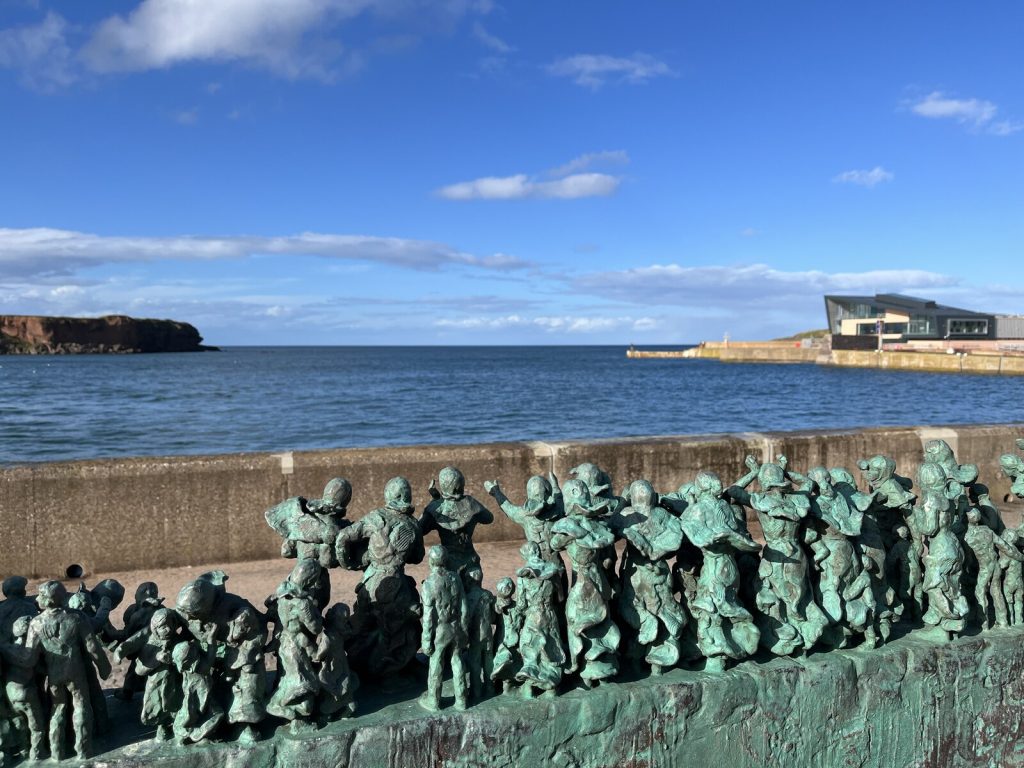
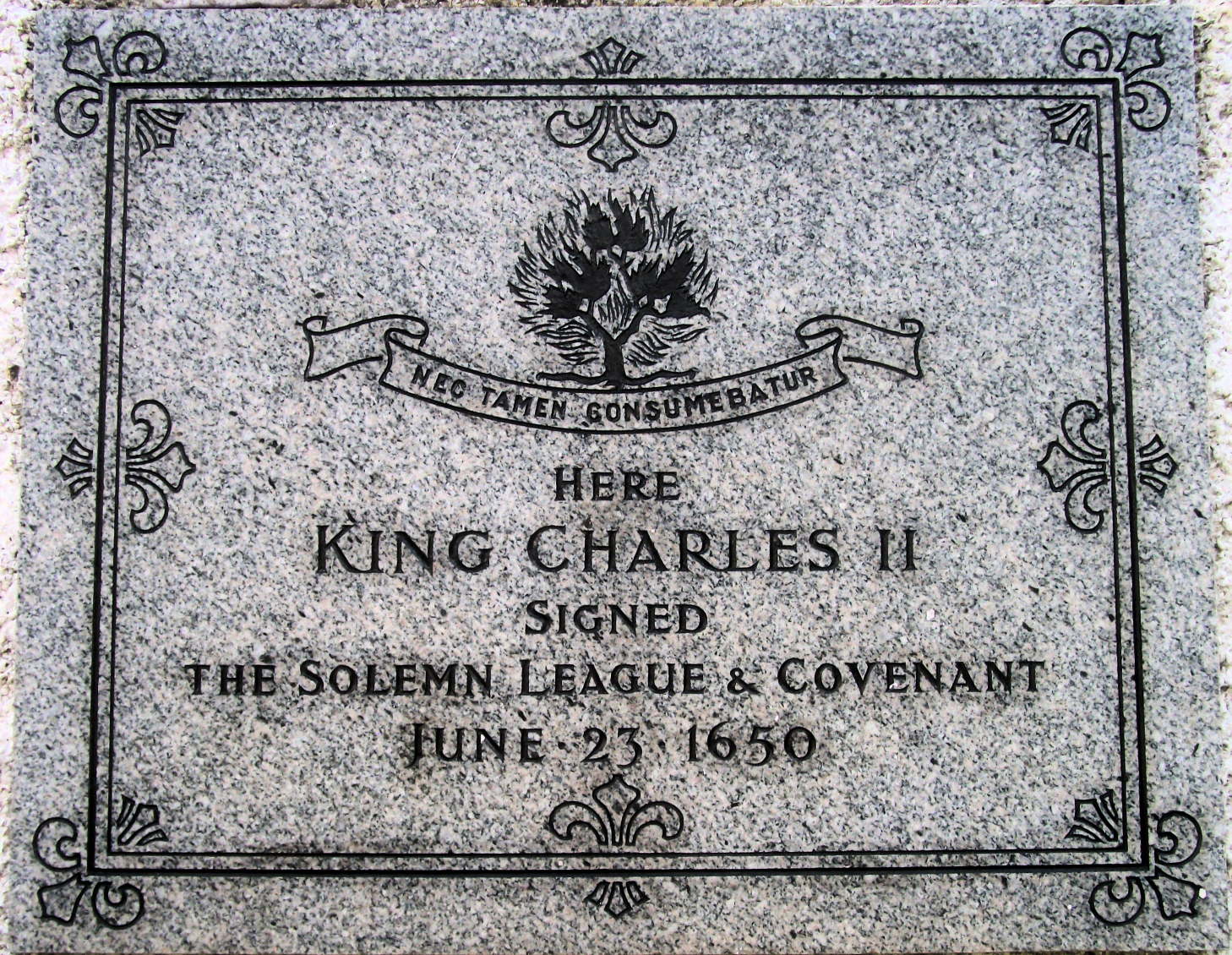
Charles II is remembered on an unobtrusive plaque in Garmouth, attached to the side of a house in a narrow winding street. It is an understated memorial for a man whose life was anything but quiet. The plaque commemorates an event that is largely forgotten, and yet for a moment, this tiny village on the Spey Estuary in the Northeast of Scotland would see a Stuart king returned to the throne in the middle of a bloody civil war.
Long before the glitter and scandals of Whitehall, he remembered his Scottish heritage and used it as a means of obtaining a crown. However, the bargain made was soon forgotten.
Charles I and The Solemn League and Covenant
By 1641, Charles I was already in deep conflict with the English Parliament. His closest advisers, Archbishop Laud and Thomas Wentworth, had been imprisoned in the Tower of London and would later be executed. Then, in August 1642, civil war finally broke out.
At first, the king seemed to have the upper hand, and the Parliamentarians were struggling. By 1643, the Parliamentarians turned north for help. The English Protestants wanted a military union with Scotland. The Scottish Covenanters saw an opportunity. They wanted to further the cause of Presbyterianism. They wanted a religious union.
As Robert Baillie put it, “The English were for a civil league, we for a religious covenant.” That difference mattered. The English wanted troops. The Scots wanted the Church of England to be reshaped so that it matched the Church of Scotland in belief, worship and government.
The result was a compromise. It became the Solemn League and Covenant, written mainly by Alexander Henderson. And it would change the course of the Wars of the Three Kingdoms.
What the Solemn League and Covenant actually was
The Solemn League and Covenant was both a military alliance and a religious agreement. Its purpose was to protect the Reformation in Scotland and reform the Churches of England and Ireland so that all three would share the same church government, doctrine and worship.
It also aimed to remove what the Covenanters saw as error. That meant Roman Catholicism, Episcopalianism and other beliefs they considered wrong.
The Scots agreed to the Covenant on 17 August 1643, and the English Parliament agreed it on 25 September 1643. It was widely signed across England, Scotland and Ireland. This was one of the key political-religious settlements of the Civil War era.
It also had institutional consequences. Scotland sent five ministers and three elders to the Westminster Assembly, created by the Long Parliament in July 1643. Even though they were few in number, their influence was huge. After the Covenant was signed, much of the Assembly’s work focused on bringing the three kingdoms closer together in faith and church order.
The Royalist defeat in 1648 resulted in the capture of Charles I and his subsequent beheading on 30th January 1649.
Why the Scots wanted to Crown Charles II
The Scots were outraged by what had happened to Charles I, the last Stuart king born in Scotland, at Dunfermline. It was blindingly obvious that by killing the English king, Oliver Cromwell had killed the King of Scots too. This was not to be endured.
The Covenanters were not soft-hearted people living in a peaceful age. They could tolerate, and even justify, brutal violence in the Scottish Witch Trials. But the murder of their king was different. It struck at the sacred order of the realm.
So, they were willing to crown Charles II. But the Covenanters would do it under their own terms, and that meant the king would have to sign the Solemn League and Covenant. It should be pointed out that while similar, the Solemn League and Covenant is a distinct document from the National Covenant.
Charles II in Scotland and the signing of the Covenant
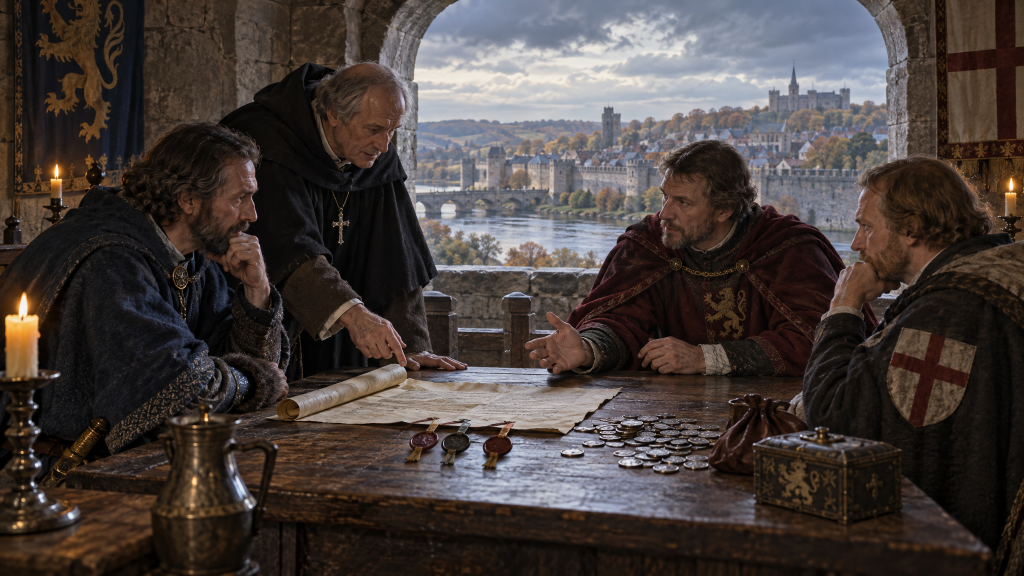
Charles II had been in exile in the Hague when his father was executed. His ship arrived in the mouth of the River Spey on the 23rd June 1650. He was still on board when commissioners arrived armed with paper and pen. The King would not be allowed to set foot in Scotland until he had signed the covenant. Reluctantly, he signed the document and abandoned the Episcopal church government. This made him popular with his Scottish subjects but woefully, unpopular with the English. He would be crowned King of Scots at Scone Abbey on the 1st January 1651.
The Covenant gave him the crown of Scotland, but it also chained him to Presbyterian demands. He had made a bargain to allow his survival, but he soon came to despise the ‘villany’ and ‘hypocrisy’ of the Covenanters.
One of his first acts after he had become King was to appoint Montrose as Lieutenant-General of Scotland. When Montrose’s campaign was unsuccessful, he washed his hands of the handsome marquis and allowed him to be executed for treason.
The aftermath of Charles II’s arrival?
Perhaps if the Scots had merely proclaimed him King of Scots, they might have been left in peace but no! They also proclaimed him as King of England and Ireland. Oliver Cromwell marched north at the head of an army. The Scots were routed and Cromwell became Lord Protector, charging the Scots £10,000 a month for the privilege of being occupied by his English garrisons.
Meanwhile, Charles famously hid in an oak tree to escape detection by the Parliamentarians. Later, he would flee overseas once more.
Cromwell died in 1658, and his son, Richard, proved unfit for the job of ruling. Charles was restored to the throne in May 1660. The English parliament declared the Solemn League and Covenant unlawful, and the old bargain was forgotten.
The Merry Monarch and the Darker Side of His Reign
Charles II was a breath of fresh air after the austere reigns of his father and Cromwell. He was over 6 foot tall, handsome and had a liking for his luxuries and comforts. In particular, he enjoyed women and fathered a whole brood of illegitimate children. He is often remembered as the Merry Monarch, a ruler of wit, charm and appetite. But that nickname hides a much harsher life. He lived through plague, fire, exile, defeat and constant suspicion.
He also ruled over some of the most famous crises in London’s history. The Great Plague tore through the city in 1665. Charles and his court fled. Then, in 1666, the Great Fire of London destroyed thousands of houses and many churches, including old St Paul’s. He had to watch his kingdom burn and rebuild in public.
Beneath his theatrical persona, he was also careful, secretive and politically shrewd. He had to be.
Poison, Mercury and the Mystery of His Death
Charles II had a deep interest in science, chemistry and experiment. He supported the Royal Society and was fascinated by practical discovery. That curiosity made him one of the more unusual monarchs of his age.
But it may also have cost him dearly. When Charles died in 1685, many people suspected poison. That suspicion fitted the politics of the age, where betrayal was expected and Catholic plots were everywhere in the public imagination.
Modern understanding points elsewhere. His final illness looks more like kidney failure, possibly uraemia, than a sinister poisoning. His use of mercury in his laboratory may have contributed. In other words, this was probably not murder. It was more likely the dangerous consequence of heavy metal exposure, misunderstood at the time.
James II, Catholic Succession and the Road to Rebellion
Charles II died without a legitimate heir. That made his brother James the next king. James was openly Catholic, and that was a serious problem in Protestant Britain.
At the time, Catholicism was widely feared and despised. So James’s succession immediately raised alarms about the future of the monarchy. Would Britain return to Catholic rule? Would Parliament resist?
Those fears did not disappear with Charles’s death. Instead, they helped set the scene for the Jacobite rebellions. The problem of succession, religion and legitimacy was left unresolved, and Britain would pay for that uncertainty for generations.
Charles II at Ham House: The Ghost Story That Still Lingers
Even in death, this charismatic king could not be laid to rest. Hios spirit is said to roam Ham House in Surrey. Charles II is said to haunt it because of the Royalist connections of the family who lived there.
Ham House feels like the perfect setting for his ghost. It is a place of memory, politics and lingering loyalty. The stories say his presence is felt as a faint, watchful echo, sometimes even with the smell of pipe tobacco in the air.
That makes sense in symbolic terms. Charles II was a king who survived by compromise, disguise and adaptation. He moved through his own age like a figure half in shadow already. So it is fitting that, in folklore, he should not rest easily.