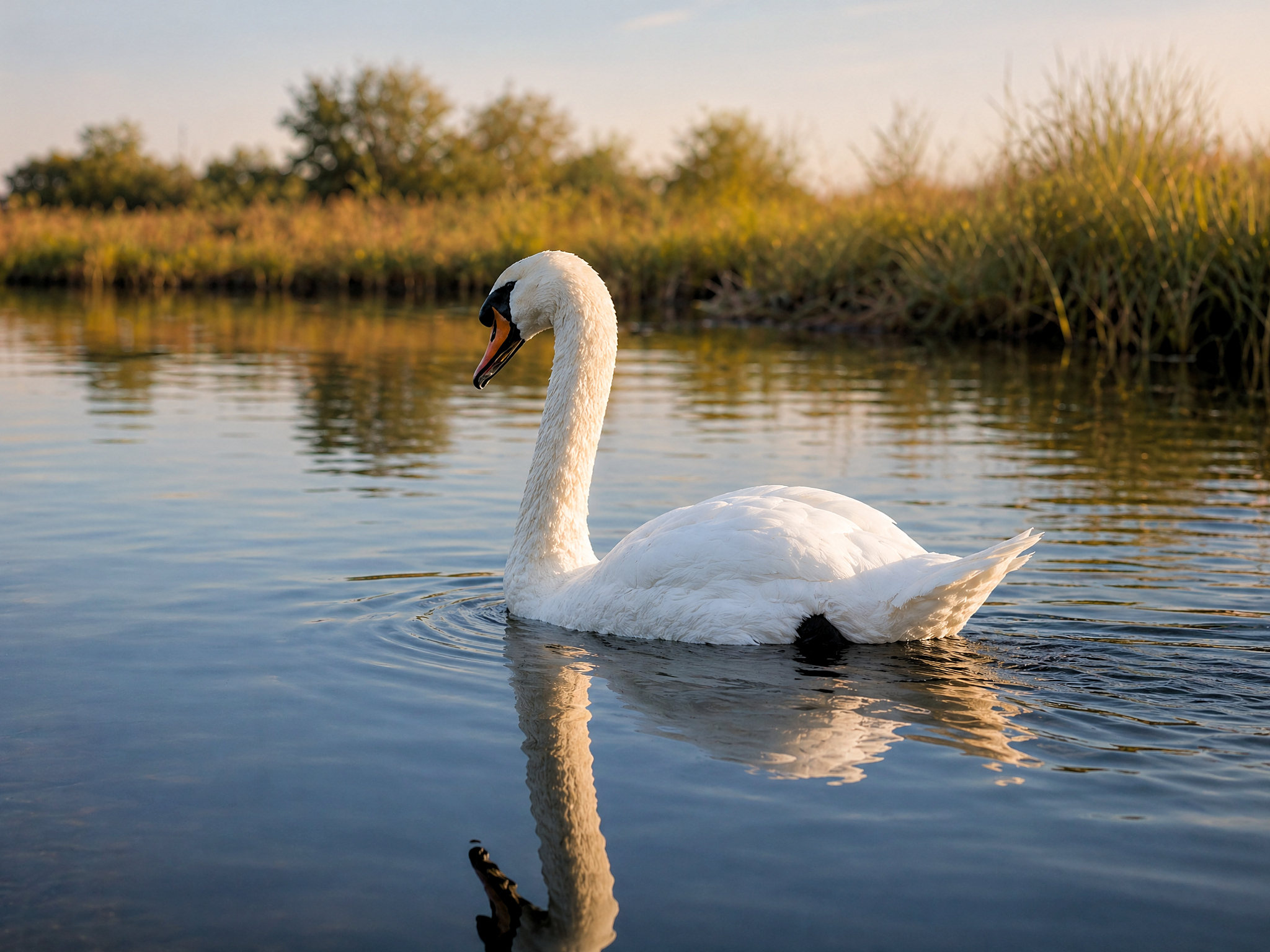
Aquatic birds in Scotland are woven into folklore that reflects survival, belief, and the shifting boundary between the natural and the supernatural. Nowhere is this clearer than in the tragic tale of the Swan of Loch Sunart, where love, transformation, and death meet on the water’s edge.
The Swan of Loch Sunart
The tale begins, as many do, with a sunset over the loch. Its fading light gilded the northern hills and cast a quiet glow over young love.
Their names were Eideard and Ceana.
Eideard was the chieftain’s eldest son. Yet he valued nothing more than the hours spent at the lochside with Ceana. She was a crofter’s daughter, raised in hardship and uncertainty. Her family worked tirelessly, always aware that one poor season could bring ruin. Still, the community endured, and no one was left entirely destitute.
Though Ceana carried this burden, her heart lifted whenever she saw him.
“I love you,” Eideard told her one evening. “I would ask my parents for their blessing, if you will have me.”
Ceana hesitated. “I love you too. But I am a crofter’s daughter. Let me first gather a dowry worthy of your family.”
He refused to see any obstacle. Like many before them, they trusted in hope.
A Mother’s Refusal
Eideard went to his parents. His mother had imagined a noble bride, one who would strengthen their household and standing.
“You will not marry her,” she said. “You will not see her again. If you defy me, you are no son of mine.”
Her words did not waver. Though Eideard argued, nothing changed. In anger and grief, he fled to the loch and waited for some answer.
None came.
The Witch’s Bargain
Suspicion soon took root in his mother’s mind. When she discovered he still met Ceana, her anger hardened into resolve. The village spoke of a witch in the forest, one who granted wishes at a price.
She sought the witch out.
“What will you pay?” the witch asked.
“Remove the girl from my son’s life,” she replied.
“Then give me your most precious possession,” said the witch, “and I will take from him what he loves most.”
Without hesitation, she gave up her cloak, the last gift from her own mother.
That evening, the witch waited by the loch. When Ceana arrived, the spell was cast. In an instant, she was transformed into a swan, white as bone, her sorrow locked in silence.
Loss and Return
Eideard came as he always did, but Ceana did not appear. He waited for days, then weeks. Eventually, he understood she was gone.
Time passed. He returned to duty, though he avoided the loch.
Until one morning.
Drawn back, he saw a swan unlike the others. Still and beautiful, it stood apart on the water.
He raised his bow.
The arrow struck true.
As the swan fell, its form changed. Feathers became flesh. Dark hair spread across the loch.
Ceana.
Horrified, Eideard rushed to her. Taking her hand, he drove his dagger into his chest, mirroring her wound. Together, they sank beneath the water.
It is said that all the swans of Loch Sunart took flight at that moment. None have returned since.
This story establishes a key pattern. Water birds are not simply animals. They are vessels of transformation, loss, and the unseen.
Swans in Scottish Lore and History
Aquatic birds in Scotland are not confined to story alone. Swans, in particular, move between folklore and recorded history.
Archaeological evidence shows that swans were eaten in Mesolithic Scotland, with their bones found in ancient midden heaps. However, by the medieval period, they had taken on symbolic and ceremonial importance.
In 1306, Edward I of England held the Feast of the Swans, where he knighted 267 men and swore “by God of Heaven and the Swan” to take vengeance against Robert Bruce. Here, the swan is no longer just an animal. It becomes a symbol of oath, power, and royal authority.
Local tradition adds another layer. The swans of Linlithgow Loch were said to have abandoned the water when Cromwell’s forces occupied the royal palace. They did not return until the restoration of Charles II.
This detail matters. It suggests that swans were believed to respond to political and moral disorder. Their presence, or absence, became a sign of legitimacy and rightful rule.
Taken together, these traditions reinforce the same idea found in the Swan of Loch Sunart. Swans are not passive creatures. They reflect the state of the world around them, whether emotional, moral, or political.
Ducks, Sacred Protection, and Tragic Error
Aquatic birds in Scotland inhabit liminal spaces. Thus, in many cases, they are protected by sacred belief.
Ducks, for example, were associated with the Virgin Mary. Because of this, harming a duck, especially one with young, was believed to bring misfortune. This belief appears clearly in Gaelic tradition, where religious reverence and older folklore overlap.
One recurring motif tells of a young man sent to hunt ducks. As he fires at a white shape on the water, he discovers too late that he has killed his beloved, who had gone to bathe in the loch.
The tragedy is not accidental in a folkloric sense. Instead, it reflects a moral structure in which violence, even unintended, carries irreversible consequences. The water becomes a liminal space, where love and death intersect.
One of the clearest examples of this is found in the haunting lament Mairead Òg. In it, a young man is sent by his mother to hunt ducks. When he fires at a white shape on the water, he realises too late that he has killed his beloved.
A Mhairead òg, ‘s tu rinn mo leòn,
’S i caileag bhòidheach lurach thu.
(Young Margaret, it is you who has wounded me,
You were a beautiful, graceful girl.)
Later, the cause is made clear:
Gur h-i mo mhàthair rinn an call,
Nuair chuir i shealg nan tunnag mi.
(It was my mother who caused the loss,
When she sent me to hunt the ducks.)
This is not simply an accident. Instead, it reflects a moral framework where violence carries consequences. The lament is sung from the young man’s deathbed, where his broken heart is draining away his life. As with the Swan of Loch Sunart, misrecognition leads directly to tragedy.
Bride’s Bird: The Oystercatcher and Protection
Aquatic birds in Scotland also appear as protectors, particularly in traditions linked to saints. The oystercatcher, known as Bride’s bird, is closely associated with St Brigid.
According to tradition, Brigid was fleeing from men who sought to kill her. She reached the shore with nowhere to hide. At that moment, oystercatchers saw her plight and covered her with seaweed, concealing her from danger.
Because of this act, she blessed them.
From then on, they were known as Bride’s birds. Their cry, often heard as “Bi glic, bi glic” meaning “be wise,” is understood as a warning shaped by that moment of protection.
This is significant. Unlike storm omens or transformation tales, the oystercatcher occupies a protective role. It is not feared but respected. Its presence signals awareness, caution, and memory.
The story also reflects a broader pattern in Scottish folklore. Animals are not passive. They act, intervene, and participate in human fate. In doing so, they become part of both landscape and belief.
Storm Petrels and the Souls of the Sea
Not all aquatic birds carry positive meanings. Along the coasts, storm petrels were viewed with unease.
Small and dark, they skim low over the waves, often appearing before rough weather. Sailors recognised this pattern, but they also believed something more.
Storm petrels were said to carry the souls of drowned men or cruel captains condemned to wander the sea. Their restless movement mirrored this eternal punishment.
As a result, they were feared rather than welcomed. Protective measures, such as nailing horseshoes to masts, were used to ward off their influence.
Here, practical observation and superstition merge. The bird signals a storm, but it also embodies the dead. This dual meaning reflects the lived reality of coastal communities, where danger and belief were inseparable.
Aquatic Birds of Scotland: More than just part of the Landscape
Across these traditions, clear patterns emerge. Aquatic birds act as omens, protectors, and transformed beings. They move between worlds, linking the living and the dead, the natural and the supernatural.
In this way, they are not simply part of the landscape. They help interpret it.