Walter Milne stands as the last Protestant martyr burned in Scotland, a death that helped accelerate the Scottish Reformation. His execution in April 1558 shocked the nation. As a result, public sympathy shifted further toward reform, weakening the authority of the Roman Catholic Church. Many other Protestants would die on the battlefield or in prison, but this was the last time someone was burned at the stake for being Protestant.
Early Life and Religious Convictions
Walter Milne was born around 1476 in Forfarshire. He later became a Roman Catholic priest at Lunan near Montrose. However, his views changed after exposure to Reformation ideas, likely during time spent in Germany.
As a result, Milne rejected key Catholic doctrines, including the Mass. He also supported clerical marriage, which placed him in direct conflict with church authorities. During Cardinal David Beaton’s tenure, he was accused of heresy. Consequently, he fled Scotland and lived in exile for over a decade.
Return to Scotland and Arrest
Walter Milne returned to Scotland in 1556, already over eighty years old. Despite his age, he continued quietly teaching Protestant beliefs. In April 1558, he was arrested in Dysart, Fife. At the time, he was found instructing a woman in the commandments.
He was then imprisoned in St Andrews Castle. Soon after, he faced trial before senior church figures in St Andrews Cathedral. Although frail, he spoke with notable clarity and conviction. Contemporary accounts describe his voice filling the church.
Trial and Defiance
Walter Milne was eighty-two years old when he was brought to trial in St Andrews Cathedral. By this point, he was frail and physically weak. Contemporary accounts state that he could scarcely climb the steps to the pulpit where he was required to answer for his beliefs.
Yet once he began to speak, the weakness fell away. His voice carried clearly through the cathedral. Observers noted the force and clarity of his words, which stood in stark contrast to his failing body.
He did not attempt to save himself. Instead, Walter Milne openly affirmed the charges and used the moment to challenge the authority of the Church. He rejected the Mass as a repeated sacrifice and insisted that Christ’s sacrifice had been made once and for all.
When condemned, he refused to recant. His response was deliberate and unyielding. He declared, “I am corn, not chaff; I will not be blown away with the wind or burst by the flail.” Even in extreme old age, he would not bend.
Execution at St Andrews
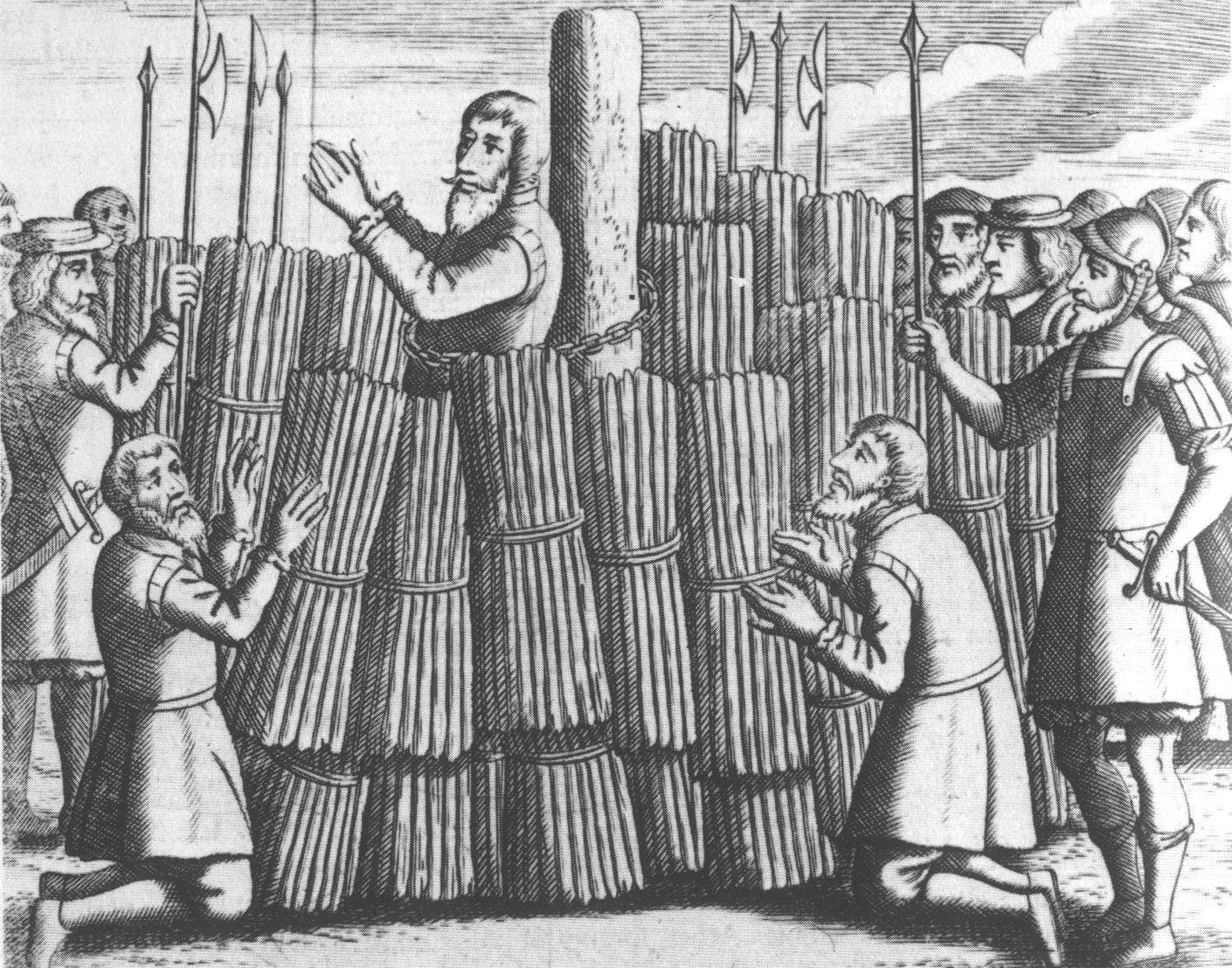
Walter Milne’s execution exposed the growing divide between the Church and the people. He was an elderly man, eighty-two years old, who could barely stand unaided. Yet he was led to the stake and condemned to die by fire.
The reaction in St Andrews was telling. Townspeople refused to supply materials for the execution. Officials declined to take part. Shops were closed in protest. Even those not aligned with reform were disturbed by what they saw.
Despite this resistance, the execution went ahead. The authorities were forced to improvise, using rope taken from the archbishop’s own pavilion.
As the fire was lit, Milne remained resolute. He declared that he suffered not for any crime, but for the truth of Christ. He urged those watching not to be led astray, but to depend only on Christ’s mercy.
His death was not quiet. It was witnessed, remembered, and reacted to. The image of an old man, frail yet unbroken, burned for his beliefs, carried weight across Scotland.
Impact on the Scottish Reformation
Walter Milne’s execution came at a critical moment. Protestantism had already been spreading across Scotland for decades. Earlier martyrdoms, including Patrick Hamilton and George Wishart, had drawn attention to reformist ideas.
However, Milne’s age made his death particularly disturbing. He was eighty-two, an unusual age for the period. Consequently, his execution appeared excessive and unjust.
Public reaction was immediate. According to contemporary accounts, his death ignited renewed support for reform. Within a year, John Knox returned to Scotland. By 1560, the Reformation had transformed the nation’s religious landscape.
Legacy and Commemoration
Walter Milne’s death was not the end of his story, but the beginning of a national transformation. Today, he is remembered through several significant memorials that reflect his importance to Scotland’s history.
In St Andrews, he is named on the Martyrs’ Monument on the Scores, sharing the space with other reformers like Patrick Hamilton and George Wishart. Near the site of his execution at Deans Court, a stone X is set into the ground, marking the spot where he stood his ground.
Most notably, he is honoured within the walls of Edinburgh Castle. In the Great Hall, a stained-glass window bears his name, ensuring that his defiance remains etched into the fabric of one of Scotland’s most iconic landmarks. This recognition in the heart of the nation’s capital underscores that Milne was not just a victim of his time, but a pivotal figure who helped shape the future of Scotland.