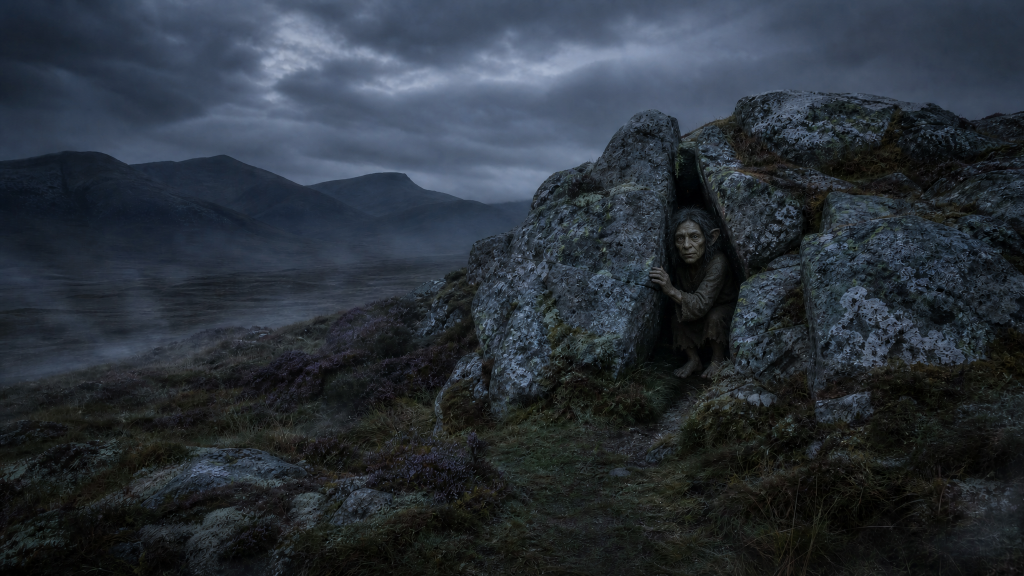
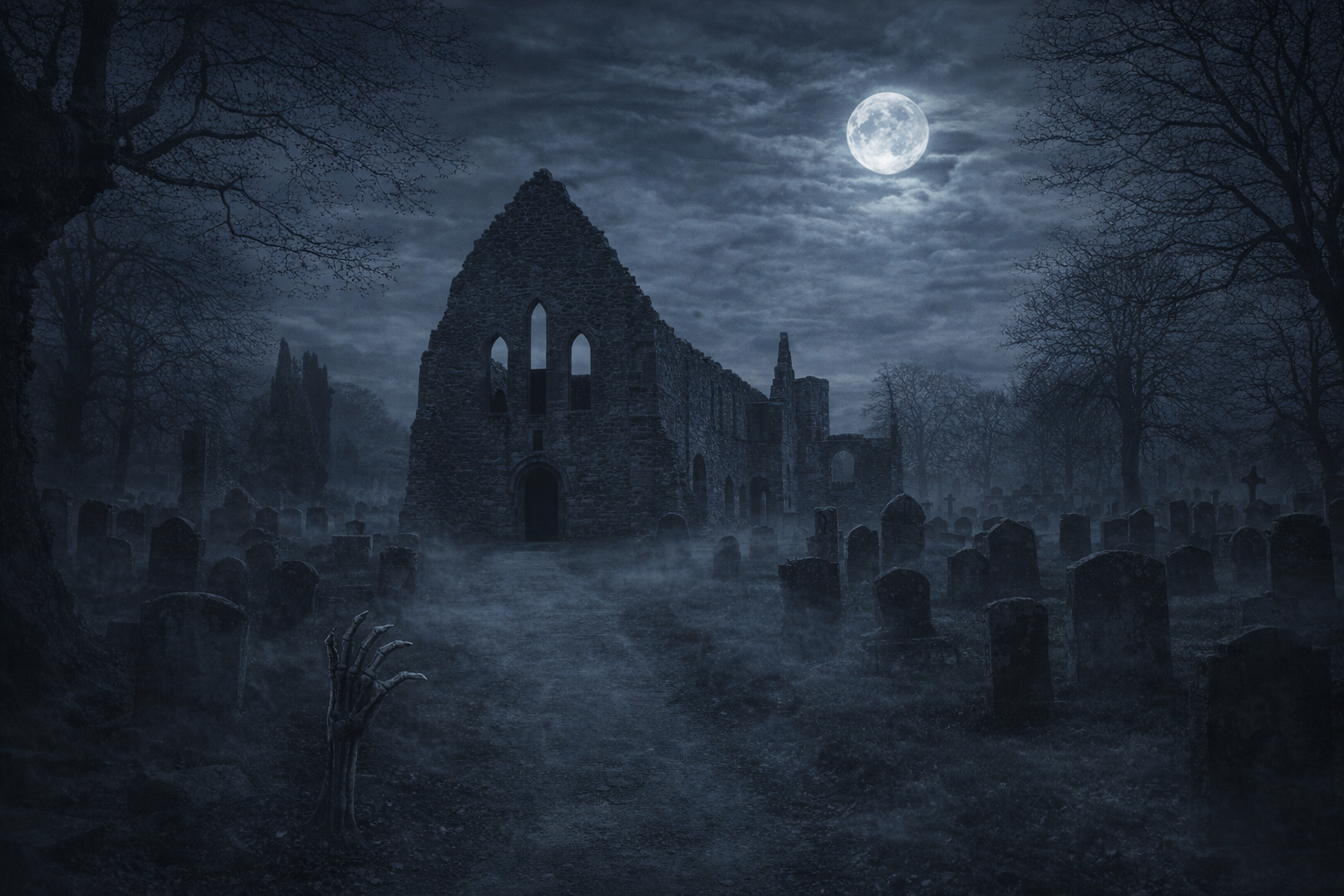
Name pronunciation: Spohk Lee-ah
General Information:
The Spog Liath is one of the most popular and chilling ghost stories found throughout the Scottish Highlands. Frequently associated with old, ruined churches and abandoned monasteries, this legend warns of the dangers of trespassing on consecrated ground after dark. Historically, the tale serves as a classic cautionary folk narrative about a restless, skeletal entity that manifests piece by piece from within a tomb.
Appearance:
As the name suggests, the defining feature is a large, skeletal grey hand or paw. This entity initially appears as a ghastly, fleshless head emerging from the earth. Consequently, as the encounter progresses, it reveals a long, grizzled neck and a spindly arm. The appendage is described as being completely devoid of blood, meat, or muscle, ending in long, bony fingers or a sharp, reaching claw.
Habitat:
This apparition is exclusively tied to sacred burial sites and ancient places of worship. It typically haunts sites like Beauly Priory, the cathedral of Iona, or the old church of Glassary in Argyll. Therefore, it is rarely encountered in the wild, as its power seems anchored to the stone tombs and kirkyards of the Highlands.
Behaviour:
The Spog Liath is a predatory and patient spirit that tests the resolve of those who stay within its domain. It rises slowly from the grave only when its victim draws breath. Thus, it uses a psychological game of “cat and mouse” to terrorise witnesses. Ultimately, if the intruder is not fast enough, the spirit strikes with physical force to leave a permanent mark or take a piece of the victim’s flesh.
Shape-shifting Ability:
While not a traditional shape-shifter like a Kelpie, it manifests incrementally. It starts as a disembodied head and slowly grows into a partial, lanky torso. In some versions, the horror is intensified because the spirit remains stationary while spoken to, but lunges forward during the natural pauses in human speech.
Variant:
Various versions of this entity exist across the islands and mainland. In Skye, it is specifically linked to the Eaglais Uamhalta near Duntulm. Meanwhile, on Iona, it is known as a fleshless hand that appears on the walls of a specific nook in the cathedral to taunt hardworking tradesmen.
Location in Scotland:
The most famous sightings are recorded at Beauly Priory (Eaglais Mhòr na Manachainn) in Inverness-shire. Additionally, it has been reported at the old church of Glassary and within the sacred grounds of Iona.
Stories/ Sightings or Experiences:
The Tailor and the Haunted Kirk
The Spog Liath is the primary antagonist in a legendary wager involving a courageous tailor. This man bet that he could sew a pair of hose at midnight inside the haunted Beauly Priory. While the moon shone through the windows, a ghastly head emerged from a tomb. The ghost looked at the tailor and spoke of its hunger, describing its “old grey cow” of a head.
The tailor replied, “I see that and I sew this,” keeping his stitches steady despite his growing dread. Furthermore, the tailor realised the ghost only moved when he drew breath. He drawled out his words to keep the spirit still, but eventually, his lungs failed him. The ghost rose higher, revealing a long neck and then a fleshless arm.
As the tailor reached the final stitches, the ghost cried out, “A big grey claw that is without meat!” With a final surge of adrenaline, the tailor finished the hose and leapt for the door. The claw struck the doorframe just as he escaped, tearing away a piece of his clothing. To this day, tradition says the mark of those bony fingers remains on the door-post.
Purpose of the myth or Legend:
This legend functions as a classic memento mori, reminding the living of the inevitable decay of the flesh. Because the tailor was a prideful man who made light of the dead, the story serves as a warning against spiritual arrogance. Specifically, it reinforces the sacredness of the “aire chlaidh” or graveyard watch, suggesting that the boundary between the living and the dead must be respected.