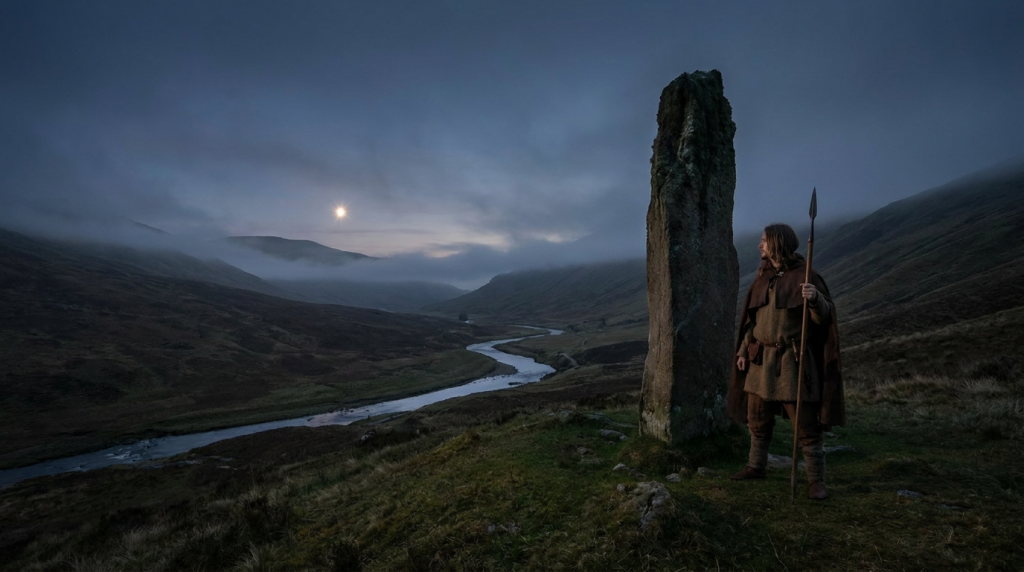
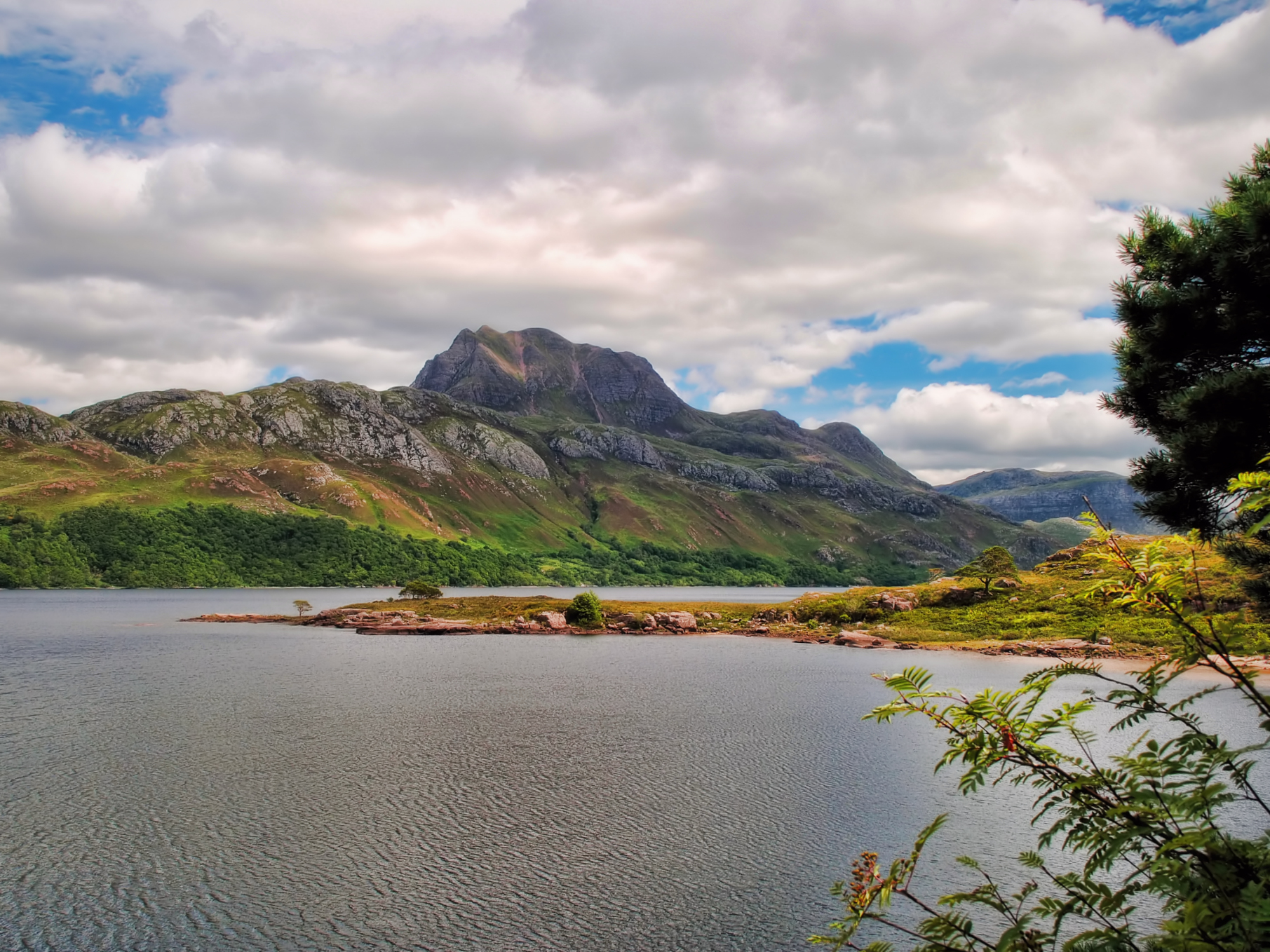
Loch Maree lies nestled deep within the rugged wilderness of Wester Ross, a dark jewel framed by the Torridon mountains. It is an ancient landscape, the loch itself, formed in a glacial trough that is 110 metres deep. This is a land of many faces. On a calm day, the water is like a mirror-the scenery is undeniably stunning. As it clouds over, the landscape takes on a brooding quality, a reminder that man is never completely in control over this wild terrain. And when the mists roll down from the hills, there is a feeling that the Otherworld is not far away and that at any moment you might see an ethereal creature step out from the haze.
This is a land of thresholds, where land meets water, where water meets forest and where islands hold dark histories. Moss-draped waterfalls cascade from the heights of Beinn Eighe and Slioch, while stands of Caledonian Forest cover the islands and the lower reaches of the mountains. The forests are home to crossbills, red deer and pine marten. Small wonder Beinn Eighe became the UK’s first nature reserve. Overhead eagles, both Golden and White-tailed, wheel and keen while otters, black-throated divers, sea trout and salmon inhabit the waters of the Loch. Yet these dark waters are said to be home to another creature, something more sinister. This is a land where history and folklore converge.
The Pictish Origins and the Arrival of Saint Máel Ruba
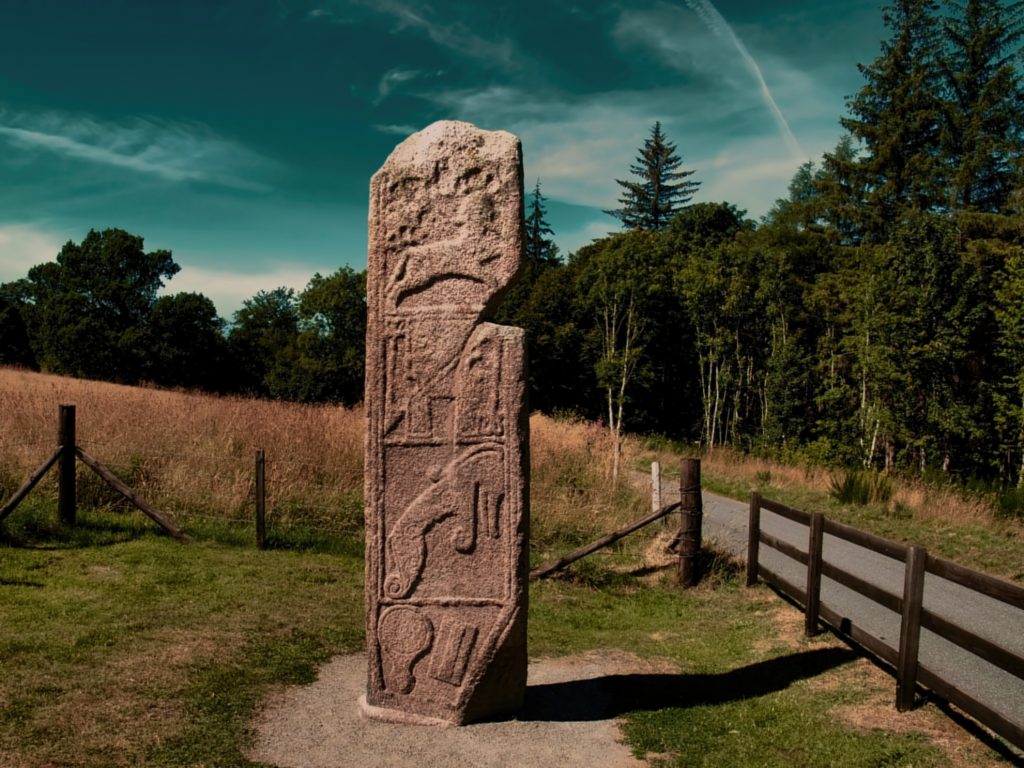
Loch Maree sits within a landscape that was a stronghold of the Picts long before the transition to Gaelic, or the first Viking longships arrived. Evidence of this ancient presence remains visible in the Class I Pictish symbol stones discovered at nearby Gairloch and Poolewe. These stones likely date to before Christianity, marking the region as a site of tribal power and pagan ritual. Consequently, the loch was likely a sacred geography for these early people, who found spiritual significance in its deep waters and isolated islands.
The early Picts were pagan, practising a faith rooted in animism and the natural world. They likely practised some form of animal sacrifice. Rhynie Man, the stone found near the Rhynie complex, depicts a grotesque man carrying a poleaxe; the kind used in ritual sacrifice. It has been suggested that Rhynie Man might even wear a mask. At Burghead, numerous stones were found incised with bulls. Pagan rituals were often centred on “liminal” spaces where the earth met the water. Furthermore, the islands of the loch provided the perfect sanctuary for these pre-Christian ceremonies. This established a tradition of sanctity that would persist for over a millennium, even as new faiths began to cross the mountains from the west.
Rubha Chailleach – The Crone’s Point
Even the place-names around Loch Maree hold layers of older belief systems, and none is more striking than Rubha Chailleach. This long blue headland pushes into some of the loch’s deepest water, and its name is one of the few surviving clues to the spiritual weight the landscape once carried.
Across Scotland, Cailleach appears in the names of hills, corries, lochs and headlands. Consequently, Rubha Chailleach sits within a broader pattern in which the land itself preserves the presence of the Crone. In Gaelic tradition, the Cailleach is often linked to the wintry, ancient figure sometimes called the Cailleach Beira. She shapes the land, controls the weather and may represent a lingering memory of a pre‑Christian mother or earth goddess.
The Muc-sheilche: The Turtle-Pig of Loch Maree
Even the monster said to live in the depths of Loch Maree might be the vestige of some older belief. The Muc-sheilche is a malevolent water-serpent whose name translates from the Gaelic as “turtle-pig” or “shelled-sow.” This linguistic curiosity suggests a creature that is neither fish nor mammal, but a thick-skinned, perhaps armoured, inhabitant of the deep. Unlike the more famous, modernised Nessie, the Muc-sheilche remains rooted in darker, more primitive folklore. It is viewed not as a tourist curiosity but as a predatory force that embodies the cold, unforgiving nature of the Highland wilderness.
Local tradition describes the beast as a colossal, dark shape that rolls through the water like a submerged log. Furthermore, its presence was once so feared that 19th-century locals made genuine attempts to eradicate it. At nearby Loch na Bèiste—the “Loch of the Beast”—a local proprietor named Mr Banks reportedly spent a fortune attempting to drain the water to find the creature. When that failed, he resorted to tipping vast quantities of quicklime into the depths in a desperate bid to poison the monster.
Is it possible that what we now call Muc-sheilche was once revered as the spirit of Loch Maree, but with the coming of Christianity, became demonised to be the monster we know today?
The Mission of Saint Máel Ruba
In the late 7th century, the Irish missionary Saint Máel Ruba travelled north from his monastery at Applecross to convert the Picts. He established a cell on one of the islands, which eventually took his name. Over centuries of local linguistic shift, “Eilean Maol Rubha” became Isle Maree. Is it possible that this island was chosen because it was once a pagan sacred site with a sacred well? Frequently, the early Christians chose former pagan sites as their bases, making the transition from the old religion to the new easier. The arrival of Christianity did not immediately erase the older, darker beliefs of the local population. Instead, the two systems merged into a unique and persistent folk religion.
This synthesis created a site where Christian devotion and pagan sacrifice coexisted. While the island was dedicated to the saint, the rituals performed there remained startlingly primitive. Pilgrims did not merely come to pray; they came to strike bargains with forces that demanded blood. This transition from pure paganism to a “Christianised” cult allowed ancient customs to survive well into the modern era.
The Blood of the Bull Sacrifice
The sacrifice of bulls on Isle Maree is one of the most documented examples of pagan survival in Scotland. This practice was likely an offering to a pre-Christian deity known as “Mourie,” whose name was later conflated with that of the saint. Historically, the bull was a symbol of lunar power and virility. By the 17th century, the ritual had become a desperate preliminary to the “cure for insanity” sought by families across the Highlands.
Church records provide primary evidence of these forbidden acts. In 1678, the Presbytery of Dingwall took disciplinary action against four men for sacrificing a bull on the island. Furthermore, in 1695, Hector MacKenzie and his family carried out a sacrifice to seek a cure for a sick relative. These accounts prove that the ancient pagan impulse to appease the land with blood remained a living reality for centuries after the saint’s death.
The Holy Well and the Poisoned Wishing Tree of Isle Maree
Isle Maree is also home to an ancient Holy Well and a Wishing Tree. These stand as monuments to centuries of human desperation and environmental tragedy. The island became the primary destination for those seeking a miraculous cure for “lunacy” through harrowing rituals. Patients were bound and jerked into the cold loch water three times. Furthermore, they were forced to drink from the holy well while kneeling before the saint’s altar in a desperate bid for sanity.
The ritual persisted for generations, blending Christian intercession with the primal shock of the “cold water cure.” However, the well reportedly dried up in the 19th century after a shepherd attempted to cure his mad dog in the sacred water. Both the dog and the shepherd died shortly after, leading to whispers of a permanent curse upon the desecrated site.
The Poisoned Wishing Tree of Isle Maree
Near the ruins of the well stands the Wishing Tree, an ancient oak whose bark is entirely encrusted with thousands of coins. Queen Victoria famously added a florin to the trunk during her visit in 1877. Visitors hammer copper and silver into the wood to “leave” their illness or to buy a wish from the spirits. Consequently, the high concentration of copper leaching into the living wood has poisoned the tree, leading to its slow and visible death. Reverend Joseph McKenzie McPherson, writing of the tree in 1929, blamed its destruction on the insertion of coins damaging the bark: “the devotion of pilgrims has proven its undoing”.
The death of the Wishing Tree serves as a cautionary tale for those visiting the “joining of realms” in the Highlands. Furthermore, the practice of leaving non-biodegradable offerings has begun to choke the delicate ecosystem of Isle Maree. While the impulse to connect with the Otherworld is ancient, the physical impact of these modern rituals is often devastating. Therefore, preserving these sacred sites requires a shift in how we interact with the landscape. Respecting the environment is now as vital as respecting the spirits that were once thought to dwell there.
The Tale of Olaf and the Princess
Loch Maree holds within its dark, peat-stained depths the memory of a Viking tragedy that still haunts the silence of its islands. This narrative centres on Isle Maree, where the ruins of a 9th-century tower once sheltered a Norwegian prince and his Scottish bride.
Olaf was a young Norwegian prince and chief among the Vikings who dominated the West coast of Scotland. He lived with his warriors on board his long ship except in the winter when the cold winds blew off the Atlantic and snow covered the mountain peaks. Then the men would encamp on the islands in Loch Ewe. At these times, Olaf would frequently travel to the Isle of Maree to seek out the priest on Maree Isle. Olaf was known for his temper and frequently needed some priestly advice and absolution.
A Tower at Loch Maree
Olaf was a man of passion, and so when he fell in love, it was only to be expected that the flames of love that burned within his breast matched his fiery temper.
But how could he ask his beautiful Scottish true-love to swap the peacefulness of her father’s home for the restless life aboard his warship? Olaf sought advice from the priest. The wise man proposed that he build a tower next to his humble cell on the Isle of Maree.
Immediately, the plan was set in motion; the tower was built, and Olaf swept his young bride off her feet and took her to the island. There, the priest married the couple.
The Departing
For a while, all went well. The lovers were inseparable, but all too soon the summons came. There was to be an expedition, and Olaf was expected to assume command of his men. With an aching heart, he told the princess of his departure. But no matter how many tears she shed, nothing would prevent Olaf from leaving on the morrow.
They agreed that on his return, a white flag would be displayed from Olaf’s ship if all was well. On the other hand, if some misfortune was to befall him, a black flag was be displayed in its stead. Similarly, the princess would use the same system of black and white flags.
Olaf Returns
Olaf’s campaign was a success, and he set off home in haste, half-crazy with excitement. He hoisted a snow-white flag from his boat on Loch Maree.
Meanwhile, during the weeks of their separation, the young princess doubted his loyalty. What if he loved the excitement of battle more than he loved her? She devised a plan to test his loyalty. She had a bier placed on her barge. As his ship came into view, she had the black flag raised. She lay down upon the bier as if she were dead and ordered her rowers to push off into the loch.
Tragedy at Loch Maree
Olaf saw the black flag. He saw the princess lying upon the bier, and as the ships drew close, he jumped from his boat. Kneeling by the bier, he plunged his dirk into his breast. He died almost instantly. The princess was now convinced of Olaf’s love, but it was everlastingly too late!
She drew the blade from Olaf’s heart and plunged it into her own, her lifeblood mingling with Olaf’s. The bodies of the unhappy pair were buried beneath the shade of the holly trees on the island. To this day, two slabs incised with the outlines of medieval crosses mark their graves.
The Red Smiddy
Loch Maree still carries the marks of Scotland’s early industrial age at a site known as the Red Smiddy on the River Ewe. In the seventeenth century, this charcoal‑fired ironworks consumed huge tracts of native oak woodland, turning living forest into fuel for smelting bog iron. Consequently, what is now a quiet, scenic stretch of water once echoed with hammer blows, smoke and the steady felling of trees.
The “Red Smiddy” takes its name from the iron ore and slag that stained the soil a deep rust colour. Furthermore, it symbolises a period when the loch was treated primarily as a resource to be exploited, rather than a sacred place. While the ironworks brought short‑term profit, the long‑term cost was the loss of much of the primaeval oak wood that once fringed these shores. Therefore, the discoloured earth and scattered furnace remains stand as a reminder that human activity has been scarring this landscape for centuries.
The Joining of Realms at Loch Maree
Loch Maree remains one of Scotland’s most atmospheric landscapes because it functions as a joining of realms where history and folklore collide. From the tragic Viking graves on Isle Maree to the industrial scars of the Red Smiddy, every layer of the loch tells a story of human struggle and spiritual seeking. Consequently, the water is not merely a scenic backdrop but a repository for centuries of Highland belief and dark history.
The presence of the Muc-sheilche and the enduring name of Rubha Chailleach suggest that the ancient pagan world never truly left these shores. While the Holy Well has run dry and the Wishing Tree stands poisoned, the sense of the ancient deities persists. Therefore, visiting the loch today requires an appreciation for both its natural beauty and its more unsettling past.
Whether through the lens of Pictish stones or the echoes of the Cailleach, the loch reminds us that the land carries memories far longer than our own. By walking these shores with an awareness of their history, we acknowledge a landscape that is as haunted as it is holy.
References
Gairloch in North-West Ross-Shire- John H Dixon (1886)
Illustrated Gaelic-English Dictionary- Edward Dwelly (1988, 10th Ed)