
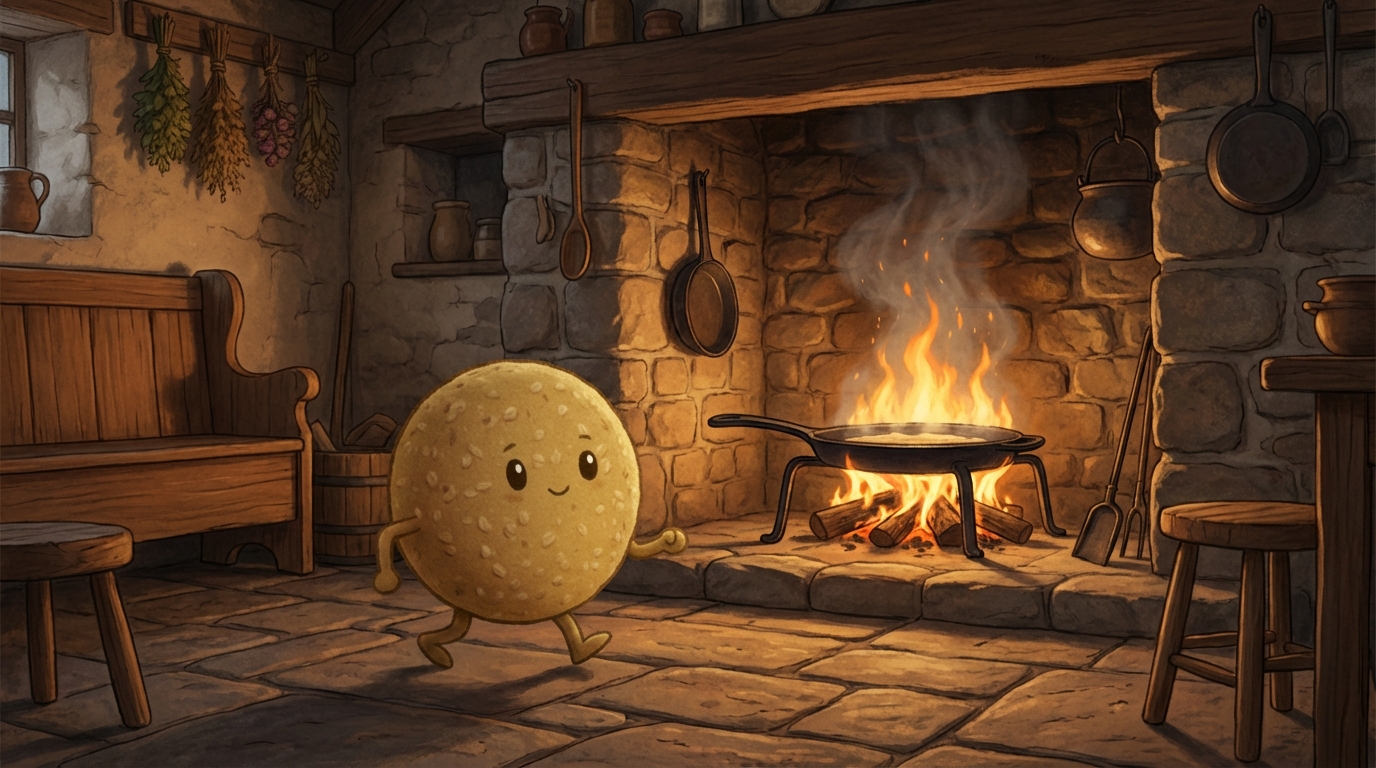
The Wee Bannock is a beloved story from Scottish folklore, especially when the air turns crisp and families gather for Shrove Tuesday. While many people across the globe know this day as Pancake Day, in Scotland, the traditions carry a unique Celtic flavour. This day marks the final feast before the fasting period of Lent begins on Ash Wednesday. Historically, it was the perfect time to use up rich ingredients like eggs, milk, and butter, which were forbidden during the forty days of Lenten sacrifice.
What is Shrove Tuesday and Pancake Day?
Shrove Tuesday is the traditional feast day before the start of Lent on Ash Wednesday. The name comes from the word “shrive,” which means to confess one’s sins and receive absolution. Because the date of Easter changes every year, Shrove Tuesday is a moveable feast that always takes place exactly 47 days before Easter Sunday. In many cultures, this evolved into “Fat Tuesday” or Mardi Gras, a time for indulgence. Because pancakes are a clever way to use up all the remaining fats and dairy in the larder, the day became synonymous with frying up golden treats. In Scotland, these pancakes are traditionally called bannocks, which are often thicker and heartier than the thin crepes found elsewhere.
Scotland’s Answer to the Gingerbread Man
Across Europe there are variations on runaway food in fairytales. In Scotland, the story of the Wee Bannock replaces the tale of the Gingerbread Man found in other English-speaking traditions. Instead of a ginger-spiced biscuit running from a fox, we have a stubborn, oatmeal-based cake. This story is a staple of Scottish oral tradition, often told to children huddled by the fire. While the Gingerbread Man famously taunts his pursuers with a song, the Wee Bannock relies on its “jook-about” agility to dodge tailors, weavers, and millers across the Scottish countryside.
The Tale of the Wee Bannock Begins
There once was an old man and his wife who lived in a lovely little cottage by the side of a burn. They were a canty and contented couple, possessing two sleek cows, five hens, a cockerel, and a few cats. One morning, the old woman decided she would like an oatmeal bannock for her supper. She baked two fine cakes and set them before the fire to harden. However, when the old man came in from the byre, his eyes fell on the treats. “Och, these look rare and tasty,” he muttered, breaking one through the middle.
The Wee Bannock Makes a Break for It
When the other bannock saw this, it decided it should not have the same fate. It louped up from the hearth and ran across the kitchen floor. “Gracious me!” cried the old woman, “Look at yon Wee Bannock, it’s awa’!” She chased it with her spindle in one hand and her distaff in the other, shouting, “Stop, ye wee cowart!” But the bannock was young and supple, while she was old and stiff. It escaped over the hill behind the house, leaving the old couple breathless and hungry. It ran and ran and ran!
The Wee Bannock and the Village Folk
The runaway cake first took refuge in a tailor’s cottage. The tailor and his two apprentices were sitting by the window while the tailor’s wife was sitting carding by the fire. All of a sudden, the Bannock appeared and the tailors were so startled they jumped behind the tailor’s wife!
“Hoot,” she said, “what a set of cowards ye be! ’Tis but a nice wee bannock. Grip it, and I’ll fetch a drink of milk.”
Despite their attempts to catch it with shears, the bannock dodged them all.
It then trundled to a weaver’s house.
“What’s that, Tibby?” the weaver asked with a start.
“’Tis a wee bannock!” she cried.
“Dinna bother your head where it came fae,” the weaver shouted, “but grip it, woman, grip it!”
But though they tried to catch it with the weaver’s shuttle, it dodged and turn and twisted, till at last it flew out the door and vanished down the hill.
The Wee Bannock and the Butter Churn
In the next home that the Wee Bannock entered, the Goodwife was churning butter. The sight of the Wee Bannock fair made her hungry, but as she made a grab for the Wee Bannock, he dodged round the churn with the Goodwife in hot pursuit. The Goodwife was in such a hurry she nearly upset the churn, and by the time she righted it, the Wee Bannock was out the door and half down the brae to the mill.
The miller was busy sifting flour, when he saw the bannock.
“It’s a sign of plenty when bannocks are running about with naebody to look after them,” he said; “but I like bannocks and cheese, so just come in, and I will give thee a night’s lodging.”
But the Wee Bannock had no desire to be eaten by the miller, so it ran out the mill.
It ran and ran until it arrived at the Smiddy.
Narrow Escapes at the Smiddy and the Farm
The smith, busy at his anvil, looked up and grinned. “If there be one thing I am fond of, it is a glass of ale and a well-toasted cake. Come inbye, and welcome to ye!”
But the bannock had no wish to be washed down with ale. It turned and dashed out, narrowly avoiding the smith’s heavy hammer.
Next, the Bannock arrived at a farm.
At a nearby farmhouse, Janet cried to her husband, “Hit it over the back with your cloving-stick, Sandy! Quick, or it will be out the door again!”
But the bannock played “jook-about,” and ducked behind a chair.
Janet threw her heckle or comb for carding flax, but it missed the Wee Bannock who took out the door and carried on to the next house, a little cottage by among the heather.
The Final Fate of the Wee Bannock
In the little cottage, the wife was making brose for supper, in a pot over the fire, while her husband was braiding ropes of straw to tie up their cow.
“Oh, Jock! come here, come here,” cried the Goodwife. “Ye were asking for a little bannock for yer supper; come here, quick, and help me to catch it.”
“Sneck the door,” cried the husband, “and we’ll try to catch it. It would come in handy after the porridge.”
The master of the house tried to smother it with his coat, but the breathless cake wriggled free and jumped over him, laughing as it ran into the grey gloaming.
The old man got onto his feet and chased after the Wee Bannock, through the stackyard, across the fields and into a fine patch of yellow whins.
Exhausted, the Wee Bannock sought shelter under a whin bush, but in the dark the Wee Pancake never noticed that it was a fox’s earth.
Deep below the ground, the fox’s nose twitched. Hunger gnawed at its belly for it had been two days since the fox had last eaten. The smell of the fresh baked bannock wrapped around its heart like a hairy worm. He edged forward and found the sleeping bannock.
“Oh, welcome, welcome,” he purred. Then he opened his muckle maw and snapped the little cake through the middle with his teeth—and that was the end of the poor Wee Bannock.