Name pronunciation: (/nʌklɑːˈviː/)
General Information:
The Nuckelavee is the most malevolent demon to haunt the Scottish islands. This grotesque entity originates from Orcadian folklore, where it is feared as a bringer of plague and destruction. While many water horses like the Kelpie have some redeeming qualities, this creature is purely evil. Its name likely derives from the Orcadian word knoggelvi, which translates to “Devil of the Sea.” Some historians suggest the “nuck” part of the name relates to “Old Nick,” a traditional name for the Devil. The monster is so terrifying that islanders would never speak its name without immediately saying a prayer for protection. During the summer months, the benevolent spirit known as the Mither o’ the Sea keeps the beast confined. However, as her power wanes in the autumn, the demon is unleashed to roam the land.
Appearance:
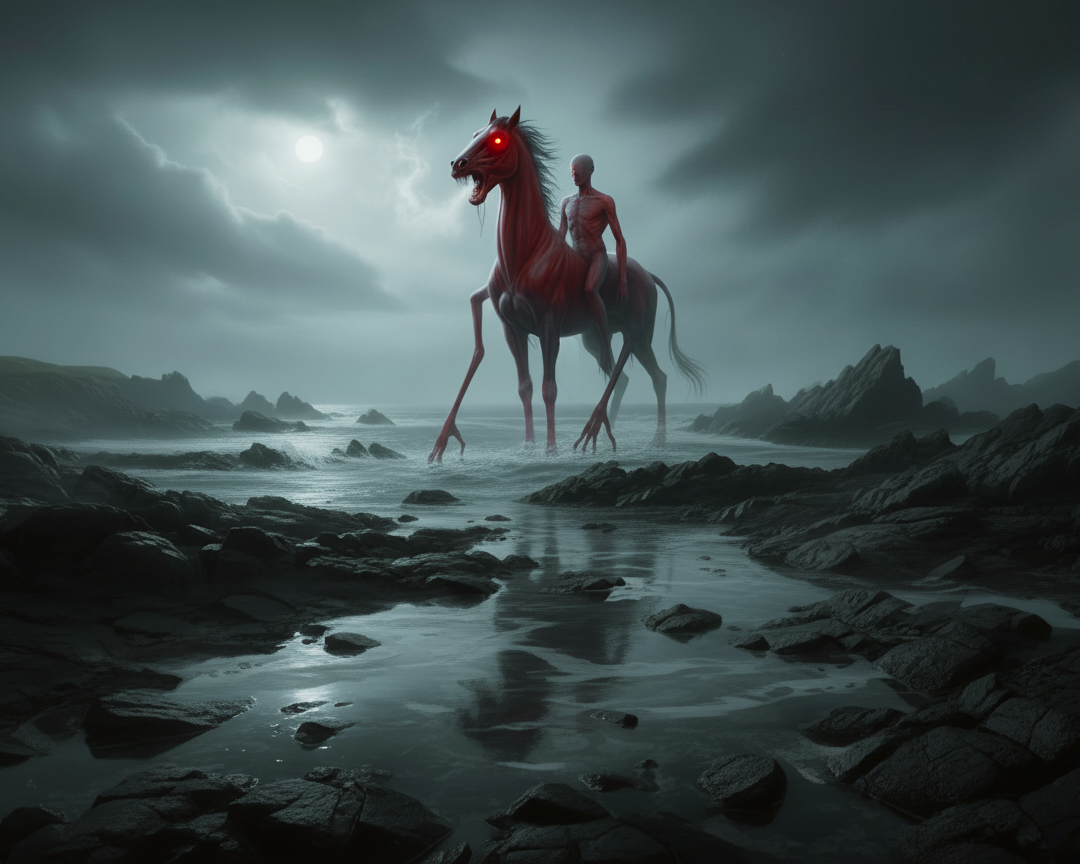
The Nuckelavee appears as a horrific fusion of a man and a horse. It stands three times the height of a human and possesses a colossal horse head with a single, glowing red eye. A man-shaped torso grows directly from the horse’s back, but this rider has no legs. Instead, its giant arms are so long that they skim the ground. The most gruesome detail is that the creature has no skin. Its entire body is a pulsating mass of raw muscle, yellow veins, and white sinew. Black blood courses through its body, visible to any unfortunate witness. The horse head features an enormous, gaping mouth that releases a toxic, pungent vapour.
Habitat:
The Nuckelavee primarily inhabits the tempestuous seas surrounding the Orkney Islands. It is a sea-dweller by nature, though it frequently ventures onto the sandy dunes and coastal moors. The creature is often found near the shoreline, particularly during the dark winter months. It has a strong aversion to fresh water and will never be found near rivers or streams. Additionally, the demon refuses to come ashore if it is raining.
Behaviour:
The Nuckelavee is a solitary and malevolent hunter with extensive evil powers. Its breath is a deadly poison that can sicken livestock and cause crops to wilt in the fields. Islanders traditionally blamed the beast for droughts, epidemics, and poor harvests. It is particularly enraged by the smell of burning seaweed, a practice once common for producing soda ash. In retaliation for the smoke, the monster would spread a fatal horse disease known as mortasheen. The creature is relentless when pursuing prey, yet it is easily distracted by splashes of water.
Shape-shifting Ability:
The Nuckelavee does not possess the typical shape-shifting abilities found in other Scottish water spirits. While nobody knows its true form while it remains in the sea, it always takes the same disgusting, centaur-like appearance upon land. It cannot disguise itself as a handsome human or a normal horse to lure victims.
Variant:
The Nuckelavee is considered a unique entity, though it shares similarities with the mukkelevi of Shetland. It is also frequently compared to the Norwegian nøkk and the Shetland nuggle. Some folklorists believe the legend is a composite of Celtic water horses and Scandinavian sea demons brought over by Norse settlers.
Location in Scotland:
The Nuckelavee is specifically in the Orkney Islands, off the northern coast of Scotland. Sightings have been reported on the island of Stronsay and along various Orkney beaches.
Stories/ Sightings or Experiences:
The Narrow Escape of Tammas
Tammas was an islander who claimed to have survived a face-to-face encounter with the beast. One moonlit night, he was walking home between a freshwater loch and the sea. He noticed a dark figure approaching and soon realised it was the skinless demon. The monster reared up, its single red eye fixed on him while its long arms reached out to grab him. Tammas knew the creature hated fresh water, so he backed toward the loch. He accidentally splashed the monster’s leg with loch water, which caused the beast to snort in fury. This brief distraction allowed Tammas to sprint toward a nearby freshwater stream. He jumped across the running water just as the creature’s claws reached for him. He escaped with his life, though he lost his bonnet to the demon’s grasp.
Call of the Nuckelavee
In this tale, a lone woman walks the dunes of an Orkney beach while following the voice of her drowned father. She sees a dog that looks like her father’s old pet and follows it into the surf. Suddenly, the colossal, skinless form of the Nuckelavee rises from the waves. The creature holds the decaying remains of the dog in its clawed hand. The rider’s face splits open to reveal rows of sharp teeth, and it speaks with the sound of a thousand tortured souls. Just as the beast closes in, a sleek selkie intervenes. The selkie had answered a wish made at a gravestone in Castletown. This distraction allows the woman to stumble back toward safety as the two mythical beings face off in the moonlight.
Purpose of the myth or Legend:
The Nuckelavee served as a powerful explanation for natural disasters that ancient islanders could not understand. It provided a face for invisible threats like respiratory diseases, crop blights, and sudden livestock deaths. The legend also acted as a stern warning about the genuine dangers of the unpredictable Scottish coastline. By attributing droughts and plagues to a skinless demon, the community could process their shared trauma through folklore. The creature’s weakness to fresh water also reinforced the importance of geography and local landmarks for survival.