Name pronunciation:
tarav OOSH-kə (Scottish Gaelic; uisge = water)
General Information:
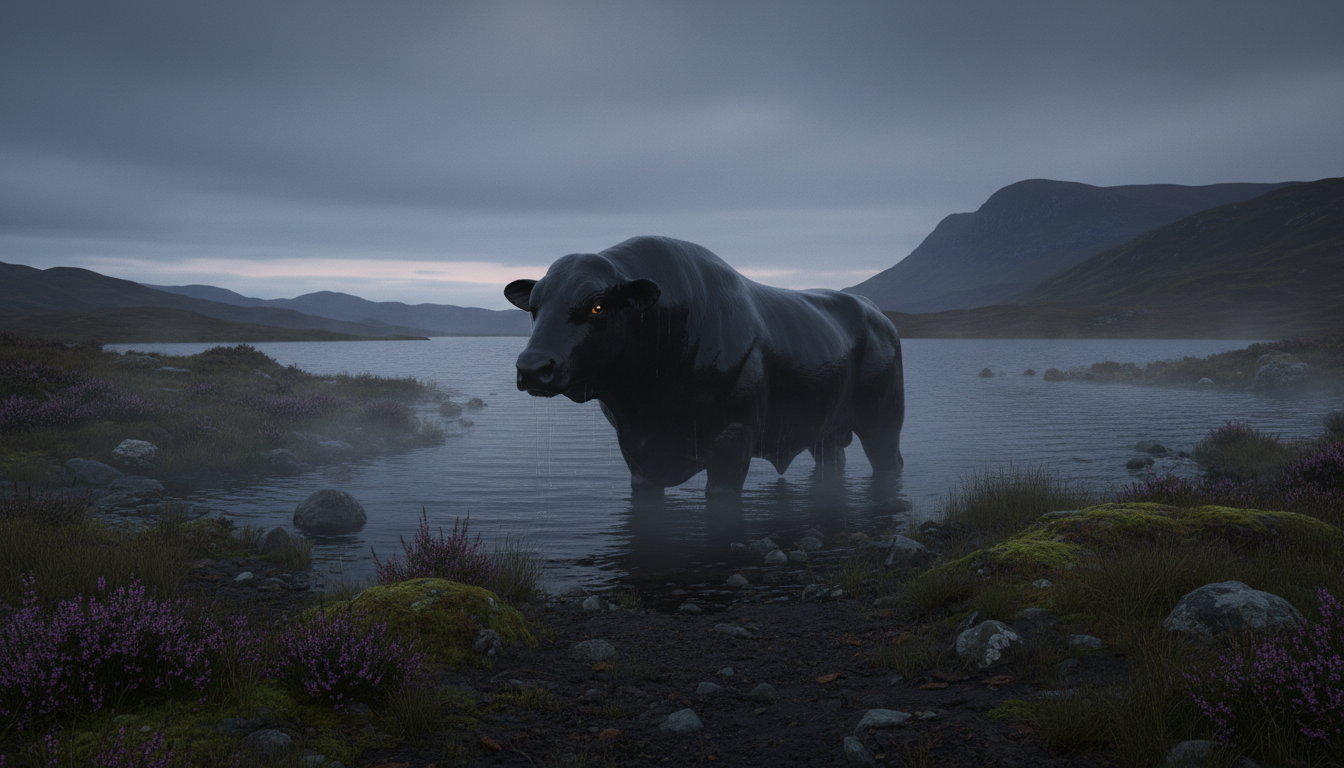
The Tarbh Uisge is the Scottish water bull. It is a mythical monster that resembles other Scottish water beings, such as water horses and kelpies. However, it prefers the form of a bull. It is said to haunt lonely moorland lochs. It may also come among farm cattle at night.
The name is Scottish Gaelic. Edward Dwelly glosses tarbh-uisge as “water bull”, and he notes its “fabulous” nature. In other words, it is not simply a bull that lives near water. Instead, it is a supernatural creature.
Folklorists often describe the Tarbh Uisge as more amiable than its equine counterpart, the each-uisge. Even so, it can become violent if angered. It is also linked with shapeshifting. John Francis Campbell records that it can live on land as a human.
Appearance:
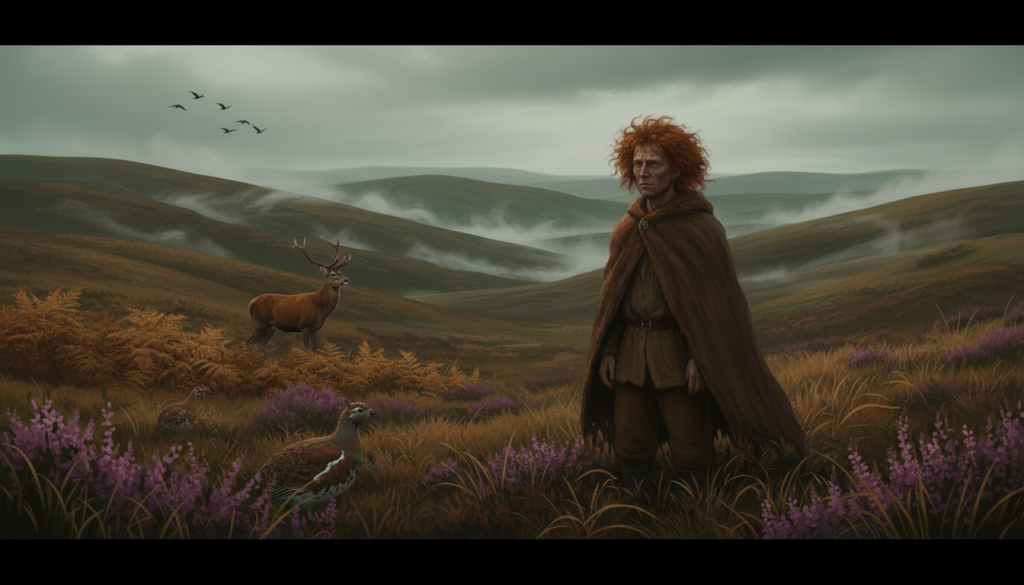
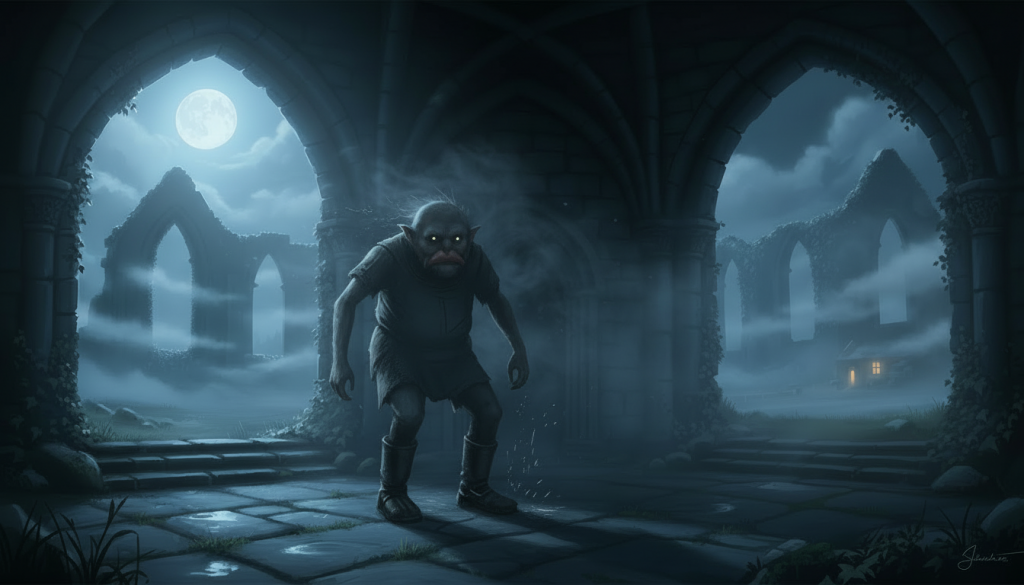
The Tarbh Uisge is usually described as bull-shaped and often black. In some accounts it looks small, ugly, and unnaturally dark. It may appear soft, velvety, or slippery in texture, which hints at its amphibious nature.
A striking detail appears again and again in tradition. The creature is said to have no ears. Therefore, its hybrid calves are born with short ears. These calves are often described as “knife-eared” in English, and carc-chluasach in Gaelic.
Habitat:
The Tarbh Uisge is said to live in:
- Lonely moorland lochs and small hill tarns
- Remote Highland lochans used for summer grazing
- Places where cattle are pastured near water
- Stories place it in several regions, including Islay, Lorn, Breadalbane, and islands such as Gigha.
- It is also linked to lochs between Loch Awe and Loch Rannoch in one account of attempted capture.
Behaviour:
The Tarbh Uisge is typically nocturnal. It is often heard more than it is seen. People report lowing near the loch at night. It may then come among cattle in folds or pasture.
Unlike the water horse, it is often described as harmless towards humans. In one Lorn story, a dairy-maid and a herdsman fled when they heard its strange bellow. Yet when they returned in the morning, the cattle were unharmed.
That said, its temper can vary. Some tales stress it can become a powerful and violent black beast if provoked.
Shape-shifting Ability:
The Tarbh Uisge is a shapeshifter. It can live in water or on land. The water bull is sometimes said to take human form. It can also be part of a wider cycle of water-being transformations in folklore.
In the Islay tale, the danger comes from a water horse in human guise. Yet the water bull, reared from a strange calf, ultimately takes on the role of protector.
Variant:
Most traditions focus on the male water bull. However, water cows appear in some accounts.
Sir Walter Scott mentions a water cow in a story about attempts to drain Loch na Beiste.
A water cow was also said to live near Borrodale on Skye.
Water cows were reportedly seen near Leverburgh on Harris. Their calves were noted for purple-coloured ears in some tellings.
These variants show that “water bull” lore is not one single story. Instead, it shifts by region.
Location in Scotland:
The Tarbh Uisge is connected with multiple Scottish landscapes and islands, including:
- Islay (Inner Hebrides): a major tale of a water bull raised in a byre, later battling a water horse
- Lorn (Argyll): a fold encounter with a small black bull-shaped creature and a strange bellow
- Breadalbane: lochans associated with water-bull tradition and cattle grazing
- Between Loch Awe and Loch Rannoch: a recorded attempt to trap one using a tethered sheep
- Gigha: reports of sightings within living memory in local tradition
- Skye and Harris: water cow traditions and unusual calves
Stories/ Sightings or Experiences:
The Islay Tale: The Guardian of the Byre
On the island of Islay, a strange calf was once born to a crofter’s herd. It was as black as coal, but its most striking feature was its ears, which were half the size they should have been. A wise woman—later revealed to be a witch—recognised the creature’s supernatural lineage immediately. She warned the herdsman that this was no ordinary beast and commanded that it be reared in total isolation for seven years, fed exclusively on the milk of three different cows.
Years later, the crofter’s daughter was grazing cattle by a lonely loch. A handsome stranger in fine clothes approached her, his smile charming and his manner disarming. When he asked her to comb his hair, she agreed, and he fell asleep with his head in her lap. As she worked, she was horrified to find his hair entwined with water weeds and seaweed that only grew in the deepest parts of the loch. Realising he was an each-uisge (water horse) in human form, she carefully slid her apron from beneath his head and fled toward the farm.
The creature awoke, transformed into a thundering black horse, and gave chase. Just as he was about to overtake her, the wise woman screamed for the herdsman to “open the bull house!” The water bull, now a massive and powerful beast, charged from the barn to meet the predator. A titanic battle erupted, the two monsters clashing with such fury that they tore across the landscape until they both plunged into the sea. The water horse was never seen again, but the body of the water bull was found washed up the next day, bloodied and broken. He had died protecting the family that had raised him.
The Lorn Encounter: The Cock-Crowing Bellow
In the district of Lorn, a dairy-maid and a cattle-man were finishing their evening work at the fold when they witnessed a small, ugly, and intensely black animal approaching the herd. It was bull-shaped but had a strange, velvety, and slippery appearance. Most unsettling was its voice; instead of a typical lowing, it emitted a weird, piercing sound described as being “like the crowing of a cock.” Terrified by the unnatural sight and sound, the pair fled into the night. When they returned at dawn, they found the cattle resting peacefully as if nothing had happened, leading them to believe they had encountered a Tarbh Uisge seeking the company of the mortal herd.
The Hunt for the Tarbh Uisge
While the water bull is often seen as amiable, its elusive nature has occasionally tempted hunters. John MacCulloch recorded an account of locals near Loch Awe and Loch Rannoch who attempted to snare a water bull that frequented the moorland. They tied a sheep to a sturdy oak tree as bait, hoping to trap the beast with heavy shackles. However, the Tarbh Uisge proved too powerful; it snapped the iron tackle as if it were twine and vanished back into the depths.
Another legend tells of a farmer and his two sons who attempted to hunt the creature with a musket. Knowing that supernatural beings are often immune to lead, they filled the barrel with silver sixpence coins. Despite their preparation and the legendary efficacy of silver against the “fey,” they failed to capture or kill the beast, which remained a ghost of the lochside.
Knife-eared Calves and the Question of Disaster
Many traditions claim that when the Tarbh Uisge mates with ordinary cows, the calves can be recognised by their ears. John Gregorson Campbell says the water bull has no ears, so its calves are born half-eared or “knife-eared”.
However, belief about these calves varies by region. In some places, people said a water bull calf should be killed at birth before it brings disaster to the herd. Yet in other regions, hybrids were considered superior cattle.
This tension suggests an important point. Folklore does not only preserve wonder. It can also encode farm anxiety about deformity, breeding, and livelihood.
Purpose of the myth or Legend:
Tarbh Uisge stories seem to serve several purposes.
First, they explain fear and uncertainty around water. Lochs are beautiful, but they are also dangerous. Therefore, a creature that comes from deep water to mingle with cattle makes sense as a warning.
Second, they reflect cattle culture. Bulls represent fertility, wealth, and survival. In Celtic belief, the bull could also carry sacred weight as a symbol of abundance. So the water bull becomes an unnerving fusion of the holy and the wild.
Third, the stories act as a folklore map of rural risk. Unusual calves, breeding fears, and the need to protect the herd appear again and again. Yet the legend also allows for hope. In the Islay tale, the supernatural calf grows into a guardian