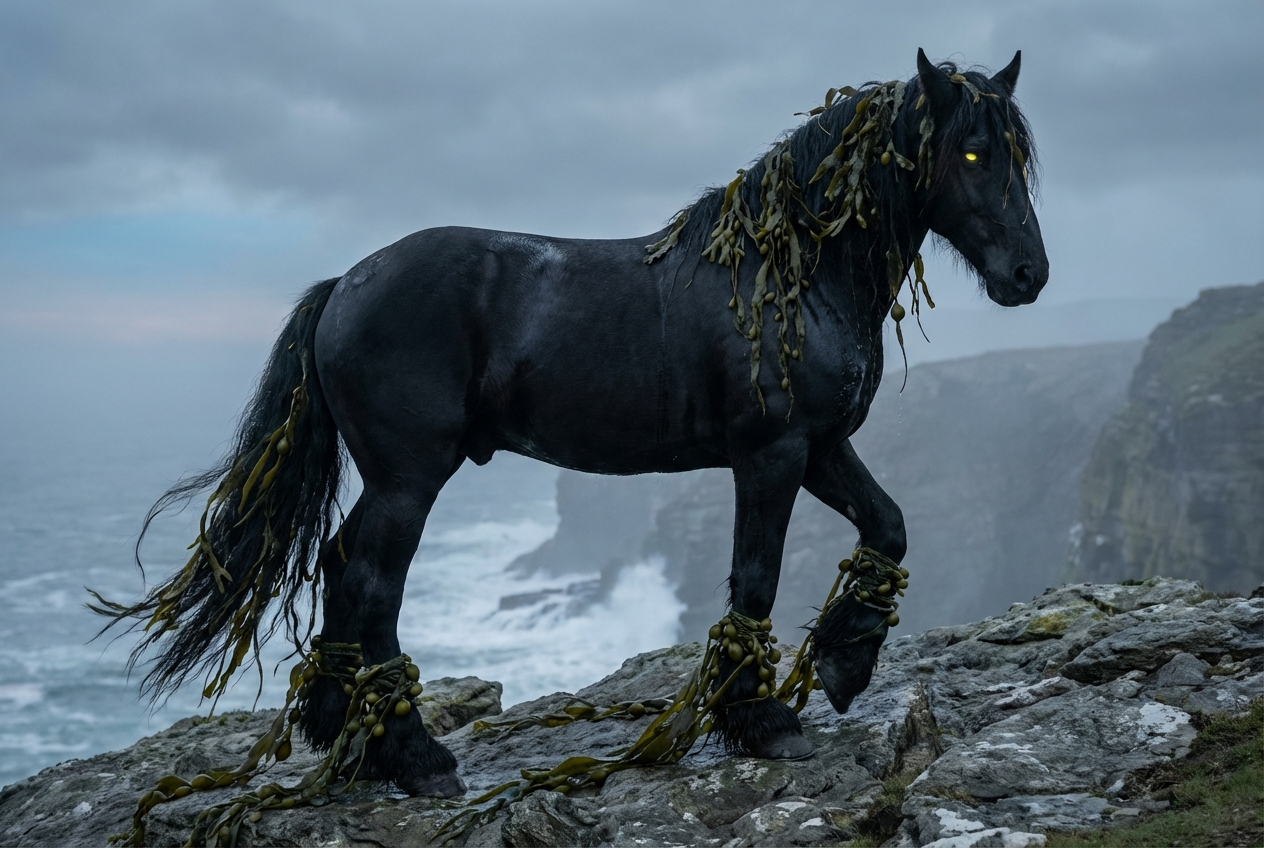
Tangie sightings have haunted the rugged coastlines of Orkney and Shetland for centuries. This is one of Scotland’s most malevolent water spirits. While many are familiar with the kelpie, the tangie is a distinct and terrifying shape-shifter. It draws its name from “tang,” or Fucus seaweed.
Name pronunciation:
TAN-gee
General Information:
Tangie is a malevolent water spirit native to the folklore of the Shetland and Orkney Islands. It is often categorised alongside other Scottish water-horses, yet it possesses unique traits that tie it specifically to the seaweed-strewn shores of the north. Unlike more playful spirits, the tangie is notorious for its predatory nature and its tendency to target lone travellers.
Appearance:
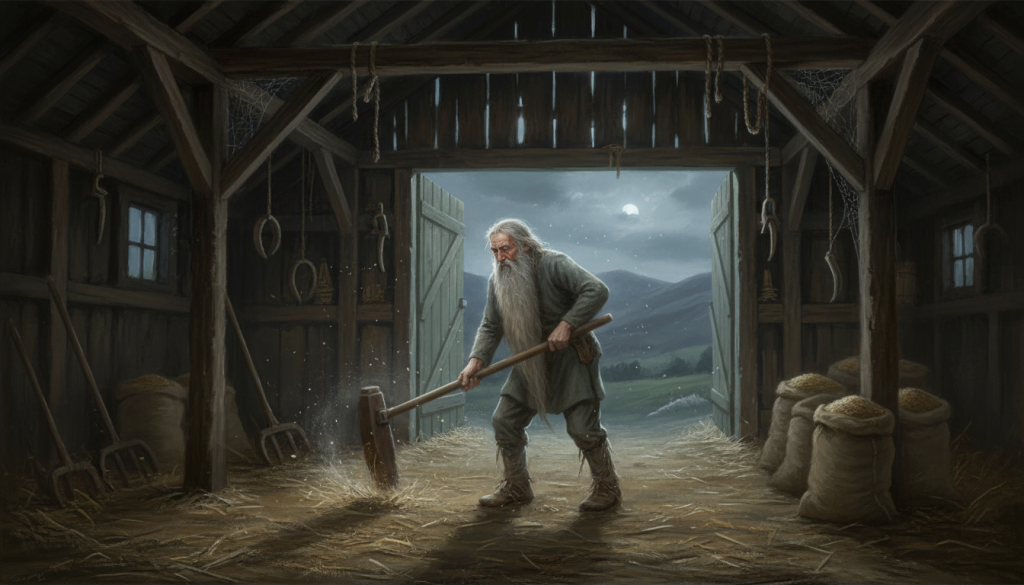
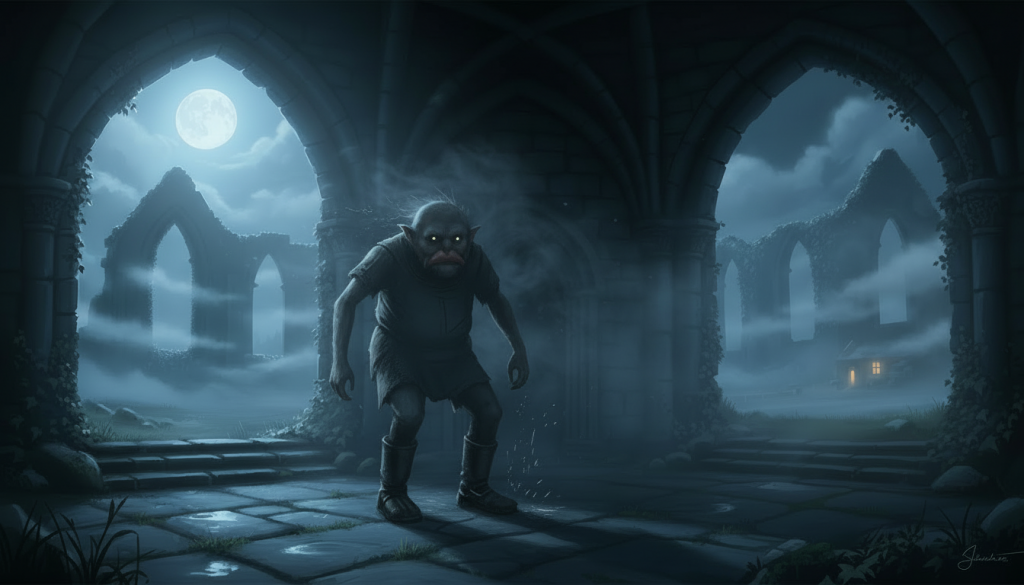
Most accounts describe the tangie as being perpetually covered in “tang,” which is the local name for seaweed of the genus Fucus. In its equine form, it appears as a powerful, dark horse with a coat that drips with brine and kelp. When it takes a human shape, it usually manifests as an aged, weathered man. However, it often retains a sea-worn or slightly unnatural appearance that betrays its true origin.
Habitat:
The tangie dwells in the cold, deep lochs and coastal waters of the Northern Isles. It is frequently sighted on the lonely roads and pathways that skirt the water’s edge, particularly near steep cliffs.
Behaviour:
Behaviourally, the tangie is a stalker that thrives on the abduction of humans. It is known to terrorise travellers at night, with a dark preference for preying upon young women. According to folklorist J.A. Teit, the creature can also cause “derangement” in both humans and animals, a supernatural disorientation that makes its victims easier to capture and drag beneath the waves to be devoured.
Shape-shifting Ability:
Shape-shifting is the tangie’s primary tool for deception. It can transition between the form of a horse and a man with ease. This allows it to approach unsuspecting victims on the road or blend into the shadows of a coastal path before revealing its true, monstrous intent.
Variant:
The Tongie appears to be a variant of the kelpie, along with other breeds from the Northern Isles, such as the Nuggle or Shoopiltee.
Location in Scotland:
Orkney and Shetland Islands; specifically associated with Fitful Head and the surrounding crofts of Dunrossness.
Stories/ Sightings or Experiences:
The Legend of Black Eric and the Demon Steed
The most enduring legend of the tangie involves a notorious sheep rustler named Black Eric who lived among the heights of Fitful Head. Eric was a man of immense strength and cruelty. However, his success as a thief was attributed to a dark partnership with a tangie. He would ride the creature in its horse form to commit his crimes, with the beast’s supernatural speed and “derangement” magic assisting in his evil deeds. Local fishermen even reported seeing blue flashes of light around the cliffs where the pair operated.
The reign of terror eventually met a violent end when a brave crofter named Sandy Breamer (or Ola Brand in some poetic versions) confronted the outlaw. During a desperate struggle on the cliff’s edge, Eric was stripped of his iron staff. He fell to his death in the churning sea. However, the tangie did not disappear with its master. Having learned the art of raiding from Eric, the creature continued to harass the local crofts and terrorise young women, proving that the spirit was a danger in its own right.
The Haunted Spindle of the Watermill
Following the death of Black Eric, his heavy iron staff was recovered from the shore. In an attempt to it into something productive, the staff was repurposed as a spindle for a local watermill. This proved to be a terrifying mistake. On Halloween night, the mill became a place of unearthly screams and groans as the machinery struggled against the cursed iron.
Witnesses claimed to see a terrifying vision of Black Eric standing upon the flying millstone, reclaiming his property. The mill eventually tore itself apart in a violent storm, with the spindle vanishing back into the darkness. This story serves as a grim reminder that the influence of the tangie and those who consort with it cannot be easily tamed or repurposed by honest men.
Purpose of the myth or Legend:
The tangie serves as a cautionary figure, warning of the dangers of the treacherous coastal landscape and the risks of travelling alone at night. It reinforces social boundaries and encourages vigilance near the water. Additionally, the association with “derangement” provides an explanation for the confusion that can strike a person in the wild, misty environments of the Northern Isles.