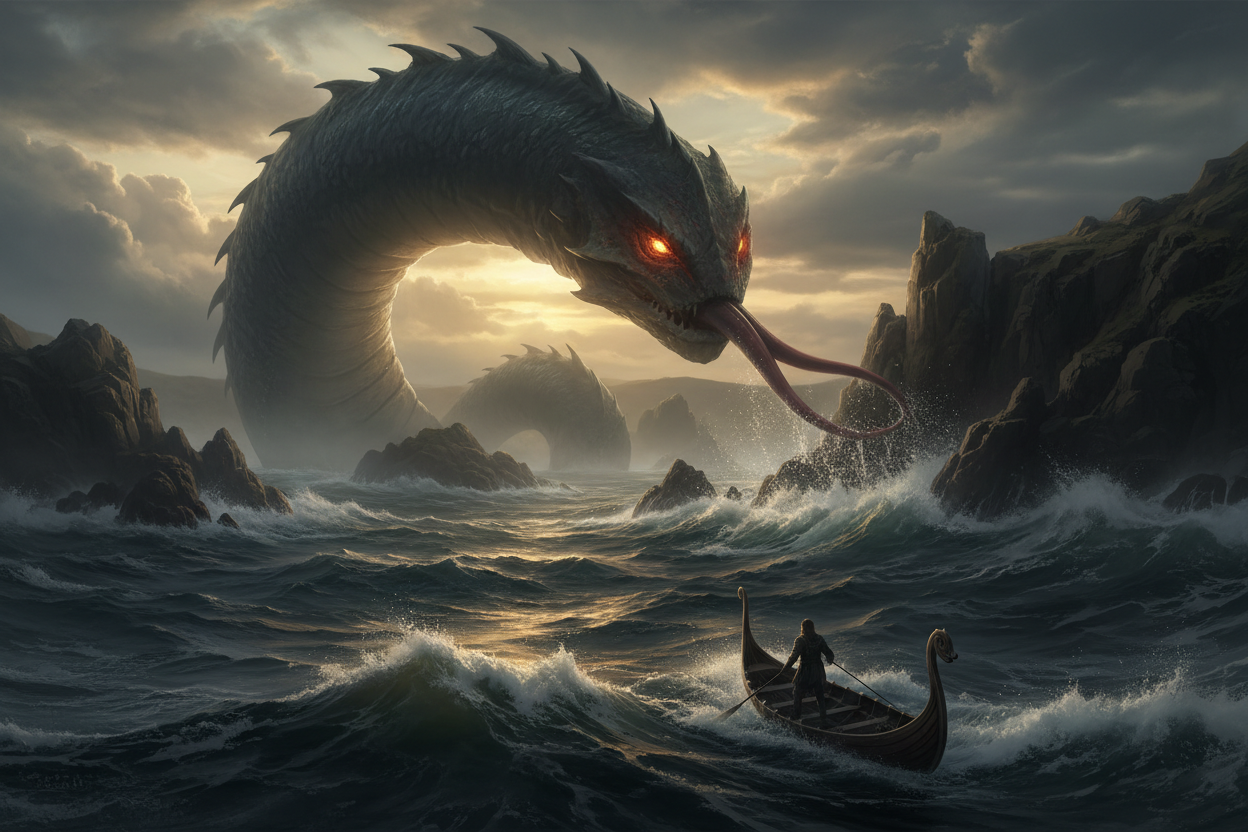
The Stoor Worm is one of Scotland’s most dramatic dragon legends and a powerful example of how Norse and Scottish folklore may have blended in Orkney. This monstrous sea serpent, often called Mester Stoor Worm, appears in a tale that feels very much like a Viking saga, yet it is firmly rooted in the northern isles of Scotland.
Name pronunciation:
Stoor Wurm
Mester Stoor Wurm
General Information:
The Stoor Worm is a gigantic sea dragon from Orcadian tradition. It is so vast that it can coil around the whole world. Many storytellers see it as a symbol of chaos and destruction. However, the tale also features heroism, magic and the creation of new lands. Because the story closely echoes themes from Norse mythology, many believe the Stoor Worm’s origins lie in Viking lore that later blended with local Scottish stories.
Appearance:
The Stoor Worm is described as a colossal sea serpent whose head is as large as a mountain and whose eyes are as dark and deep as lochs. It has a long, forked tongue capable of crushing castles and sweeping entire cities into its mouth. Its breath is so foul and poisonous that it kills any living thing nearby. Ships shatter like eggshells when this dragon rises from the sea. Everything about it is oversized, menacing and world-shaping.
Habitat:
This monster lives in the ocean at the edge of the known world. In older times, Scotland itself was thought to sit near the world’s end, and Orkney lay even farther into the northern seas. In the story, wherever the Stoor Worm lays its massive head along the coast, the nearby people must feed it to keep it satisfied. Its presence is tied to remote shorelines, deep waters and the vast, mysterious sea that once seemed filled with dragons and other horrors.
Behaviour:
The Stoor Worm brings terror and destruction wherever it appears. Over time it becomes one of nine plagues sent to curse the world. Eventually, it develops a particular taste for a gruesome delicacy. Every seventh day, at sunrise, it yawns nine times and demands a meal of seven virgins from the nearest kingdom. Its hunger and cruelty drive the plot of the tale. People live in fear of its demands, knowing that refusal means utter devastation.
Shape-shifting Ability:
The Stoor Worm does not shape-shift in the tale.
Variant:
The Stoor Worm is often linked to the Old Norse Storðar-gandr, another name associated with Jörmungandr, the world-serpent of Norse myth and child of Loki. Like Jörmungandr, Mester Stoor Worm is enormous and world-encircling, and its death reshapes seas and lands. The Scots word “stoor” can also mean dust, storm or disturbance, while “worm” (from Old English “wyrm”) often means dragon or serpent in old tales. The legend sits at the crossroads of Viking dragon lore and Scottish island storytelling.
Location in Scotland:
Orkney, the archipelago north of mainland Scotland, is the heartland of the Stoor Worm story. Historically, the islands were part of a Norse realm and only later became firmly tied to Scotland. The creation part of the tale also links the monster to the Orkney Isles, Shetland Isles, the Faroe Isles, the Baltic Sea and Iceland.
Stories/ Sightings or Experiences:
Assipattle and the Stoor Worm
The best-known story of the Stoor Worm centres on a young boy called Assipattle, whose name means “Cinder Lad.” He is the seventh son of a seventh son and spends his days by the hearth making up stories. While his father and brothers work hard on the farm, Assipattle dreams of adventure and is mocked as lazy and useless.
Meanwhile, the kingdom lives in terror of Mester Stoor Worm. To save his people, the King consults an old wizard, who coldly suggests sacrificing the Princess. Distraught, the King delays the sacrifice and offers a huge reward to anyone who can slay the dragon: the kingdom itself and the mighty sword Sikkersnapper, said to come from Odin.
Many brave warriors arrive, but most flee at the sight of the monster. Only twelve stand their ground, and the Stoor Worm destroys them. As the final deadline approaches and hope fades, Assipattle slips away from his home. He sets out alone in a small boat, carrying only a bucket with a smouldering peat from the family hearth.
Assipattle to the Rescue
On the seventh day, as the sun rises, the Stoor Worm begins to yawn. Each yawn drags a massive tide of water into its mouth. Assipattle guides his tiny boat close. During one great yawn, the surge pulls him and his vessel straight into the dragon’s cavernous jaws. Swept down its throat in a swirling torrent, he eventually runs aground deep inside the creature.
There he finds the Stoor Worm’s liver. With his knife, he cuts a hole into the organ and thrusts the glowing peat into it. The liver catches fire. As it burns, Assipattle races back to his boat. The dragon begins to retch, and in a violent heave, it spews boy and boat back into the sea. Assipattle reaches the shore just in time to witness the monster’s end.
The Creation of Orkney, Shetland and Iceland
As the Stoor Worm thrashes in agony, black smoke pours from its nostrils and its forked tongue lashes out. In its pain, the tongue hooks over one of the horns of the moon. Then it slips, tearing a huge rift in the earth below. The waters rush in and form what we now call the Baltic Sea.
While the beast writhes, its enormous teeth fall from its mouth. The first cluster of teeth becomes the Orkney Isles. More teeth tumble down into the sea and form the Shetland Isles and the Faroe Isles. Finally, in its death throes, the Stoor Worm curls up tightly upon itself and turns into the landmass now known as Iceland.
With the dragon dead, the kingdom is saved. Assipattle marries the Princess and becomes ruler, fulfilling the classic pattern found in many heroic sagas and fairy tales.
Purpose of the myth or Legend:
The Stoor Worm legend serves several purposes. First, it provides a dramatic, mythic explanation for the shape and position of northern lands and seas, including Orkney, Shetland, the Faroes, the Baltic and Iceland. Secondly, it reflects a likely Norse influence, echoing the story of Jörmungandr and fitting well with the era when Orkney was under Viking control. The presence of Odin’s sword and the world-serpent style monster strongly support this link.
At the same time, the tale also carries a moral message. Assipattle, the mocked “lazy” boy, proves that courage, imagination and quick thinking can succeed where brute strength fails. The story reassures listeners that heroes can come from the most unlikely places. Finally, like many dragon stories, the Stoor Worm narrative explores themes of sacrifice, fear and the hope that even the greatest evil can be defeated through wit and bravery.