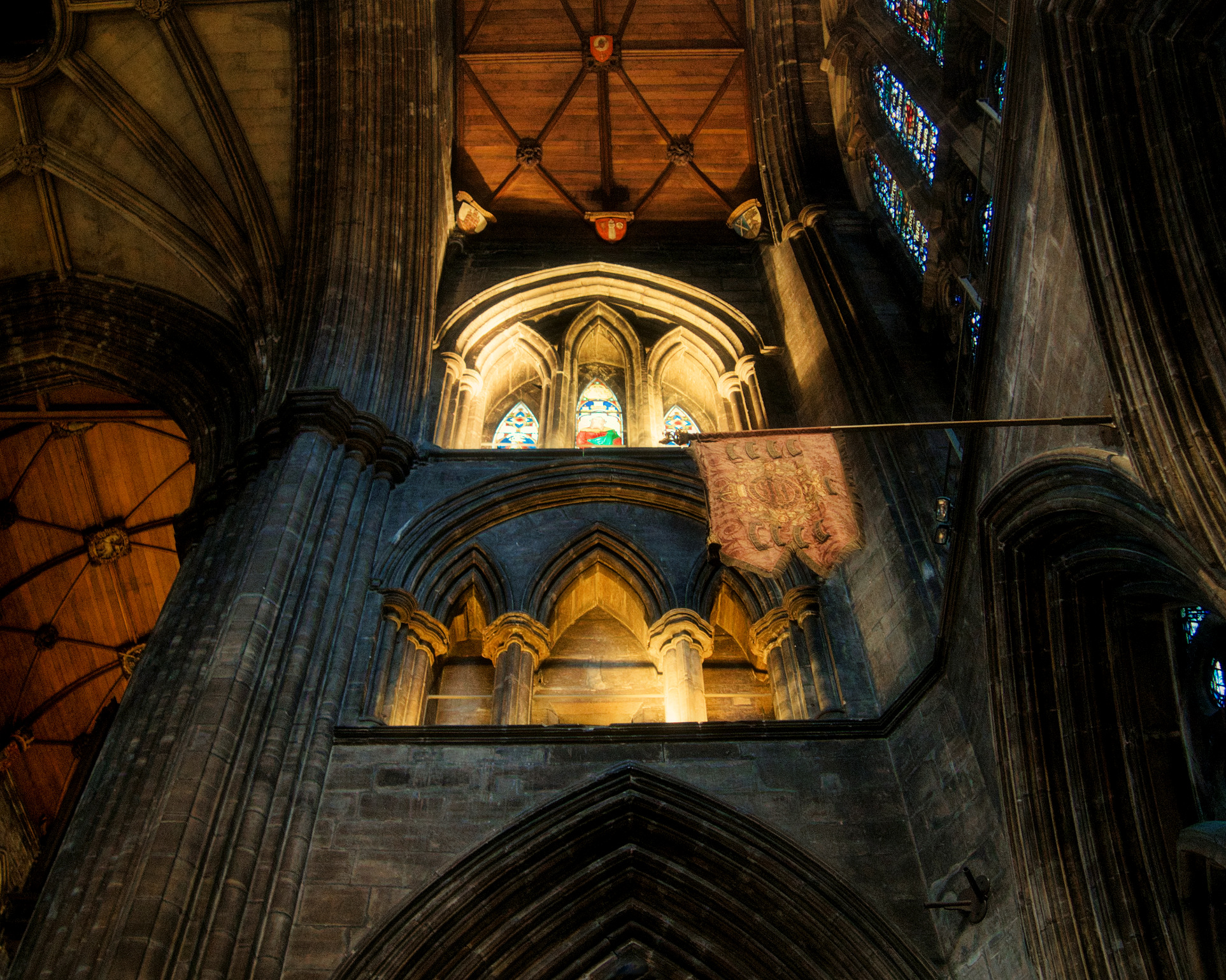
Saint Mungo, also known as Saint Kentigern, was born under heartbreaking circumstances. His mother, despite her royal blood, was abused treacherously and was lucky to survive the wrath of her father. This story begins not in Glasgow but on the east coast of Scotland. Princess Teneu, also known as Enoch, was the daughter of King Lleuddun, the ruler of the Gododdin.
The Story of Princess Teneu
There are two stories about how she became the mother of Mungo. In one version, she fell in love with her cousin, Owain mab Urien, who was already married. The resulting encounter led to her pregnancy. However, this story feels like a whitewash of something far more brutal.
In the twelfth century “Lives of Saints,” we read that Teneu was devoted to the Virgin Mary. Apparently, she prayed that she might conceive in the same way as Mary. This was impossible. According to the Cottonian manuscript, her cousin Owain raped her while he was dressed as a woman, making it the first recorded rape in Scottish history. Afterwards, he told his cousin, “Weep not, my sister, for I have not known thee as a man is used to know a virgin. Am I not a woman like thyself?”
In her innocence, she was confused about whether she had been violated. Sometime later, she found that she was with child. Interrogated by her father, she claimed she had not lain with a man. I can’t help but wonder if perhaps she was more discerning than her biographers have given her credit for. Maybe she realised that naming her cousin would start a war between the two kings.
Facing the Wrath of an Angry Father
I cannot imagine how isolated Teneu must have felt while dealing with her angry father. When he discovered her condition, he offered no mercy. Instead, he viewed her pregnancy as a source of deep tribal shame and sentenced his own daughter to death.
The punishment began at the windswept summit of Traprain Law. Teneu was taken to the edge of the precipice and tied to a chariot before being launched into the void. Her father intended for the rocks below to shatter her, yet she miraculously survived the fall unscathed. Consequently, the King and his people grew more fearful and accused the princess of witchcraft.
They decided to let the cold waters of the Firth of Forth finish the execution. Teneu was thrown into a fragile, oarless coracle and cast out into the grey currents. She drifted alone through the haar, eventually washing ashore at Culross in Fife. Here, Saint Serf rescued the young princess and took care of her and the child, who was born in 518 CE.
A Royal Gododdin Heritage
The royal bloodlines of Saint Mungo were forged in the fires of the Old North. His maternal grandfather was King Lot, who ruled from the volcanic stronghold of Traprain Law. This sovereign commanded the vast territories of Lothian, a region that still bears his name today. Furthermore, King Lot is often identified in later legends as the brother-in-law of King Arthur.
On his paternal side, the saint carried the prestigious lineage of the Kingdom of Rheged. His father was Owain mab Urien, the king of North Rheged. This kingdom was one of the most powerful Brittonic realms of the 6th century. Consequently, Mungo was not merely a humble monk; he was a prince of two great houses.
The Childhood of Saint Mungo at Culross
Saint Serf raised the young Kentigern at the monastery in Culross. Serf gave him the affectionate nickname Mungo, which means “Dear One.” However, his upbringing was far from peaceful. His classmates were deeply jealous of his intellect and his mother’s history. These boys frequently tormented him and attempted to sabotage his work.
In one instance, they killed Saint Serf’s pet robin and blamed the young saint. This environment of spite led to his first miracle. He held the dead bird and prayed until it returned to life. Eventually, the jealousy of his peers became too much, and he left the monastery as a young man.
How Saint Mungo Founded Glasgow
After leaving his home, Mungo travelled to Stirling, where he stayed with a holy man named Fergus. As Fergus lay dying, he entrusted Mungo with his final wish. He asked that his body be placed on a cart drawn by two bulls and buried where they chose to stop.
Mungo honoured his friend’s request and set out with the cart. The bulls travelled on until they finally came to rest beside a small burn. There, Mungo named the place Glas Ghu, meaning “dear green place.” It was here that he founded the first Christian community, building a church near the Molendinar Burn.
From this place, Mungo is said to have spoken the words, “Let Glasgow flourish by the preaching of His word.” In later years, the phrase was shortened to “Let Glasgow Flourish.” This remains the city’s famous motto today.
Exile and the Merlin Connection
Christianity was still a new religion in what would later become Scotland. An anti-Christian movement, led by King Morken, eventually forced the saint into exile. He travelled south through Cumbria and into Wales. During this time, he stayed with Saint David and founded a cathedral at Llanelwy.
During his travels, he was said to have met Lailoken, the “wild man” known as Merlin. Near Stobo Kirk,in the Scottish Borders, the saint reportedly converted the mad prophet to Christianity. This encounter links the holy man to the ancient, mystical roots of the Scottish landscape.
The Return to Glasgow
Saint Mungo’s return to Glasgow began after King Riderch Hael invited him back to the kingdom. Consequently, he left Wales and travelled north through the rugged borderlands. However, he did not go directly to the Clyde. Instead, he established a temporary seat at Hoddom in Dumfriesshire for several years.
Why did he choose to delay his arrival in the north? Perhaps he wanted to evangelise Galloway before reclaiming his original church. Eventually, he moved his community to the Molendinar Burn. This site became the religious heart of the growing settlement. Furthermore, his presence transformed the small cell into a thriving spiritual centre.
The Four Miracles of Saint Mungo
Saint Mungo’s four miracles are the best-known legends attached to Glasgow’s patron saint. They survive because they are easy to remember. They also survive because they were built into the city’s identity, later appearing on the coat of arms as a bird, a tree, a bell, and a fish with a ring. A traditional rhyme keeps the set together:
“Here’s the Tree that never grew,
Here’s the Bird that never flew,
Here’s the Bell that never rang,
Here’s the Fish that never Swam.”
The Bird That Never Flew
The miracle of the bird was set in Mungo’s youth, during the time he was being taught by Saint Serf. Serf kept a tame little bird, described as a redbird in the ancient accounts. Because the other boys were jealous of Mungo, they seized a chance to harm him. While Serf was away, they killed the bird and tried to blame Mungo for the deed.
However, the story turned on a simple and vivid action. Mungo lifted the dead bird, joined its head to its body, made the sign of the cross, and prayed. The bird revived and flew back to Serf. In legend, this act proved both Mungo’s innocence and his holiness.
The Tree That Never Grew
The miracle of the tree also belonged to the monastery setting, and it kept the same theme of envy. Mungo was tasked with tending the fire and preparing light for worship. Yet his rivals extinguished the monastery’s fires, hoping to disgrace him.
Because there was no fire to be found, Mungo took a green hazel branch from a hedge. He blessed it, made the sign of the cross, and breathed on it. Fire sent from heaven caught on the branch, and Mungo used it to light the lamps so the service could go on.
The miracle was not only about wonder. It was also about responsibility. Even when others sabotaged the work, the sacred light did not fail.
The Bell That Never Rang
The bell was the least narrative of the four, and it read more like a relic tradition than a set-piece scene. In later retellings, the bell was said to have come to Mungo from Rome. It was used in worship and to mark death, calling a community together in prayer and mourning.
However, the original bell no longer existed. A later replacement, made in the 1640s, was associated with the symbol later on. That loss mattered, because it showed how legend could outlast the object that supposedly proved it.
Even so, the bell worked powerfully as an emblem. It stood for a city being gathered, warned, and blessed by sound.
The Fish That Never Swam
The fish miracle was the most dramatic because it carried real stakes. A queen, named Languoreth, was accused of infidelity by her husband, King Riderch of Strathclyde. The king demanded to see her ring. Yet, in many versions, he had arranged the proof himself by throwing it into the River Clyde.
Faced with death, the queen appealed to Mungo. He ordered a fish to be caught. When it was opened, the ring was found inside, and the queen was cleared.
The Death and Tomb of Saint Mungo
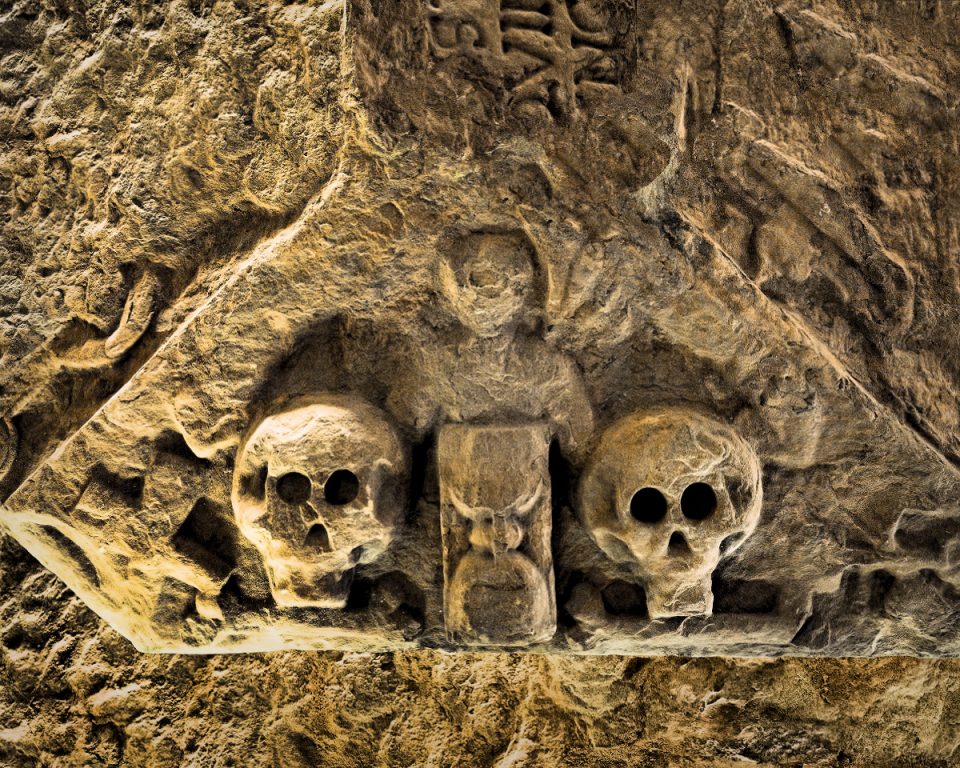
The saint died on Sunday, 13 January 614, reportedly in his bath. Saint Mungo was buried in the earth where his original church stood. Today, Glasgow Cathedral stands over his grave. You can still visit his tomb in the cold, silent crypt of the lower church. His death is now celebrated as a feast day on the 13th January by the Catholic Church. His mother, Teneu, is also remembered as a co-patron of the city. St Enoch’s Square marks the site of a medieval church dedicated to her. Together, their story remains a powerful testament to survival against the harshest of Scottish odds.