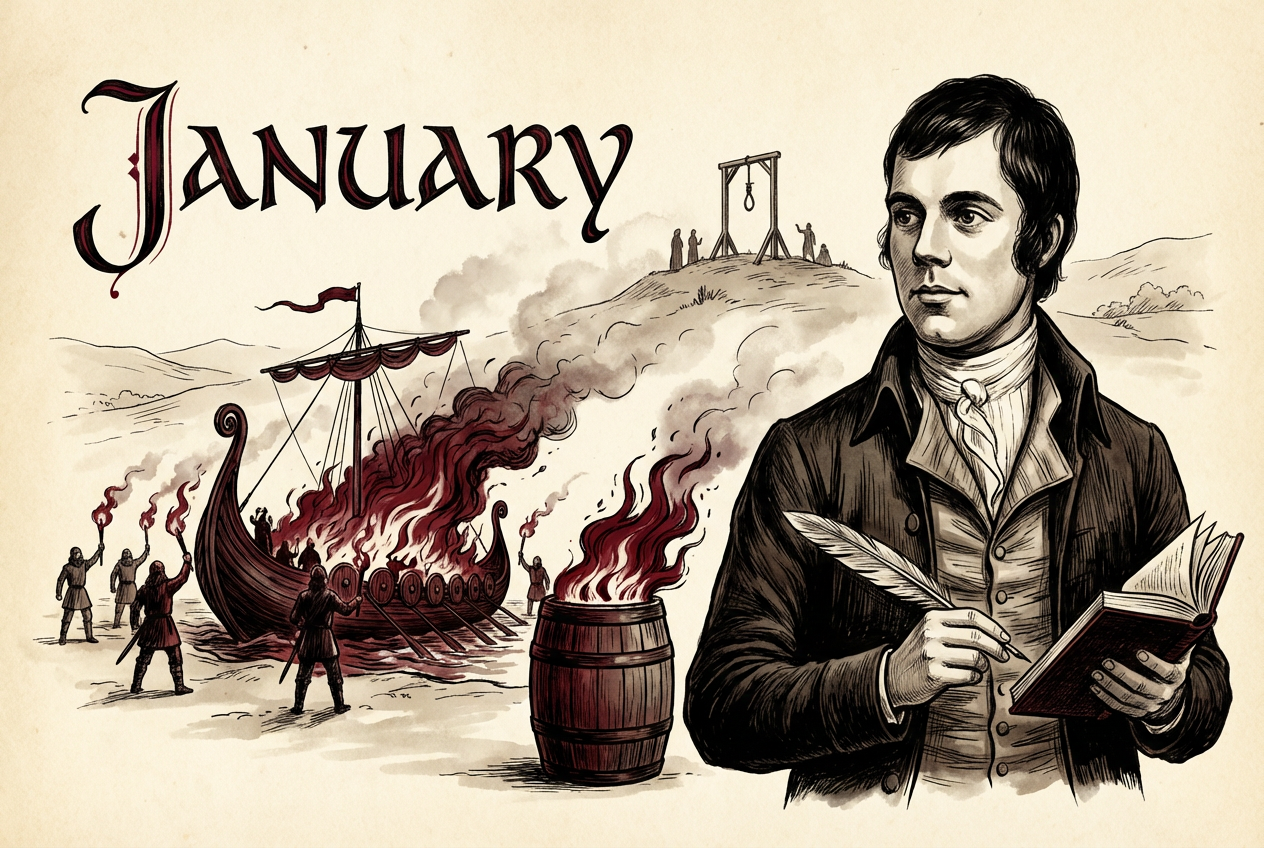
January is a month of fire and executions, royal deaths and midwinter ritual. It opens with Hogmanay’s afterglow and the Kirkwall Ba’, and closes with the approach of Brìde’s feast and the Norse spectacle of Up Helly Aa in Lerwick. Between those two flames, Scotland’s darkest legal and political history runs close to the surface.
The North Berwick Witch Trials cast a long shadow over the month. Agnes Sampson was executed on the 16th, Dr John Fian on the 27th, and the legal machinery against Geillis Duncan began on the same date a year earlier. All three cases were driven by James VI’s personal obsession with witchcraft — an obsession that would eventually reach across the Atlantic.
Royal deaths cluster here too. Charles I was beheaded on the 30th of January 1649, the last king born on Scottish soil. Bonnie Prince Charlie died on the same date in 1788, his legend long outlasting his cause. The Regent Moray was shot at Linlithgow on the 23rd in one of history’s earliest recorded firearm assassinations.
January also holds Scotland’s most celebrated birth. Robert Burns was born on the 25th, and Burns Night links literature, folklore, and the uncanny in ways that suit Spooky Scotland well. Tam o’ Shanter alone earns him a place in the calendar. And on the 28th, William Burke was hanged for the West Port murders — his body publicly dissected afterwards, punishment turned into spectacle. It remains one of Edinburgh’s most visited dark history stories.
Stranger stories surface too. A letter in 1819 claimed workmen at Dunsinane uncovered a vault containing the original Stone of Destiny. Arthur Grant reported a Loch Ness Monster sighting on the 5th.
1 January — New Year’s Day: New Year’s Day brings traditions that can spill deep into the afternoon. In Orkney, this includes the Kirkwall Ba’ — a rough-and-ready street ball game with medieval roots. Hogmanay’s afterglow still feels loud, communal, and very Scottish.
1 January 1651: Charles II is crowned King of Scots at Scone in the last coronation to take place on Scottish soil. The ceremony is a defiant act of royal tradition during the Cromwellian occupation.
2 January 1819: A letter to The Morning Chronicle claims workmen at West Mains of Dunsinane House uncovered a vault containing a large stone believed to be the original Stone of Destiny. Whether true or not, the story adds another eerie layer to Scotland’s most contested relic.
5 January 1934: Arthur Grant, a young veterinary student, reports seeing the Loch Ness Monster. His account becomes one of the early modern sightings that helped shape the Nessie legend. Loch Ness slips a little further into the world’s imagination.
6 January — Uphalieday: Uphalieday, Twelfth Night, or Epiphany marks the day Yuletide greenery is traditionally taken down. It signals a shift from midwinter celebration back to ordinary time.
7 January 1661: Montrose’s remains are disinterred and carried in procession through Edinburgh. The restored monarchy reclaims its martyr.
8 January 1707: Sir John Dalrymple dies — the Secretary of State for Scotland whose name remains bound to the Glencoe Massacre of 1692. The arguments over blame and responsibility have never fully settled.
11 January — Burning the Clavie: The Burning of the Clavie takes place at Burghead. A tar barrel is set alight and carried through the town before the flames are left to burn on the ancient altar site at Doorie Hill. January’s darkness is met with fire and spectacle.
13 January — Feast of Saint Mungo: The Feast of Saint Mungo marks the day of Glasgow’s founder. It recalls the saint linked to the city’s motto and its enduring origin stories.
16 January 1591: Agnes Sampson is executed, a victim of the North Berwick Witch Trials. Her case sits at the heart of the panic surrounding James VI and witchcraft — one of the starkest January milestones in Scotland’s witch-hunt history.
23 January 1570: The Regent Moray is shot and killed at Linlithgow in one of history’s earliest recorded firearm assassinations. Scotland’s political crisis deepens during the civil wars of Mary’s reign.
24 January 1446: The Battle of Arbroath is fought as part of a violent feud between the Ogilvies and the Lindsays. Arbroath’s history is marked by more than abbey stones and declarations.
25 January 1759: Robert Burns is born. He becomes Scotland’s national poet and the author of Tam o’ Shanter — a poem that suits Spooky Scotland perfectly. Burns Night links literature, folklore, and the uncanny.
27 January 1590: The legal case against Geillis Duncan begins as part of the North Berwick Witch Trials. Her testimony, extracted through brutal interrogation, becomes the foundation for one of Scotland’s most terrifying periods of persecution. The machinery of the law is turned against dozens of people.
27 January 1591: Dr John Fian is executed — another victim of the North Berwick Witch Trials. His story is tangled with confession, torture, and political fear. It reflects how quickly evidence could be manufactured.
28 January 1829: William Burke is executed for the West Port murders. His body is publicly dissected afterwards, turning punishment into spectacle. The tale remains one of Edinburgh’s darkest.
30 January 1649: Charles I is beheaded. The last king born on Scottish soil, his death reshapes politics across Britain and Ireland. This date sits at the hinge of monarchy, rebellion, and retribution.
30 January 1788: Bonnie Prince Charlie dies in Rome. He led the Jacobite rising that ended in catastrophe at Culloden in 1746. His legend outlived his cause and still shadows Highland history.
31 January — Là Fhèill Brìghde: In older tradition, Là Fhèill Brìghde begins on this evening, marking the approach of Brìde’s day and the turning toward spring. Winter folklore starts to loosen its grip.
Last Tuesday in January — Up Helly Aa: Up Helly Aa takes place in Lerwick, Shetland. The torchlit procession ends with the burning of a Viking longship. The islands answer midwinter with flame, noise, and Norse memory.