Habetrot is a benevolent yet physically distorted figure from the folklore of the Scottish Borders and Northern England. Although she is often associated with the “Three Old Spinning Women” tale type, she remains a distinct character in Lowland tradition. She serves as the patroness of spinsters, offering supernatural aid to those overwhelmed by the demands of the spinning wheel.
Name pronunciation:
Hab-eh-trot
General Information:
Habetrot is a legendary figure primarily celebrated in Selkirkshire and the surrounding Border counties. She is the presiding genius of the spinning wheel, representing a time when spinning was the constant employment of women. Unlike many malevolent fairies, she is generally helpful to humans, particularly young women who struggle with their domestic duties. She is often accompanied by a group of fellow spinsters, the most notable being Scantlie Mab.
Appearance:
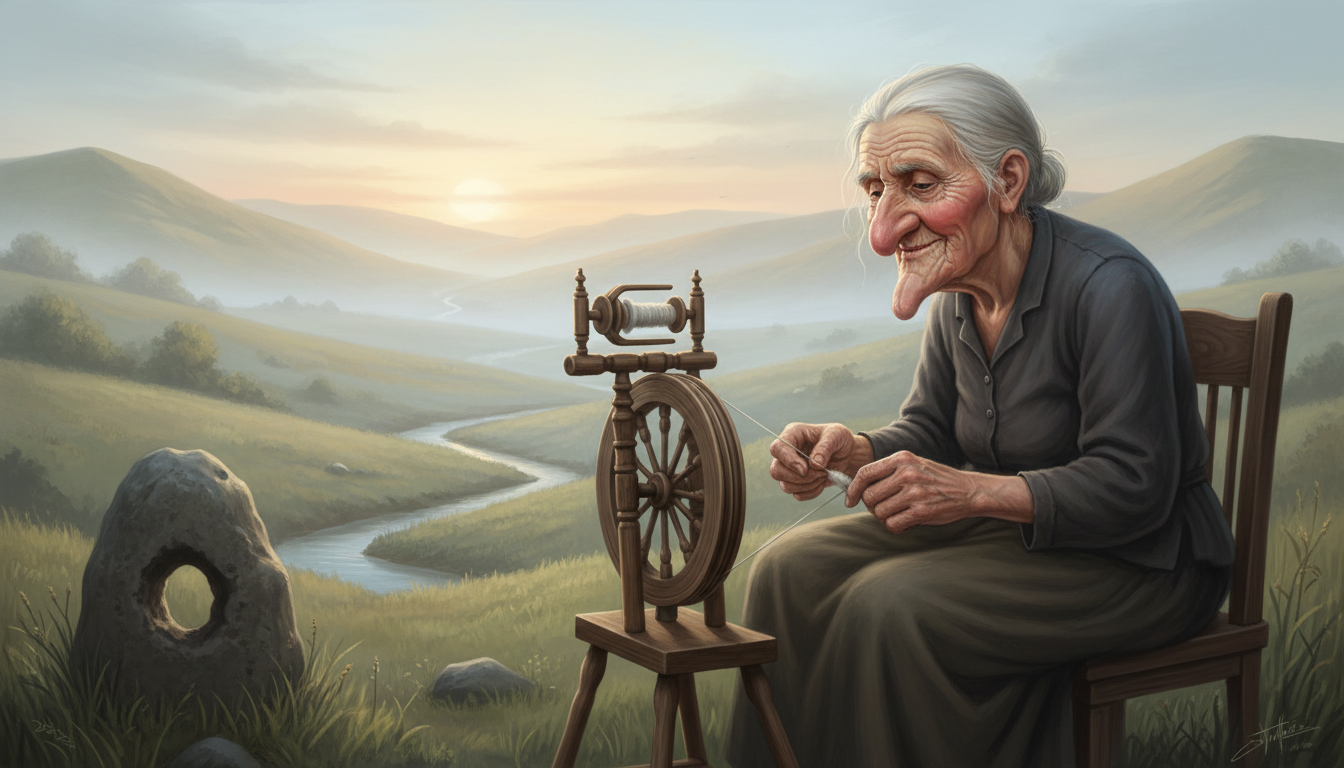
Habetrot appears as an elderly woman with a remarkably long and thick lower lip. This physical deformity is a direct result of her craft, as traditional spinners constantly wetted their fingers with their lips to draw thread from the distaff. Her companions share similar disfigurements, such as splayed feet, flat thumbs, or bulging grey eyes. Scantlie Mab is specifically described as having a long, hooked nose and eyes that seem to start from her head.
Habitat:
Habetrot lives underground in a deep cavern, often accessed through or near a “self-bored stone” (a stone with a natural hole). Her home is a “dreary den” hidden from the sun, where she and her sisterhood sit on colludie stones—white pebbles found in rivers—to perform their endless work. This subterranean workshop is typically located near flowery knolls and wooded burns.
Behaviour:
Habetrot is industrious and kind-hearted, though she possesses a sly sense of humour. She spends her time spinning high-quality yarn and singing ditties to her sisterhood. While she is willing to perform tasks for humans, she often requires that her involvement remains a secret. She is also known to protect young brides from the drudgery of labour by tricking their husbands into believing that spinning will ruin their wives’ beauty.
Shape-shifting Ability:
Habetrot does not typically exhibit the classic shape-shifting abilities of creatures like the Kelpie. However, she can move unseen among trees and bushes, appearing and disappearing at will. Her primary “magic” lies in her supernatural speed at the wheel and her ability to influence human perception through clever staging and warnings.
Variant:
Variants of her name include Habitrot, Habtrot, and Habbitrot. Similar tales include the German “The Three Spinners” and the Norwegian “The Three Aunts.” In some Border legends, she is also the only one capable of spinning the specific linen required to cure “grave-merels.” she is the lowland equivalent of the Gaelic Loireag.
Location in Scotland:
Habetrot is most famously associated with Selkirkshire in the Scottish Borders. Her legends are rooted in the Lowland landscape, specifically near small burns and rural farms where flax was grown and processed.
Stories/ Sightings or Experiences:
The Idle Cuttie and the Seven Heads of Lint
Habetrot first appears in the folklore of Selkirkshire as a saviour to a young girl who preferred wandering the meadows to the drudgery of the spinning wheel. Her mother, a stern “gudewife,” grew so vexed by her daughter’s “idle cuttie” ways that she presented an impossible task. she demanded that seven heads of lint to be spun into yarn within three days. Desperate and untaught, the girl fled to a flowery knoll by a small burn. There she encountered an old woman sitting upon a “self-bored stone.” This stranger had remarkably long, thick lips, yet she offered to finish the task if the girl would fetch her lint.
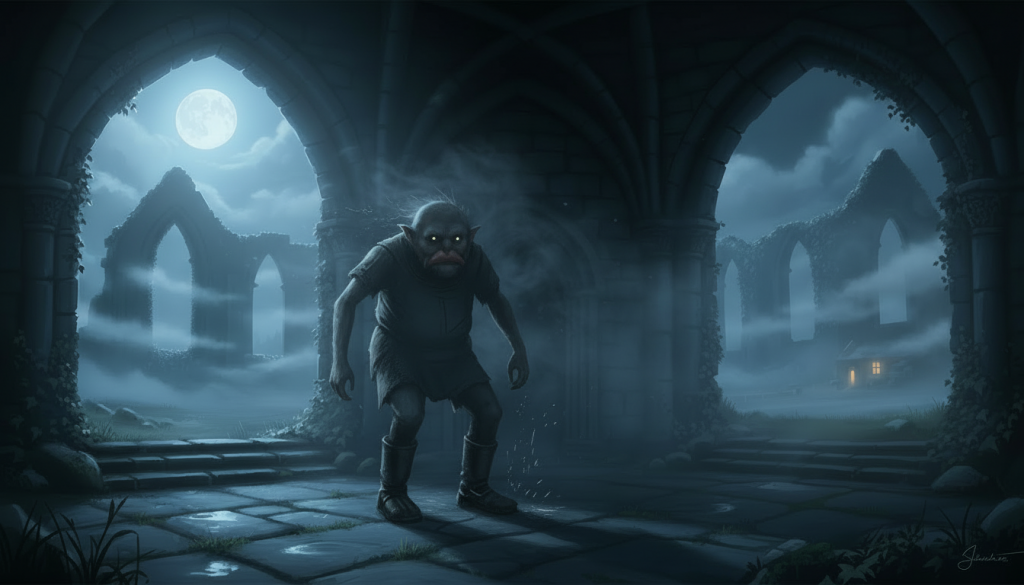
While the girl waited, she placed her ear against the hole in the stone and heard an uncouth voice from the cavern below. Looking down, she saw Habetrot walking among a group of disfigured spinsters, including the grey-eyed Scantlie Mab, who was busily reeling the yarn. Habetrot soon returned with the finished hanks, warning the girl never to reveal who had truly spun them. When the mother found the yarn, she was so overjoyed that she ran into the street crying that her daughter had “spun seven” and “eaten seven” (referring to some black puddings the girl had fried in her hunger).
A Happy Ending
A passing Laird heard these cries and, believing the girl to be a master of industry, immediately sought her hand in marriage. The girl wed the Laird but lived in constant fear that he would eventually discover her lack of skill. Fortunately, Habetrot intervened once more, inviting the bridal pair to her subterranean cell. When the Laird saw the “ugsome” looks and distorted lips of the sisterhood, he asked what had caused such ugliness. Each spinster grunted that it was the result of a lifetime of spinning. Terrified that his beautiful bride would suffer the same fate, the Laird vowed she should never touch a spinning wheel again, and all the flax from his lands was thereafter sent to Habetrot to be spun in secret.
The Cure for Grave-Merels
Habetrot also features in a darker Border legend concerning the dangers of “unchristened ground,” which refers to the burial sites of stillborn or unbaptised children. It was considered exceptionally unlucky to step upon such earth, as the offender might catch a supernatural illness known as “grave-merels” or “grave-scab.” This affliction caused the victim’s limbs to tremble and their breath to fail, while their skin burned as if it had been pressed by a hot iron. Because the illness was of a spiritual nature, ordinary medicine was useless against its effects.
The only way to relieve the suffering of the afflicted was to procure a very specific, magically prepared garment. First, linen had to be grown in a field using manure from a farmyard that had remained undisturbed for forty years. This rare flax then had to be taken to the flowery knoll. There it would be spun into thread by the supernatural hands of Habetrot herself. The resulting fabric required bleaching by an “honest bleacher” in the milldam of an “honest miller,” a task often considered as difficult as finding the fairy herself.
Finally, the linen had to be sewn into a sack by an “honest tailor” before the patient could wear it. Only through this combination of human integrity and Habetrot’s ancient spinning could the burning of the skin be quenched and the trembling of the limbs stilled. This legend highlights Habetrot’s role not just as a patron of industry, but as a powerful healer within the folklore of the Scottish Borders. Consequently, she remained a figure of both respect and necessity for those living in the rural Lowlands.
Purpose of the myth or Legend:
The legend of Habetrot served several social and practical purposes in rural Scotland. Primarily, it acted as a cautionary tale regarding the physical toll of repetitive manual labour, specifically the “occupational hazards” of spinning. It also provided a mythological explanation for the high-quality textiles produced in the region. Furthermore, the “grave-merels” legend reinforced the sanctity of burial grounds and the importance of baptism within the community.