Name pronunciation:
GROO-uh-gach (ch as in Scots “loch”)
General Information:
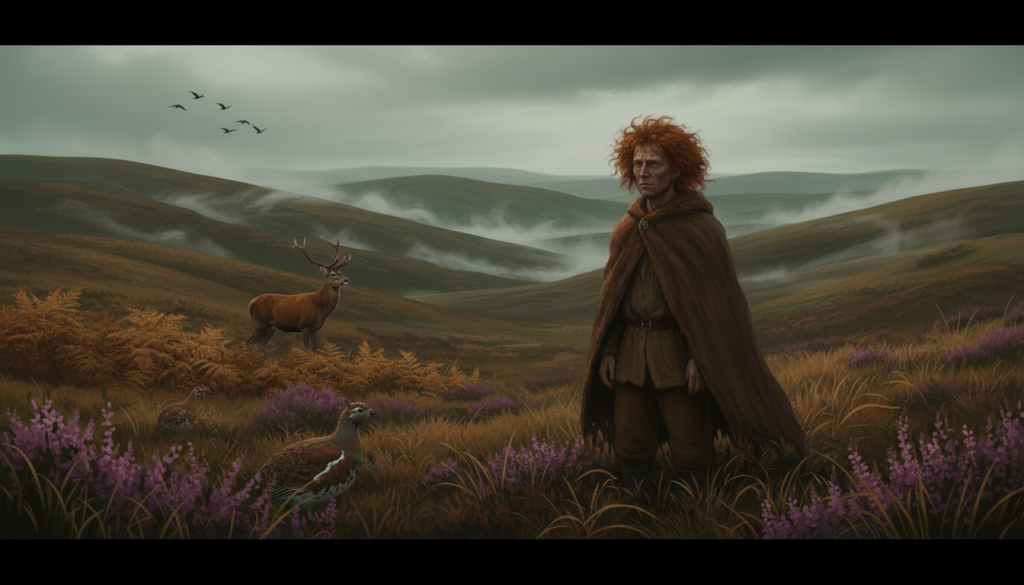
The Gruagach is a Gaelic household and cattle guardian spirit found across the Highlands and Islands. The Gruagach is often translated as a type of brownie. But, the traditions around this being are older and deeper than that label suggests. In Gaelic, gruag means “hair”, and gruagach usually means a long-haired maiden. However, in folklore the Gruagach appears as a long-haired, otherworldly helper who watches over cattle and byres. It is known to accept libations of milk, and sometimes strikes those who mistreat animals. In some regions, the Gruagach is female, in others male, and in several traditions scholars see echoes of very ancient goddess or priestess worship behind this figure.
Appearance:
The Gruagach is most often described as:
- Long-haired: The name directly links to hair. Long, flowing hair (often golden or yellow) is a constant theme.
- Well-dressed: In some accounts she is “well-dressed like a gentlewoman”. In others, he is “in the attire of a gentleman of a bygone period”.
- Human-shaped but uncanny:
- As a female figure with long golden hair and a white breast, moving lightly among the cattle.
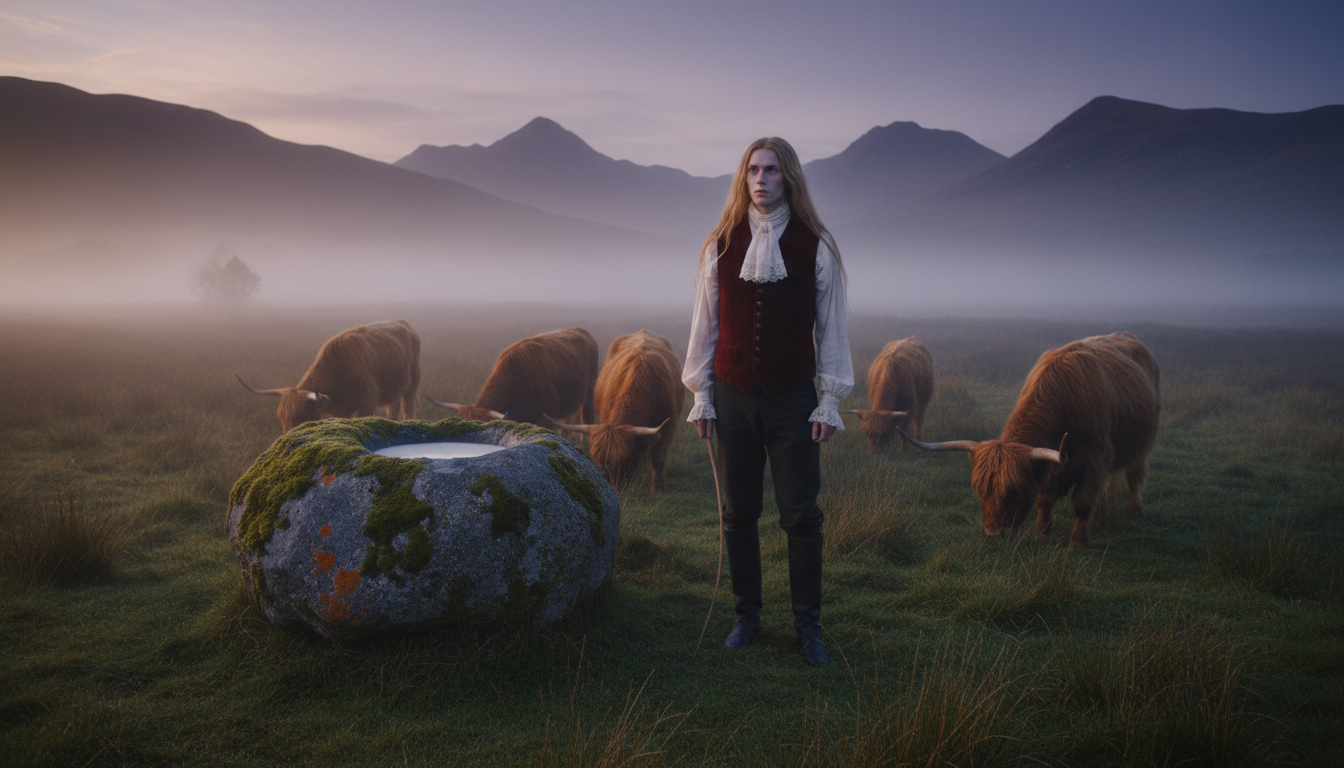
- As a tall, well-dressed young man with long yellow hair and a white frilled shirt in parts of Skye and Bracadale.
- Semi-invisible: Many people say the Gruagach was never fully seen, only as a shadow flitting across a byre wall or glimpsed dancing in the folds.
The Gruagach nearly always carries a small rod, reed, or switch (slatag), used to tap or strike those who anger or disrespect this guardian.
Habitat:
The Gruagach is strongly tied to cattle culture and shieling life. Typical locations include:
- Byres, folds and summer shielings in Highland glens and island townships.
- Hills and knolls overlooking pastures, such as Cnoc a’ Ghruagaich (“Gruagach Hill”) in Skye and other sites across the Hebrides.
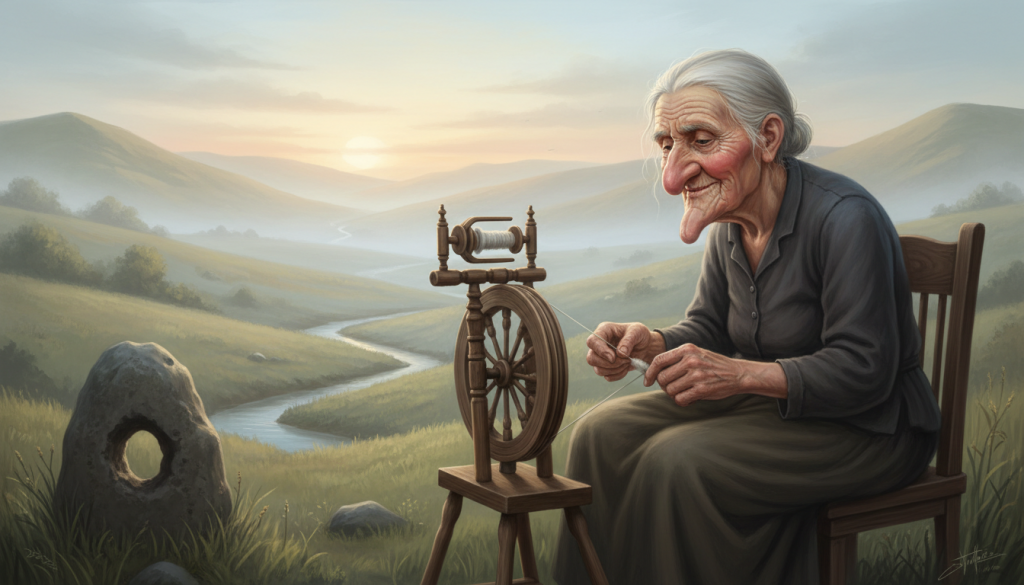
- Sacred stones, especially large boulders or cup-marked rocks with shallow hollows used for libations of milk, known as clach na gruagaich (“Gruagach stone”) or leac na gruagaich (“flagstone of the Gruagach”).
These stones appear in Arran, Kintyre, Islay, Mull, Lismore, Tiree, Coll, Barra, Uist, Benbecula, Harris, Lewis, parts of the mainland and Skye, showing how widespread belief in Gruagach once was.
Behaviour:
The Gruagach is usually benevolent but easily offended. Key behaviours include:
Guardian of cattle:
The Gruagach keeps cattle from going over rocks or straying into danger, and can protect them from illness and misfortune.
Controller of milk and cream:
- If properly honoured, the herd thrives and the milk yields well.
- If neglected, no milk will be found in the udder, or cream will refuse to rise.
Receiver of milk libations:
- Milk is poured into a hollowed stone or onto a special boulder for Gruagach, often on Sundays or at key times such as going to or from the summer pastures.
- If offerings are missed, the best cow might be found dead, or tied cattle may be let loose in the night as a warning.
Enforcer of kindness:
- Harsh words or blows towards cattle can provoke a supernatural response.
- In one Bracadale shieling story, a girl drives a restless cow roughly. The unseen Gruagach, angered by her cruelty, strikes her with the rod, and she dies suddenly. Her mother’s lament blames the Gruagach but also her daughter’s impatience.
The Gruagach may laugh and titter in the corners of a byre. Sometimes it might walk silently beside people at night, or be seen running and dancing lightly among the cattle on summer afternoons. Beyond tricks such as untying cattle or withdrawing milk, the Gruagach rarely harms humans outright unless animals are badly mistreated or offerings are repeatedly ignored.
Shape-shifting Ability:
The Gruagach is not a classic shape-shifter like a kelpie or each-uisge, but its nature shifts between:
- Visible and invisible: Sometimes seen clearly as a person; at other times known only by a shadow, a presence, or unexplained actions.
In some scholarly interpretations, the Gruagach is a faded remnant of earlier divine or priestly figures, capable in older myth of more pronounced transformations and magical feats.
Variant:
The Gruagach appears in several overlapping forms and interpretations:
- Cattle-guardian Gruagach: The best-known type, a dairy and herd spirit, receiving milk libations and protecting folds.
- Brownie-like Gruagach: Classified by some as a type of Gaelic brownie, doing odd jobs around farms and castles, but with a focus on cattle and byres.
- Glaistig / Gruagach overlap: In some districts it is closely linked to the glaistig, another female guardian of cattle to whom milk is given.
- Learned or war-skilled Gruagach in tales: In heroic stories such as “The Young King of Easaidh Ruadh” and the “Fair Gruagach, son of the King of Eirinn”, Gruagach can mean a notable long-haired figure associated with feats of arms or teaching martial skills, possibly echoing older priestly or druidic roles.
- Tooth Fairy: In at least one modern note, gruagach nam fiaclan is given as the name for the tooth fairy, showing how the term continues to shift in meaning.
Scholars have also linked gruagach to related words and beings across the Celtic world, such as Breton groac’h and Welsh gwrach, suggesting a very old shared root associated with powerful, often supernatural females and hags. It may suggest a connection with an ancient Mother Goddess tradition.
Location in Scotland:
The Gruagach traditions are concentrated in:
- The Hebrides: Skye, Raasay, Lewis, Harris, Uist, Barra, Benbecula, St Kilda and surrounding islands.
- The West Highlands: Argyllshire, Mull, Islay, Lorn, Kintyre, Gigha and nearby districts.
- Other scattered sites: Arran, Lismore, Kerara, parts of Ross-shire, Sutherland, near Culloden and Cawdor, and within many old cattle-rearing districts.
Named sites include Cnoc a’ Ghruagaich, Clach na Gruagaich and many Gruagach stones, often boulders with natural or carved hollows used for libations.
Stories/ Sightings or Experiences:
The Shieling Death at Glen Mhic Asgill
A powerful Skye song, “Òran mun Ghruagaich” (“A Song about the Gruagach”), records a mother’s grief for her daughter who died suddenly at a shieling in Glen Mhic Asgill, Bracadale. The girl and her mother were tending cattle when one cow became troublesome at night. The girl, tired and frustrated, drove the animal roughly with harsh words. Unseen nearby, the Gruagach, guardian of the herd, took offence.
Later, the daughter collapsed and died. In her lament, the mother calls on the embers of the peat fire to give light so she might see the Gruagach who has struck her child. Local belief held that the Gruagach, angered by cruelty to the cattle, had smitten the girl with the reed or switch. The story underlines that to insult or hurt animals under the Gruagach’s protection was a serious “sin”, and that even a normally gentle guardian could wield deadly power when roused.
The Milk-Stone and the Empty Byre
Across Skye and the Hebrides, stories repeat the same pattern. A dairymaid is responsible for leaving a portion of warm milk in a hollow stone for the Gruagach every evening. When she remembers, the herd stays safe and the milk yields are good. However, if she forgets even once, trouble follows.
In many accounts, the punishment is swift but not fatal:
- The cattle are found untied and wandering in the byre.
- The milk “goes wrong”, staying thin or refusing to separate into cream and skim.
In harsher versions, a prized cow is found dead at the foot of a rocky slope, or the whole herd gives no milk at the next milking. The message is clear: remember the Gruagach’s portion, or risk losing your own.
The Dancing Gruagach of Valtos
An elderly woman from East-side Skye recalled seeing the Gruagach in her youth. On bright summer afternoons, she would watch a figure “running and dancing lightly out in the fields among the cattle” (a’ ruith ’s a’ dannsa cho guanach, aotram a-mach anns na buailtean am measg na sprèidhe). This Gruagach appeared as a joyful, agile presence, moving between the animals, and not as something frightening.
By the time the local minister reported the story, he added that the Gruagach had not been seen in the area for more than eighty years. However, the belief in the hill and its stone, and the idea of leaving milk there, still lingered in memory.
The Gruagach of Insch and the Fallen Cattle
On the small island of Insch near Easdale, a brownie-like Gruagach was said to have followed the MacDougalls of Ardincaple for generations. He guarded their cattle night and day, especially when the dairymaid took the milk cows there in summer.
Each night, the maid had to leave warm milk in a knocking-stone in a cave where she and the herd slept. If she forgot, then by morning one of the cattle would be found dashed on the rocks. Some wondered whether he shared his nightly portion with another unseen friend, as the hollow stone could hold two or three pints of milk. This story shows Gruagach as a long-standing family guardian, both protective and strict.
A Friend of the Cattle – and their People
Although quick to punish neglect, the Gruagach is generally portrayed as a “friend of the cattle” and a friend of the community that relies on them. Ministers, folklorists and local singers all stress that Gruagach:
- Keeps cattle from harm.
- Encourages gentle handling of animals.
- Responds positively to respect and generosity.
In this way, Gruagach stories became a tool for teaching good herding practice and kindness. This was particularly important for educating the young people at the shielings.
Purpose of the myth or Legend:
Gruagach myths served multiple functions in Highland and Island life:
Protection of cattle:
Cattle were central to the economy, diet and status of Highland communities. Belief in the Gruagach reinforced the idea that herds had a spiritual guardian watching over them.
Encouraging good behaviour:
By linking cruelty to animals or neglect of tasks with supernatural punishment, the stories taught care, patience and respect. Dairymaids and herds were encouraged to be gentle and diligent, knowing that the Gruagach would “see” everything.
Maintaining ritual continuity:
Libations of milk poured onto ancient stones kept alive very old ritual habits. These possibly date back to pre-Christian or even prehistoric times. These practices connected everyday work at the byre to older sacred landscapes and beliefs.
Echoes of older religion:
Scholars see Gruagach as a “wee remnant” of something much larger. Perhaps she is an echo of a Mother Goddess, priestess cults, or a tradition of powerful, long-haired female (and sometimes male) figures linked to fertility, battle-skills, prophecy and the land. Over centuries, this grand figure may have softened into a local cattle spirit and brownie. However, traces of something older remain in the stories, stones and songs.
The Gruagach therefore stands at a crossroads between household spirit, fairy helper, cattle guardian and distant memory of a once-mighty divine or priestly presence in the Gaelic world.