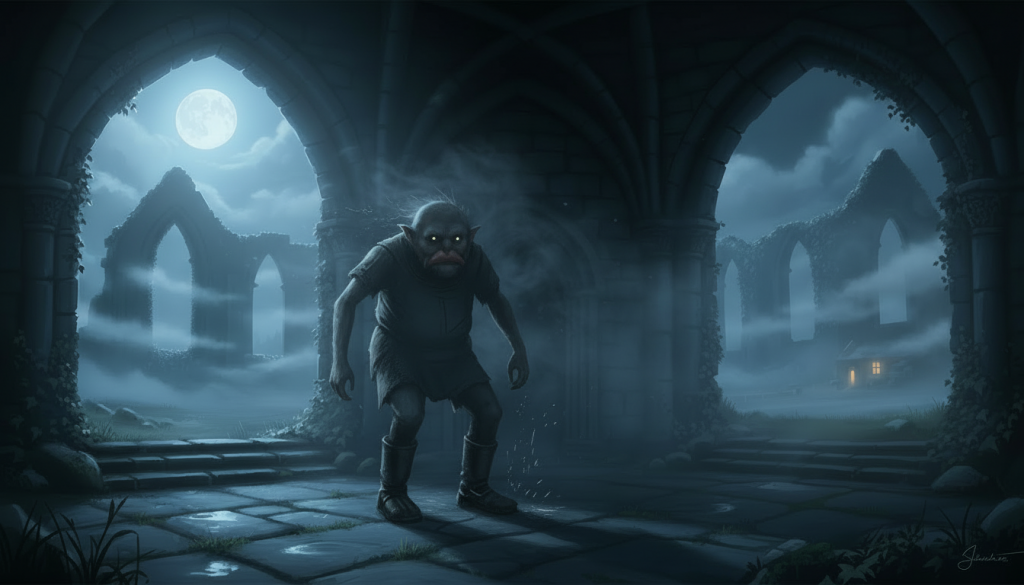

The Bregdi is one of Shetland’s most feared sea monsters, blamed for chasing boats and dragging crews to a watery grave. However, some later accounts suggest the legend may be rooted in real encounters with the basking shark, known locally as da brigdi. Therefore, the Bregdi sits in that uneasy space between folklore warning and seafarers’ lived experience.
Name pronunciation:
BREHG-dee (approx.); in Shetland speech you may hear it as “da BRIG-dee”
General Information:
The Bregdi is a malicious sea monster from Shetland waters. It appears in island tradition alongside other feared beings of the deep, including the Kraken. In some tellings, it is a sea-serpent. In others, it is described as a vast “fish” or whale-like creature. Moreover, it is associated with fine weather, when it might be seen close to the surface.
Some coastal lore even claims a sea-serpent controlled the tides by breathing in for six hours, then releasing its breath again. While that is not always tied directly to the Bregdi, it shows the wider Shetland habit of explaining sea power through living, intelligent forces.
Appearance:
In folklore, the Bregdi is immense and unnatural, with long fins capable of wrapping around a boat. It may also show a prominent fin above water, said to be the size and shape of a boat’s sail. Consequently, it could be spotted from a considerable distance, which only increased dread.
In later, more naturalistic explanations, the creature is identified as a large shark, especially the basking shark. That interpretation fits the tall dorsal fin and surface “sunning” behaviour described in some stories.
Habitat:
The Bregdi belongs to Shetland waters, particularly off the north and east coasts. It is most often reported in calm or fine weather. Additionally, it is linked with the creature lying on the surface, warming itself in the sun, which is reflected in the name Sulbrigdi.
Behaviour:
The Bregdi’s defining trait is pursuit. It chases boats, then attacks once it has caught up. In one tradition, it wraps its long fins around the vessel, lifts them over the gunwales, and dives with the boat in a deadly embrace.
In another set of accounts, it uses its fin as a weapon. It may rush at a boat and “cut it in two” with a sharp fin. Alternatively, it may strike sideways, crushing or flattening the boat on the water. Some crews were said to escape with smashed gunwales, which suggests near misses were part of the tale’s fuel.
Shape-shifting Ability:
No consistent shape-shifting is recorded for the Bregdi. Instead, the creature’s “changeable” nature appears in how it is described. Sometimes it is a monster of myth. Sometimes it is treated as a dangerous but recognisable animal.
Variant:
The Bregdi is sometimes called Sulbrigdi. In that form, it is described as a great body lying on the sea “sunning” itself, with sul linked to sun. This variant emphasises its surface stillness before the chase begins.
There is also a strong regional overlap with da brigdi, the basking shark explanation. As a result, some storytellers treat “Bregdi” as the supernatural reading of a genuine sea encounter, rather than a separate creature entirely.
Location in Scotland:
Shetland, especially waters off the north and east coasts.
Stories/ Sightings or Experiences:
The Boat Taken Under
A boat is making its way home when the sea behind it changes, not with a wave, but with a presence. Soon, long fins rise beside the gunwales. The crew scramble, because they know what comes next. If the fins fold over the boards, the Bregdi will dive, and the boat will go with it. In the oldest tellings, the sea closes above them and that is the end.
Yet there is a way out, and that knowledge matters. If a sailor strikes fast, slashing at the fins the moment they appear, the creature loosens and flees. Cold steel, even a simple skuni (knife), is enough. Therefore, the story becomes a warning, but it also becomes instruction.
Steel and Amber
Not every defence against the Bregdi is brute force. In some accounts, amber beads terrify it. A single amber bead thrown at the creature is said to be enough to drive it off. Consequently, a sailor’s kit becomes more than practical gear. It becomes protection, chosen with the unseen in mind.
Older custom also hints at offerings and precautions. Pieces of iron were sometimes thrown into the water. In some versions, coins may have been offered. Even when people later spoke of sharks, the habits of warding and appeasing remained.
“Da Brigdi” and the Fishermen Turned Back
A family tale tells of a crew that set out to fish, then returned quickly, shaken. They spoke of a terrible sea monster with several fins, terrifying them and nearly capsizing the boat. Locally, the blame fell on da brigdi. People said there were more of them “back in the day.” Moreover, if you imagine a small wooden boat beside an enormous finned body, it is easy to see how panic could start, even without malice.
This is where the Bregdi legend grips hardest. A basking shark does not need to be a monster to feel like one, when you are alone on open water.
Purpose of the myth or Legend:
The Bregdi legend acts as a sea-warning, shaped for communities that lived by fishing and risked death each time they launched. It explains sudden damage, capsizes, and near misses in a world where the sea could look calm and still kill you.
It also preserves practical seafaring caution through story. Keep a knife ready. Watch the water in fine weather. Carry protective charms, whether iron or amber. Finally, it gives a name to fear, which can be easier to face than the formless danger of deep water.