Name pronunciation:
BOO-bree
General Information:
Boobrie is a legendary shape-shifting water monster from the lochs of western Scotland, especially Argyllshire and the Hebridean coasts. It sits firmly in the category of monsters and beasts rather than gentle spirits. People usually talk about the Boobrie in fearful tones because it preys on livestock and sometimes threatens people who stray too close to the water. Over time, the creature has also become a symbol of how dangerous and unpredictable Scotland’s wild lochs can be.
Appearance:
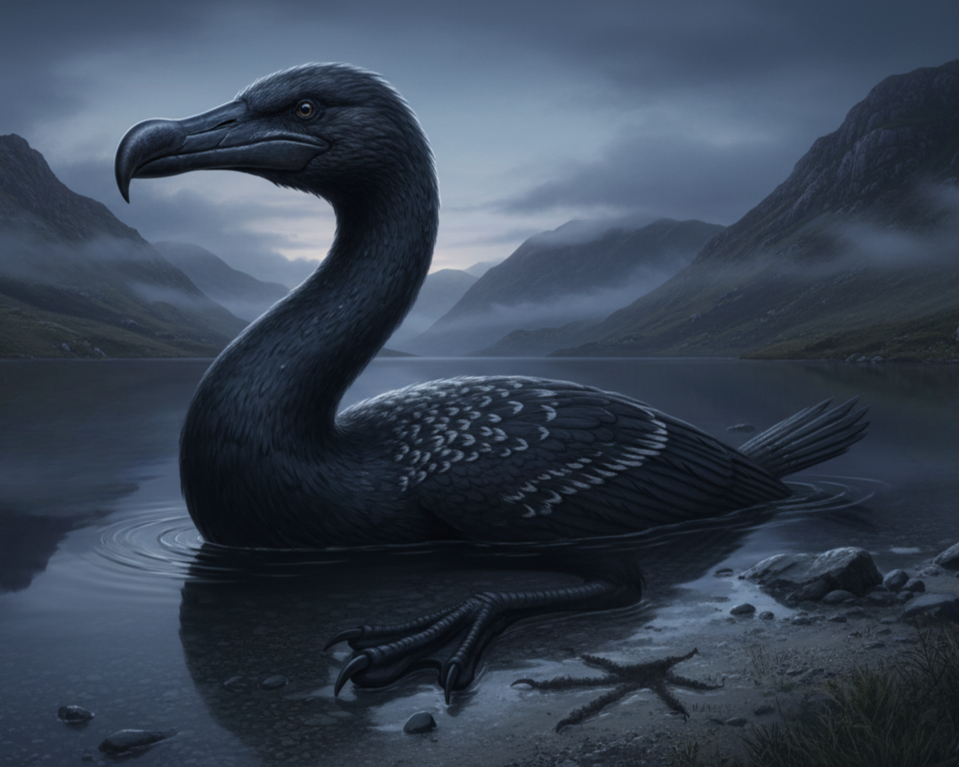
In its best known form, the Boobrie appears as an enormous black water bird that looks a bit like an outsized cormorant or great northern diver. Folklorists record detailed descriptions that claim it is larger than several eagles put together, with a long, thick neck and an enormous hooked beak that tapers like an eagle’s. Witnesses describe a beak more than a foot long and wide enough to grip a calf. Its short, powerful legs end in webbed feet with huge claws, and tracks found in stories are said to measure as wide as the spread of a red deer’s antlers. The wings seem better suited to swimming than flying, so the creature slices through the water rather than soaring through the air. In some tales the plumage is dark with white markings, which helps it vanish against choppy, foam-streaked lochs.
Habitat:
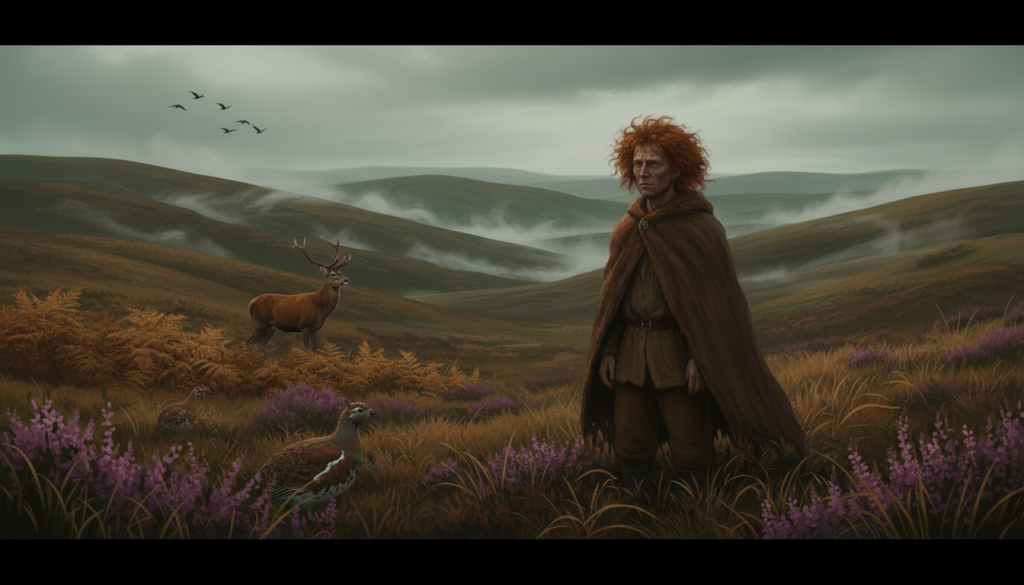
Most stories place the Boobrie in the sea lochs and deep inland lochs of the west coast of Scotland. Argyllshire is often named as its heartland, with particular links to remote places such as Loch nan Dobhran. Other accounts set it in the wider Highlands and islands, including the Isle of Mull at Loch Frisa. The creature favours lonely stretches of shoreline, thick heather, and quiet inlets where people rarely go. It sometimes shelters in overgrown heather on land, then returns to the water when it hunts. Older sources suggest that burning the heather may have driven it away from some of its former haunts.
Behaviour:
The Boobrie behaves as a mostly malevolent predator with a strong taste for livestock. It often targets calves, lambs, sheep and other animals being ferried by boat across lochs. According to several accounts, it drags its victims into the deepest part of the water before feeding. Many stories also stress its fondness for otters, which it eats in large numbers. Because farmers once relied heavily on their animals for food and income, the Boobrie represents a serious threat to a family’s survival. As a result, people in affected areas feared the creature and treated any strange bird on the loch with suspicion. In some modern summaries, the Boobrie even appears as an omen of doom linked with drownings or disappearances near the water.
Shape-shifting Ability:
The Boobrie is famous for its shape-shifting powers. Besides its giant bird form, it can appear as a water horse that gallops across the surface of a loch as if it were solid ground. Witnesses say the sound of its hooves on the water is the same as on hard earth. In other stories it becomes a water bull, or tarbh uisge, a powerful black bull that bursts from the loch to interact with humans. During late summer it may even shrink into a large, striped insect that drinks the blood of horses and acts like a nightmarish parasitic pest. Across all these forms, one feature often remains the same: its strange, bellowing call, which resembles the roar of a bull more than the cry of a bird.
Variant:
Some folklorists treat the Boobrie as part of a wider family of Scottish water spirits that includes the water horse and water bull. In these versions, the bird, bull and insect forms are not separate creatures but different guises of the same underlying being. Scholars such as Campbell of Islay and George Henderson also try to link the legend to real animals. They suggest that the huge swimming bird might have grown from rare sightings of the now extinct great auk, while the booming “bull-like” call could come from the common bittern, a secretive bird with a low, echoing cry. In this way, the Booberie can be seen as a blend of real wildlife, linguistic confusion and older beliefs about spirits that inhabit lakes and marshes.
Location in Scotland:
The core of the Boobrie tradition lies along the west coast of Scotland, especially the sea lochs and freshwater lochs of Argyllshire. Loch nan Dobhran on the Argyll coast features in one key story, while Loch Frisa on the Isle of Mull provides the setting for another well-known encounter. Some writers extend its range to the wider Scottish Highlands, where people used tales of the creature to explain strange sounds at night, missing livestock or mysterious shadows out on the water.
Stories/ Sightings or Experiences:
The Water Bull of Loch nan Dobhran
In one tale recorded by George Henderson, a man called Eachann finds a huge black bull lying close to death beside Loch nan Dobhran. He takes pity on it and feeds the animal until it recovers. Months later, his sweetheart Phemie stays alone in a sheiling near the loch. Her violent former lover, Murdoch, suddenly appears, ties her up and tries to abduct her. At that moment, a massive water bull charges in from the loch, knocks Murdoch down and kneels so that Phemie can climb onto its back. It races with impossible speed to her mother’s house, then disappears. A voice is heard in the air, declaring that it once helped a man and has now rescued a maid after three hundred years of bondage. Many readers see this bull as the Boobrie in one of its alternative forms.
The Ploughing Disaster at Loch Frisa
Another story from John Gregorson Campbell tells of a farmer and his son ploughing near Loch Frisa on Mull. When one of their four horses loses a shoe, they notice a seemingly stray horse grazing nearby and harness it to the plough. At first, everything goes well. Yet, as they reach the stretch of ground closest to the loch, the new horse becomes anxious and refuses to move. The farmer taps it lightly with his whip, and the animal lets out a deafening bellow as it changes into a gigantic Boobrie. Before the men can react, it dives into the loch, dragging the plough and the three original horses into the depths. The farmer and his son can only watch in horror as the surface closes over their lost team.
The Hunter Who Waited in Vain
In a different account, written down by John Campbell of Kilberry, a hunter spots the Boobrie floating on a sea loch one cold February day. Determined to kill the beast, he wades into the water until it reaches his shoulders. As he gets within about eighty yards, the creature suddenly dives. The man waits in the freezing water for forty-five minutes, then returns to the shore and keeps watch for another six hours. The Boobrie never returns. This story highlights both the creature’s wariness and the stubborn bravery of those who tried to confront it.
Purpose of the myth or Legend:
The Boobrie legend serves several clear purposes in Scottish tradition. On a practical level, it warns people, especially children and travellers, to treat deep lochs and sea inlets with respect. The risk of drowning, sudden storms and hidden currents becomes easier to understand when wrapped in a story about a hungry shape-shifting predator. At the same time, the myth reflects the real fears of farming communities whose survival depended on vulnerable livestock. By turning unexplained losses into the work of the Boobrie, people could give shape to their anxiety and grief. Finally, the legend keeps alive older beliefs about spirits in wild places while also preserving faint memories of rare birds like the great auk and the bittern. In modern times, the Boobrie has become part of Scotland’s wider bestiary of supernatural creatures, adding depth and character to the country’s folklore and its sense of place.