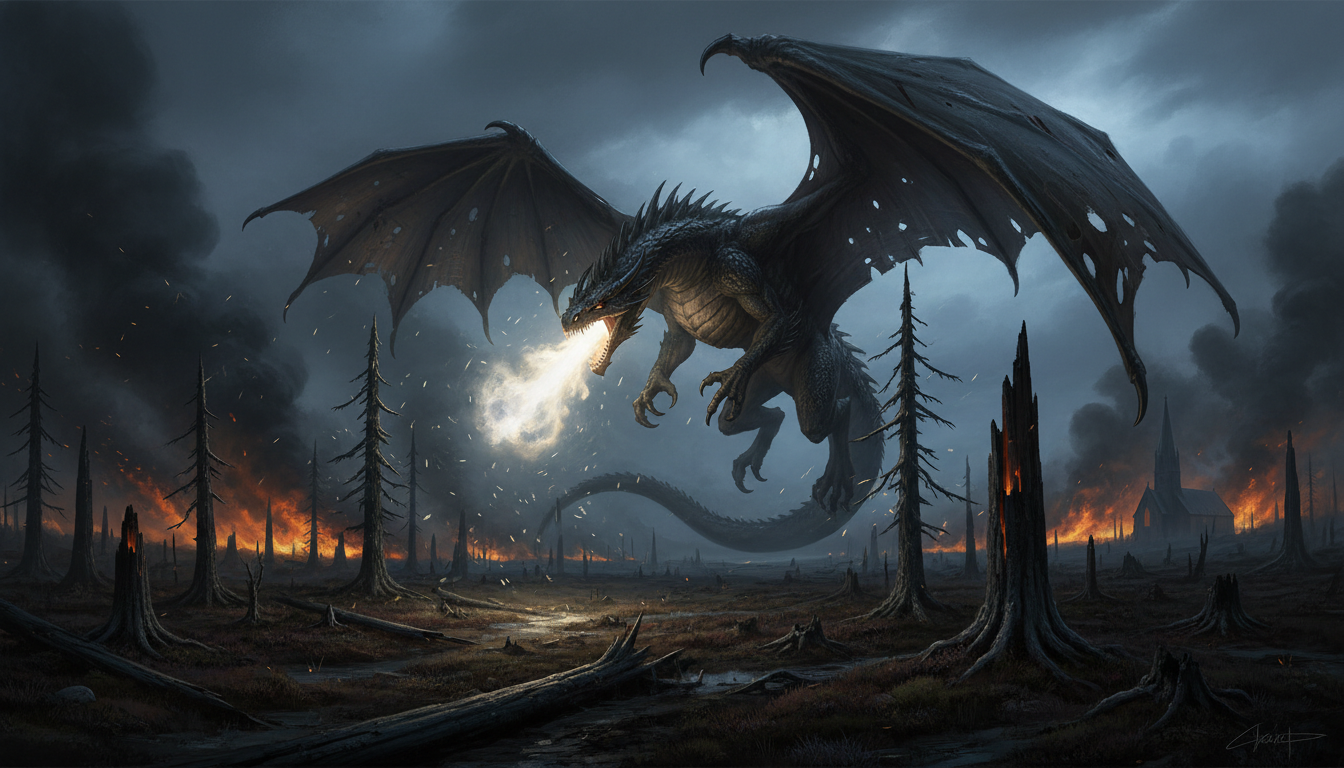
The Beast of the Charred Forest is a legendary figure that haunts the folklore of northern Scotland. While the ancient pine forests of the Highlands were once vast and impenetrable, today only charred stumps remain in the peat as silent witnesses to a fiery past. Consequently, local tradition blames this destruction on a terrifying monster born from the very flames it spread.
Name:
Beast of the Charred Forest
Name pronunciation:
Beast of the Charred Forest (English); Dubh a’Ghiuthais (Doo-ah-YOO-ish)
General Information:
The Beast of the Charred Forest is often described as a fire-breathing dragon or a malevolent spirit. According to legend, it was born from a forest fire that raged for seven years in the Dornoch area of Sutherland. Some accounts suggest the fire was started by Scandinavian invaders to control the timber trade. Therefore, the creature became a physical manifestation of that environmental catastrophe.
Appearance:
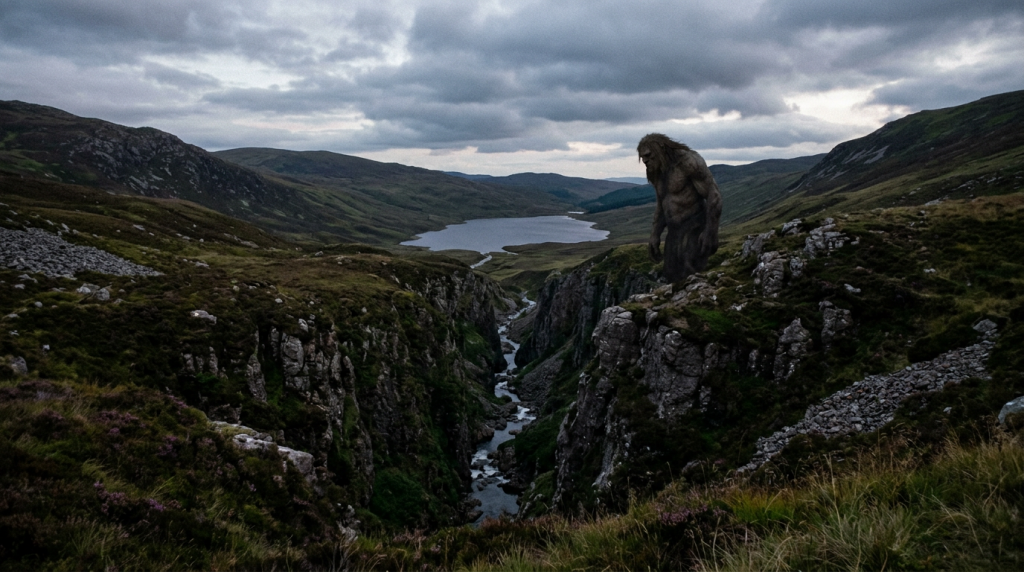
Most stories depict the creature as a powerful, dragon-like beast with the ability to breathe incinerating flames. However, regional variations offer different forms. In some tales, it appears as a monstrous winged serpent. In others, it is a hybrid creature with the head of a woman, the body of a whale, and the wings of an eagle.
Habitat:
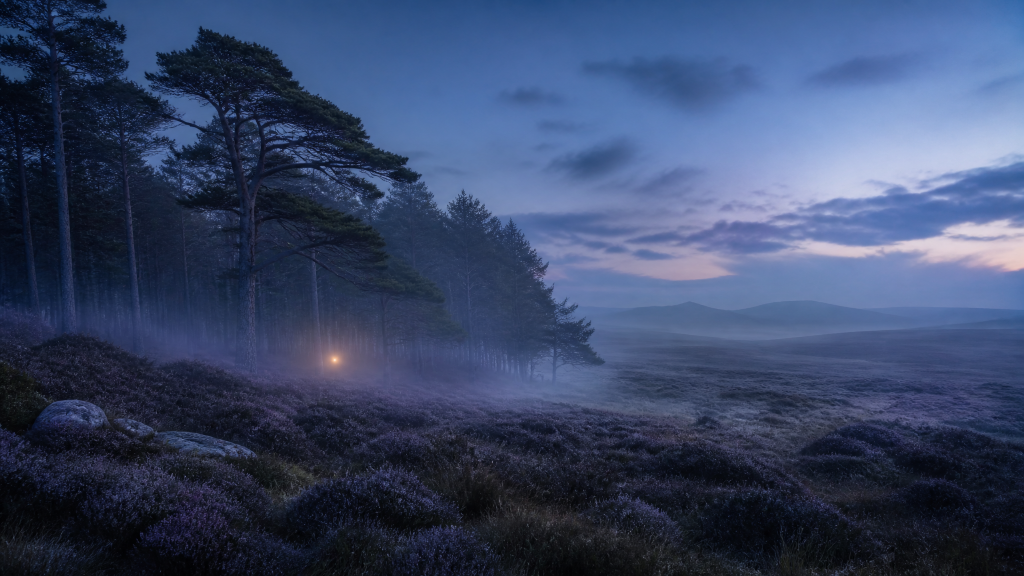
This monster primarily roamed the ancient Caledonian Forest within the regions of Sutherland and Ross-shire. It lived within the fire itself, stalking through the dense pine woods. Today, its former home is marked by the “ghost pines” or charred stumps found deep within the Scottish peat mosses.
Behaviour:
The beast was notoriously destructive and forced entire populations to flee their villages. It possessed a unique and magical defense mechanism. Specifically, the creature was indestructible to anyone it saw first. Only a person who managed to spot the beast before being noticed themselves had any hope of slaying it.
Shape-shifting Ability:
While usually seen as a dragon, one prominent variant claims the beast was actually a Norwegian princess. A witch transformed her into a great white bird to fly over Scotland and burn the woods. As she flew through the inferno, the thick pine smoke stained her feathers jet black.
Variant:
Regional names for the creature include Dhu Guisch (Black One of the Pine Tree), Dona (The Evil One), and Donnan. In Speyside, the story focuses on the “Muime,” a monstrous stepmother sent by the King of Lochlann. This version emphasizes her role as a bringer of wind and fire rather than a traditional dragon.
Location in Scotland:
The legend is most strongly tied to Sutherland, particularly the moorland between Dornoch and Skibo. Other sightings and stories place the creature in Ross, the Reay, and the forests of Badenoch and Glenmore.
Stories/ Sightings or Experiences:
The Fall of the Dragon at Dornoch
Saint Gilbert, the Bishop of Caithness, famously defeated the beast when it threatened the town of Dornoch. Knowing the creature’s power, Gilbert cunningly dug a hole and hid inside it to ensure he saw the dragon first. As the monster approached the church spire, it roared, “Pity on you, Dornoch!” Gilbert stepped out and boldly repeated the boast back to the beast. He then fired a single, blessed arrow that pierced the dragon’s heart instantly. The townspeople buried the carcass under a massive landmark known as the “Beast’s Stone.” Local tradition says that Gilbert was a master mason who finished his cathedral using witchcraft, flinging enchanted hammers and nails into place.
The Hunter of Kingussie
In the Speyside tradition, a brave hunter saved the forests of Badenoch from the fire-breathing Muime. He instructed the villagers to separate all the livestock from their young on opposite sides of the River Spey. The resulting noise was so overwhelming that the curious monster lowered her head beneath the clouds to investigate. At that moment, the hunter fired a special silver bullet through her eye. Her massive body fell and rotted away, eventually giving rise to the red and black ants found in the forest today.
The Black Fir of Lochlann
Another version tells of the King of Norway, or Lochlann, who grew envious of the magnificent Scottish pines. He believed they eclipsed his own forests and sent his daughter to destroy them. Transformed into a white bird by a witch, she rained fire upon the Highlands until the smoke turned her feathers black. She was eventually lured to the ground by the cries of distressed animals. After her death, a boat attempted to return her body to Norway three times, but fierce gales prevented the journey. Consequently, she was laid to rest at Kildonan, at the head of Little Loch Broom.
Purpose of the myth or Legend:
The legend serves as a folk history to explain the loss of Scotland’s great ancient forests. It provides a mythical reason for the charred wood found in peat bogs while also celebrating local heroes like Saint Gilbert. Furthermore, it reflects the historical trauma of Norse invasions and the subsequent clearing of the land.