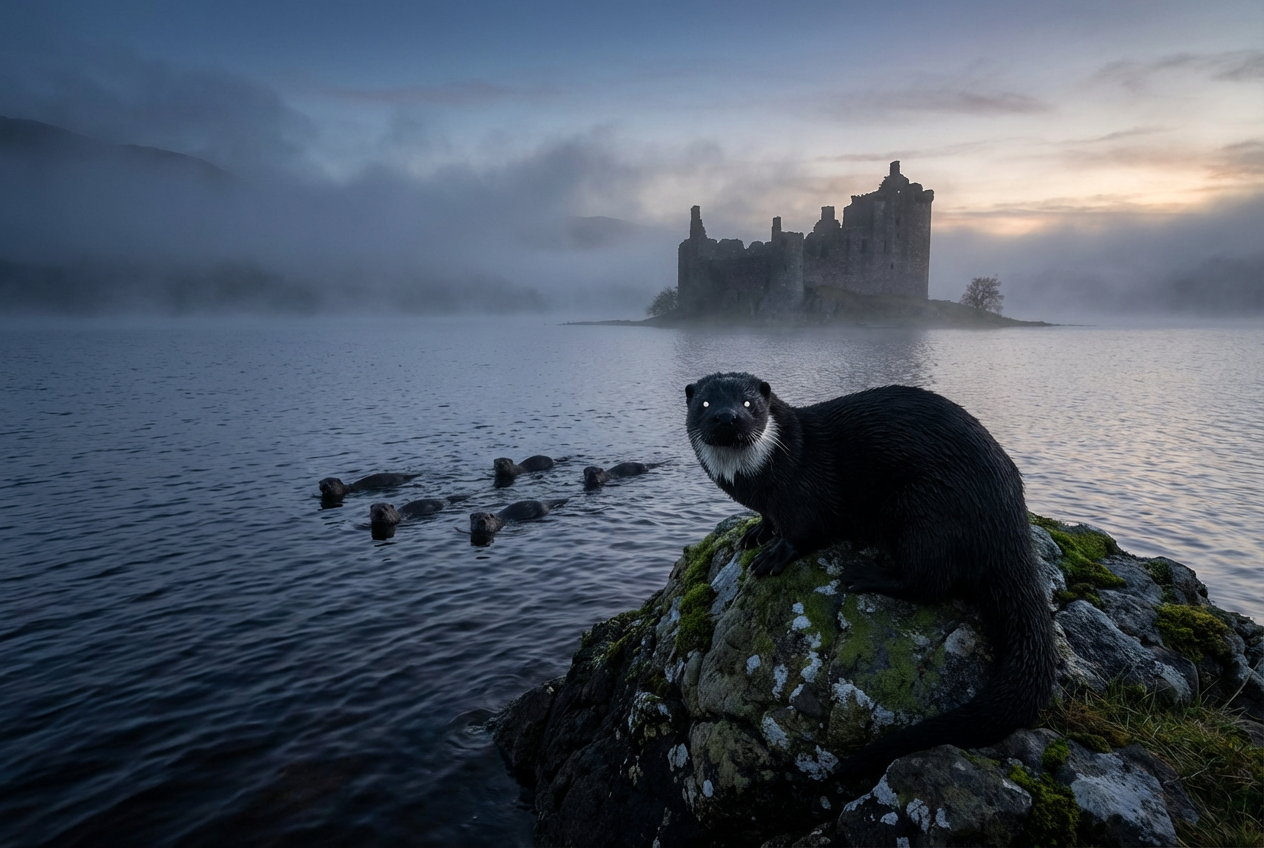
The King Otter, known in Gaelic as Rìgh nan Dòbhran or Dòbhar-Chù, is one of the most formidable creatures in Scottish and Irish folklore. This legendary beast resembles an enormous otter, though some accounts describe it as half dog, half fish. It is rarely seen, but when it does appear, it commands a band of seven (or nine) ordinary otters and possesses a hide of extraordinary magical power.
Name pronunciation:
DO-war COO (Dòbhar-Chù); REE nan DOW-ran (Rìgh nan Dòbhran)
General Information:
The King Otter is a creature of both Irish and Scottish folklore, though it features prominently in Highland tradition. It is described as a massive otter-like animal with a pelt that holds immense protective power. Consequently, hunters have long sought this creature, despite the deadly risks involved. The legend has been passed down primarily through oral tradition, with few written records surviving.
Appearance:
Physical descriptions vary slightly across regions. Most accounts describe the King Otter as being about five times larger than a normal otter, measuring between 10 and 15 feet in length. Some say it has a pure white pelt with black ear tips and a distinctive black cross on its back. Others describe it as entirely black with a single white spot on its belly or chin. In Raasay and the surrounding mainland, tradition holds that the creature possesses a jewel embedded in its head.
Habitat:
The King Otter inhabits the lochs, rivers, and coastal waters of the Scottish Highlands and Islands. It is particularly associated with the West Coast, where it migrates between bodies of water. According to legend, Eilean Donan Castle is said to be the burial ground of at least one King Otter, and its descendants are believed to live in the area to this day.
Behaviour:
Behaviourally, the King Otter is highly aggressive and dangerous. It is a man-eater with an insatiable appetite for human flesh and a bite strong enough to break rocks. It leads every band of seven (or nine) otters and is never killed without the death of a man, woman, or dog following soon after. Some traditions claim that if captured alive, the King Otter will grant any wish in exchange for its freedom.
Shape-shifting Ability:
The King Otter does not appear to possess traditional shape-shifting abilities.
Variant:
Dòbhar-Chù (Water Dog), Dratsie (old Scottish name for otter), Dobarcu, Doyarchu, Dhuragoo, Dorraghow, Anchu
Location in Scotland:
Scottish Highlands and Islands, particularly the West Coast; Lochaber; Raasay; Eilean Donan Castle
Stories/ Sightings or Experiences:
The Conwall Cemetery Headstone
One of the most famous pieces of evidence for the King Otter’s existence is a headstone found in Conwall Cemetery in Glenade, County Leitrim, Ireland. The monument is a recumbent sandstone slab measuring approximately 4.6 by 1.10 feet. It depicts an animal with the body and legs of a dog, showing characteristic depth of rib and strength of thigh. The tail is long, curved, and shows a definite tuft. The carving is said to commemorate a local woman who was killed by a Dòbhar-Chù in the 18th century. Thus, it one of the few physical records of an encounter with this creature.
The Invincible Warriors of Culloden
According to Alasdair Alpin MacGregor in The Peat-fire Flame, fragments of the King Otter’s skin were highly prized as protective talismans. It was firmly believed that even a tiny piece of the pelt, when kept in a house, would protect both the dwelling and its inhabitants from misfortune. Moreover, soldiers who carried a fragment into battle were said to be invulnerable to arrow, sword, or bullet.
Tradition holds that many Jacobite soldiers at Culloden in 1746 carried a small piece of King Otter skin with them. This is said to explain how some escaped injury or death even when swords clashed around them and bullets fell as thickly as hailstones. A Lochaber informant claimed that “an inch of it placed on the soldier’s eye kept him from harm or hurt or wound though bullets flew about him like hailstones, and naked swords clashed at his breast. When a direct aim was taken, the gun refused fire.”
The Burial Ground at Eilean Donan
Ancient legend tells that Eilean Donan Castle is the burial place of a King Otter. Its coat of silver is said to be buried somewhere on the island, and folklore states that whoever finds this pelt will be rewarded with immortality and invincibility. Consequently, treasure hunters and folklorists have long been fascinated by this tale, though the silver coat has never been recovered.
Purpose of the myth or Legend:
The King Otter myth serves multiple purposes in Highland culture. Firstly, it warns of the dangers lurking in Scotland’s many lochs and waterways. Secondly, it reflects the historical importance of otters in the Highland economy, as otter pelts were valuable trade goods. Thirdly, the protective power of the King Otter’s skin may have served as a psychological comfort for soldiers heading into battle, particularly during the Jacobite uprisings. Finally, the creature’s vulnerability only at a single small spot reinforces the folk belief that even the most powerful beings have a fatal weakness.