Name pronunciation:
ECH-OOSH-kuh (Scottish Gaelic)
General Information:
The Each-Uisge is a deadly Scottish water horse found in Highland and Island folklore, closely related to but far more dangerous than the kelpie. Each-Uisge literally means “water horse” in Scottish Gaelic, and the creature appears in Scottish, Irish and Manx traditions. It lives in the sea, sea lochs and freshwater lochs, and it is widely described by folklorists, including Katharine Briggs, as perhaps the fiercest of all water horses. It is a powerful shape-shifter that can appear as a fine horse, a huge bird or a handsome man, and it lures humans, especially women, to a brutal watery death. The Each-Uisge should not be confused with the river-dwelling kelpie.
Appearance:
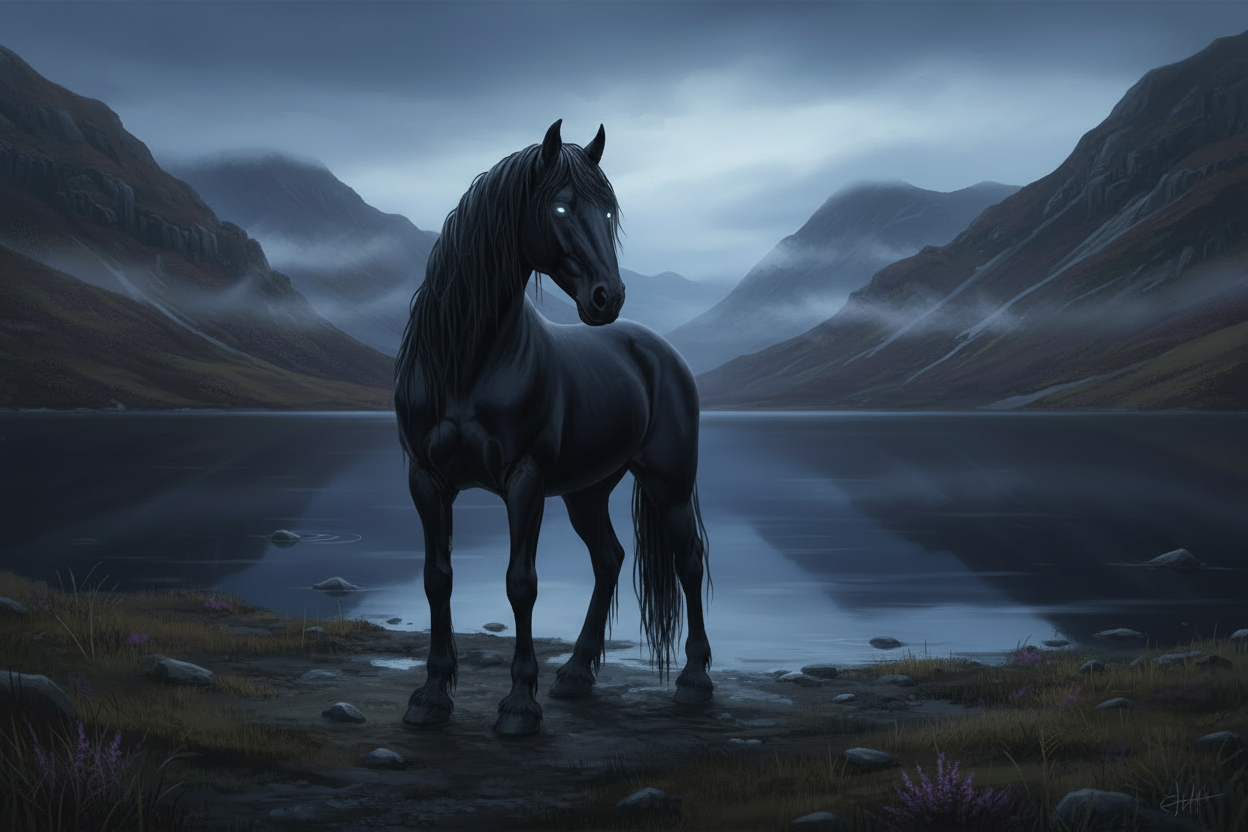
The Each-Uisge usually appears as a beautiful, strong horse or pony with an unnaturally fine coat and rich harness. In the Highlands, some accounts describe richly decorated tack and bridles that look far grander than any normal farm gear. It can also appear as a huge bird, similar to the boobrie, or as a strikingly handsome young man. In human form, it looks almost normal at first glance. However, there are key warning signs. Its hair is often full of sand, mud, weeds or strands of water plants, especially near lochs or the shore. In some stories, a girl resting with a “man” on her lap notices that he has hooves instead of feet, or sees weed and grit tangled in his hair. These small details reveal that she is dealing with an Each-Uisge rather than a real human.
Habitat:
The Each-Uisge is found in wild waters rather than small streams. It lives in:
- The open sea
- Sea lochs and sea inlets
- Freshwater lochs throughout the Highlands and Islands
Almost every region of Celtic Scotland once had a loch said to be haunted by a water horse, and Each-Uisge traditions are especially strong in the Hebrides and West Highlands. Specific sites include Loch a’ Mhuileinn on Lewis (near Cnoc-na-Bèist, “Hillock of the Monster”), lochs in Raasay, Loch na Beiste and many unnamed hill lochans. The creature can come ashore to wander near water, and its presence made people very cautious around isolated lochs and lonely shorelines.
Behaviour:
The Each-Uisge is vicious, cunning and unpredictable. In horse form, it will often stand calmly near a loch, inviting someone to mount it. While it is ridden on dry land away from water, the rider is safe. However, the moment the horse sees or smells water, its skin turns adhesive. The victim becomes glued to the creature’s back. Then the Each-Uisge charges straight for the deepest part of the loch, drags the rider under and drowns them. After drowning its victim, it tears the body apart and devours every part except the liver, which floats to the surface. Stories of livers washing ashore are a classic sign that the Each-Uisge has fed.
It preys on humans, cattle and sheep. In some tales, it comes onto land and attacks solitary people without warning. In others, it works as a seemingly normal farm horse until its owner climbs on its back, at which point it bolts into the loch. There are even stories of water horses turning on their own kind when crazed by the scent of a previous rider. Highland communities, therefore, viewed lone horses and strangers near lochs with deep suspicion.
Shape-shifting Ability:
The Each-Uisge is a skilled shape-shifter. It can appear as:
- A fine horse or pony
- A handsome man
- A huge bird, often identified with the boobrie
In horse form, its hide becomes sticky as soon as it approaches water, trapping anyone who has touched or mounted it. Some stories relate that even a single finger in contact with its skin can be enough, forcing a trapped victim to cut off the finger to break free. In human form, it is charming and seductive, but still carries traces of the water world in its hair and on its body. In rare tales, it also appears as a strange visitor in the night, hinting at a more purely spirit-like aspect.
Variant:
The Irish aughisky (Each-Uisce) is very similar to the Scottish Each-Uisge. It sometimes gallops on land in horse form. According to William Butler Yeats and other collectors, if you can catch and harness this Irish water horse and keep it away from the sea, it will make the finest steed imaginable. However, a single glimpse of the ocean is enough to send it racing back into the waves, taking its rider or owner with it.
On the Isle of Man, the Manx water horse, the cabyll-ushtey (or cabbyl-ushtey), shares this ravenous nature, devouring both livestock and humans. One Manx tale tells of a cabyll-ushtey that came from the Awin Dhoo (Black River), ate a farmer’s cow and later his teenage daughter.
It is a close cousin to the river-dwelling Kelpie, although, the Kelpie is not as vicious as the Each-Uisge. Other variations include the Nuggle or Shoopiltee and the Tangie from the Northern Isles.
These variants show that water horses are a shared tradition across Celtic regions, with the Each-Uisge as the most feared Highland form.
Location in Scotland:
Each-Usige belongs to the Highlands and Islands, where almost every district once claimed its own water-horse loch. Key locations include:
- The Hebrides, such as Lewis, with places like Cnoc-na-Bèist by Loch a’ Mhuileinn
- Raasay, where a blacksmith’s family confronted the creature
- Numerous Highland lochs, both inland and coastal, especially in remote glens
Folklore collectors like John Gregorson Campbell and Malcolm MacPhail recorded many tales from these areas, reinforcing how widespread belief in the Each-Usige once was.
Stories/ Sightings or Experiences:
The Shieling of the One Night (Lewis)
This is one of the most chilling accounts from the Isle of Lewis. Two cousins, known as Fair Mary and Dark Mary, were staying in a remote summer shieling (a small stone hut) to tend their cattle. One evening, a weary woman arrived seeking hospitality. The girls, following the Highland tradition of cairdeas (friendship/hospitality), allowed her to share their bed.
During the night, Dark Mary woke to a strange, warm trickling sensation. She discovered her cousin dead, with her heart torn out. The “woman” had vanished, but as Dark Mary looked out the door, she saw a large horse trotting away into the dawn mist. This story serves as a grim reminder that the Each-uisge does not always appear as a “handsome man” to seduce; it can take any human form to bypass the sacred laws of hospitality and gain entry to a home.
The Nine Children of Sunart (Argyll)
This legend is often cited as the reason Highland parents were so protective of children near water. Near a loch in Sunart, nine children found a beautiful, docile horse grazing by the shore. One by one, they climbed onto its back. The horse’s back seemed to lengthen miraculously to accommodate all of them.
The youngest child, however, noticed something strange and only touched the horse with a finger, which immediately became stuck. Realising the danger, he pulled out a small pocketknife and cut off his own finger to escape. He watched in horror as the horse galloped into the loch with his eight friends. The following day, eight small livers were found floating on the surface of the water. This “lengthening back” is a common trait in water-horse lore, designed to lure as many victims as possible in a single attack. This story shows parallels to the Water Horse of Pityoulish.
The Water-Horse of Loch nan Dubhrachan (Skye)
This is a rare instance where folklore meets a documented historical event. In 1870, the belief in the Each-Uisge was so potent in the Sleat district of Skye that the local community decided to take action. Reports of a “beast” waylaying travellers near Loch nan Dubhrachan became so frequent that a large-scale dragging operation was organised.
A massive net was used to sweep the loch. During the process, the net snagged on something heavy and powerful beneath the surface. The terror was so great that the men on both sides of the loch dropped the ropes and fled, convinced they had hooked the monster. While no creature was captured, the event was witnessed by many, including a young John MacRae, who provided a first-hand account of the panic decades later.
The Silver Coin and the Freebooter
In Highland tradition, the Each-Uisge is often treated as a “supernatural” entity rather than a mere biological monster, meaning it is immune to lead. A famous story tells of a “freebooter” (a Highland outlaw or soldier of fortune) who encountered a handsome stranger by a loch. Recognising the sand and weeds in the man’s hair, the freebooter drew his pistol.
He fired twice with lead bullets, but the stranger merely laughed. Remembering old wisdom, the freebooter loaded his gun with a silver sixpence. When he fired the silver, the creature let out a horrific, unearthly scream, reverted to its horse form, and plunged back into the depths. This detail aligns the Each-Uisge with other “unholy” creatures of the night that can only be repelled by pure silver.
The “Jelly” Aftermath
A recurring and scientifically curious detail in these primary accounts is what happens to the Each-Uisge after it is killed. In the story of the Blacksmith of Raasay, as well as others where the beast is slain on land, the carcass does not remain as flesh and bone. By sunrise, the body invariably dissolves into a “soft, greyish jelly” or “star-jelly” (pwdre ser).
Folklorists suggest this was a way to explain why no physical evidence of these massive monsters was ever found. It also reinforced the idea that they were made of “enchanted water” or spirit-matter rather than earthly meat.
Women, Seduction and Survival
Each-Uisge has a particular interest in human women. Campbell noted that any woman marked out by the creature was almost certain to become its victim in the end. In one legend, a young woman herding cattle met a handsome man who soon became friendly. She let him rest with his head on her lap. When he stretched in his sleep, she saw that he had hooves instead of feet and sand tangled in his hair. Realising the danger, she eased his head gently to the ground and ran, escaping before he woke.
In another tale, an Each-Uisge in human shape came to a woman’s house while she was alone and tried to seduce her. She responded by throwing a pan of boiling water between his legs. The creature fled, roaring in pain. In a third story, a father and his three sons ambushed a “young man” who regularly came to visit the daughter. When they seized him, he reverted to his horse form and tried to drag them all into the loch. They managed to kill him with their dirks before he reached the water. These stories combine fear of predatory strangers with a reminder that courage and quick thinking can sometimes defeat even the worst monster.
Purpose of the myth or Legend:
Each-Uisge legends served several clear purposes in Highland and Island communities. First, they warned people, especially children, away from dangerous waters and deep lochs. Stories of horses dragging riders under and of livers washing ashore reinforced the real risk of drowning. Secondly, they taught caution around strangers and solitary animals near water, particularly for young women, by framing the threat as both physical and sexual. Thirdly, they explained unexplained drownings, missing livestock and eerie sights on lochs in a way that fitted local belief.
Finally, the Each-Uisge links older ideas of water spirits and loch guardians with more modern “lake monster” stories, such as those about Loch Ness. Even if belief in the Each-Uisge has faded, the fear and respect for deep, dark waters in the Highlands owes much to this powerful and terrifying water horse.