Name pronunciation:
DUN-ee
General Information:
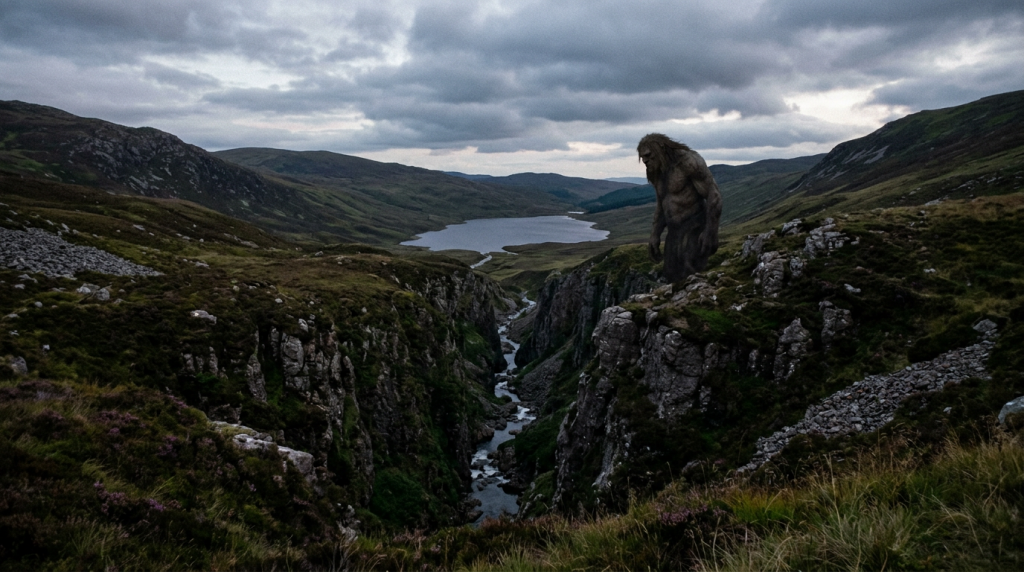
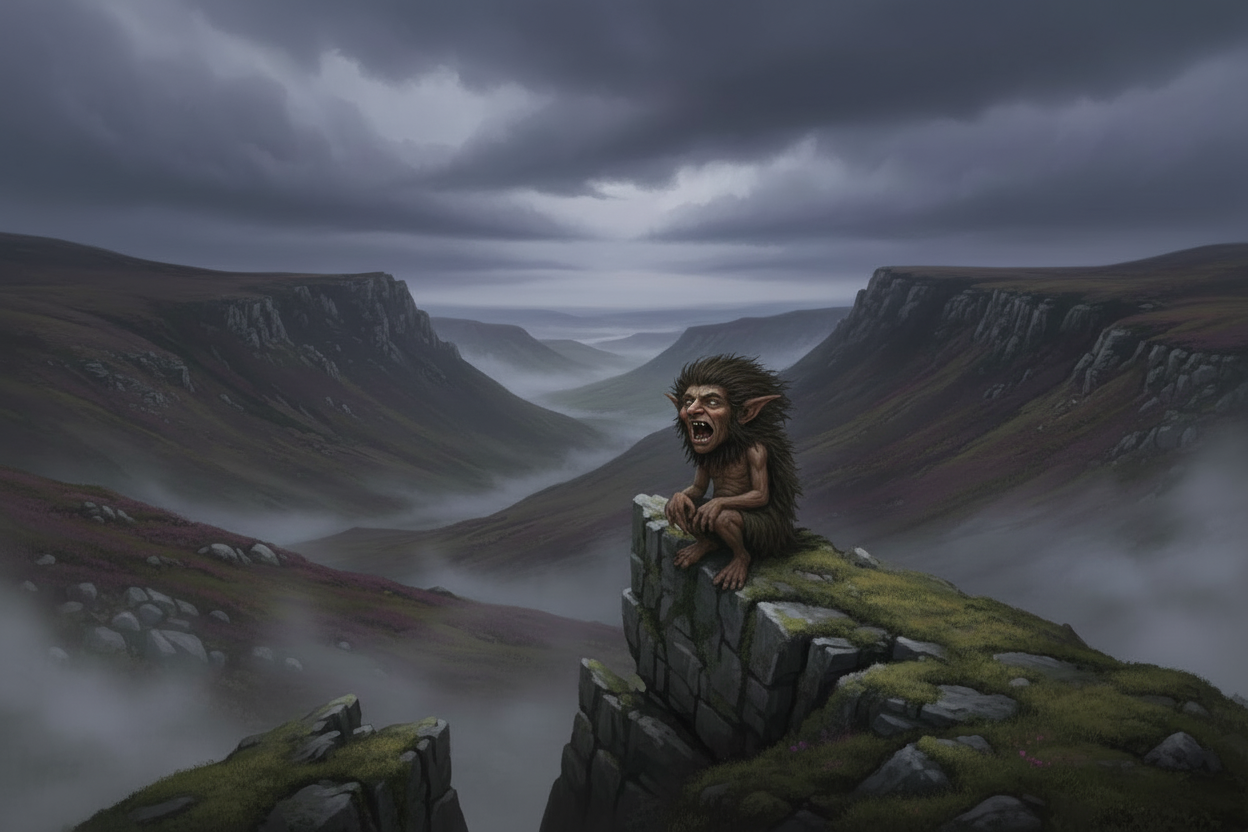
Dunnie is a small, brownie-like being from the folklore of the Anglo-Scottish borders, especially Northumberland, Roxburghshire and Berwickshire. Dunnie is usually described as a distant relative of the brownies, but instead of living in houses and barns, he roams crags, dales and hill country. He is particularly linked with the Cheviot Hills, where travellers once feared or welcomed his sudden appearance. Like brownies, he has brown skin and a hobgoblin-like look. However, Dunnie is also strongly associated with the restless ghost of a Border reiver who still haunts the fells, guarding his hidden loot and playing tricks on the living.
Appearance:
Dunnie is smaller than a typical brownie, but he shares the same rough, ugly and hobgoblin-like features. His skin is brown, and he often appears as a shabby, gnome-like figure. In some traditions, he can look like an old man or old woman, hunched and weathered by the hills. At other times, he appears in animal form, most famously as a horse. Whatever shape he takes, there is usually something slightly off about him, enough to make a careful traveller suspicious.
Habitat:
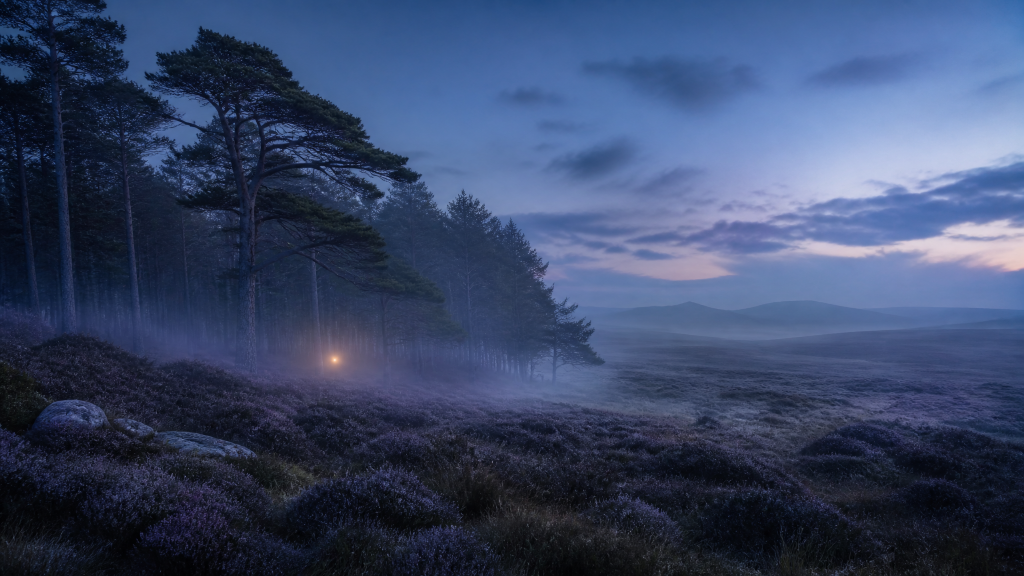
Dunnie is a creature of the border landscape rather than the hearth. He wanders the crags and dales of the Cheviots and the rough ground around Hazlerigg and other border farms. Instead of a stable home, he is tied to places like rocky caverns, hill paths and old wells. In the case of the Hazlerigg Dunnie, his haunt is closely linked to the secret cavern where he hid his stolen goods while he was still alive as a reiver. This makes him both a land spirit and a guardian of buried treasure.
Behaviour:
Dunnie is known for his loud, rambling song, which lists local places and their qualities. People could tell Dunnie was near when they heard verses such as:
“Cockenheugh there’s gear enough,
Collierheugh there’s mair,
For I’ve lost the key o’ the Bounders,
An’ I’m ruined for evermair.”
Different versions add more lines, naming villages and what they are “good for”, from ale to robbers and from cattle to rye. Beyond singing, Dunnie delights in tricks and practical jokes. He allows people to rely on him, then suddenly vanishes at the worst possible moment. Sometimes he helps sincerely, especially when someone is in real need. At other times he frightens children, dumps riders in mud or wastes a farmer’s effort for his own amusement.
Shape-shifting Ability:
Dunnie is a shapeshifter. His favourite form is that of a horse. In the Hazlerigg stories, he disguises himself as a plough-horse, standing quietly until a farmer fits a harness and leads him into the stalls. Just as the work is finished, Dunnie disappears, dropping the harness to the floor and leaving the farmer stunned. He also lets riders mount him, then trots along calmly before vanishing and throwing them into the muddiest part of the road.
In other accounts, he appears as an old man, an old woman or a helpful pony that knows the road better than any human. One Nithsdale story describes a mysterious pony that carried an exhausted man to the doctor in Thornhill, then took the doctor back across moor and fell in time to attend a difficult birth. The locals later explained that this was the Doonie, known there as a helpful border spirit. Dunnie can also be involved in fairy–human exchanges, for example by disguising himself as the horse that carries a midwife to and from fairy households.
Variant:
Dunnie is often described as a “Danish version of the Broonie”, suggesting a close link to the brownie tradition. However, it has a stronger wandering and shape-shifting element. His name is thought to come from the Gaelic Donn, meaning “brown”, which connects him linguistically to brownies. In some accounts he overlaps with figures like the Bodach of Carrick, who appears as an old man. Across Nithsdale and the Border counties, Doonie or Dunnie stories blur the lines between brownie, hobgoblin, ghost and helpful otherworldly guide.
Location in Scotland:
Although strongly associated with Northumberland and the Anglo-Scottish border, Dunnie is also remembered in Nithsdale and the wider Border counties. He appears along routes over the moors, near notable wells, and in dramatic places like Crichope Linn. In the Cheviot Hills, he is said to wander the crags and dales, singing about Cockenheugh, Collierheugh and other landmarks. The Hazlerigg Dunnie in particular haunts the hills above Hazlerigg, where his hidden hoard is still thought to lie.
Stories/ Sightings or Experiences:
The Hazlerigg Dunnie and the Hidden Loot
The most famous Dunnie is the Hazlerigg Dunnie of Northumberland. In life he was a Border reiver, raiding farms and villages along the Anglo-Scottish frontier. After one especially rich haul, he struggled to carry all his plunder, so he hid it in a secret rocky cavern in the hills above Hazlerigg. He then returned to raiding, but his luck finally ran out. While stealing corn from a granary, he was caught by local farmers. A violent struggle followed, and they killed him. Before he died, he swore that he would not rest, because it had taken so many men to bring him down and because his treasure was still hidden in the fells.
After his death, people began to see and hear the Hazlerigg Dunnie in the hills, singing his long place-name song and playing tricks. He liked to frighten children and tease adults. One of his best-known pranks involved turning into a patient plough-horse. A farmer would harness him, lead him to the stable, and finish all the usual horse-care tasks. Only then would Dunnie vanish, letting the harness crash to the floor and leaving the farmer shocked. At other times he carried riders along the road, only to disappear and dump them in the deepest mud. He was also said to take on the shape of a horse that ferried midwives between fairy homes and human homes, making him a liminal figure between both worlds. Nobody knows if his hidden hoard was ever found, so some say he still haunts the fells, guarding it.
The Doonie’s Midnight Ride to Thornhill
A Nithsdale story describes the Doonie as a lifesaving helper rather than a mere trickster. One winter night, Douglas M’Math’s father arrived home to find his wife in labour and in danger. The only woman nearby was heavily pregnant herself and of little use. He had to fetch the doctor from Thornhill, miles away over moor and hill. The farmer’s horse was away at another holding, so he faced a long, risky walk with no guarantee the doctor would even be home.
On his way across dark fields, he came to a large pool and walked straight into a pony standing in his path. Instead of kicking, it nuzzled his shoulder. When it would not lead towards the farm, he climbed onto its back. The pony set off at a steady pace, heading exactly for Thornhill. At first he feared it might be a malevolent water-horse, but soon realised it was carrying him by the quickest route to the village. It stopped right outside the doctor’s door and disappeared.
When the doctor stepped outside, the same mysterious pony was waiting. It refused bridle and saddle, yet carried him all the way back to the shieling and arrived just in time to help deliver a healthy baby. When M’Math later tried to feed the pony with corn, it was gone. The next day the farmer explained that this had been the Doonie, a well-known border spirit who often helped people in tight spots. The story shows that Dunnie could be a guardian as well as a joker.
The Doonie at Crichope Linn
Another tale, also linked to the Mitchellslacks family, tells of a boy climbing in Crichope Linn, a deep, narrow gorge carved in the sandstone. While raiding pigeon nests, he slipped and was left clinging to a hazel bush above a dangerous drop. He could not climb back and knew he could not hang on for long. Looking down, he saw a strange old woman standing on a ledge near the base of the linn. She spread out her apron and called, “Let go, and I’ll catch you.”
With no other choice, he let go. He slid from her apron into a hidden deep pool, then surfaced and was pulled out by the old woman. She grabbed him by the neck and dragged him to safety. Then she led him out of the gorge by a route he had never seen before and could never find again, no matter how he searched later. As he turned to thank her, she had vanished. The farmer later told this story as an example of the Doonie’s help and warned his children not to risk themselves in the linn again. Here, Dunnie appears in human form but still moves through impossible paths, reinforcing his role as a border spirit who knows ways that humans do not.
Purpose of the myth or Legend:
Dunnie, like brownies, serves several purposes in border folklore. First, he explains strange events on moorland roads, in hill country and at dangerous places like linns, wells and crags. Sudden help, mysterious horses, and narrow escapes become signs that Dunnie has intervened. Second, his connection with reivers and hidden treasure reflects the violent history of the Anglo-Scottish border, where raiding, theft and blood feuds were once common. The idea of the Hazlerigg Dunnie guarding his loot ties real fear of bandits to a supernatural watchman who never quite rests. Third, as a trickster, Dunnie warns against overconfidence and carelessness. He reminds riders to be wary of strange horses and encourages respect for wild places. Finally, the Dunnie stories keep local place-names, routes and landmarks alive through his long song and repeated tales, turning the landscape itself into a living map of memory and myth.