Name pronunciation:
BROW-nee (Scots); BROON-ay or GROO-ah-gach (Gaelic)
General Information:
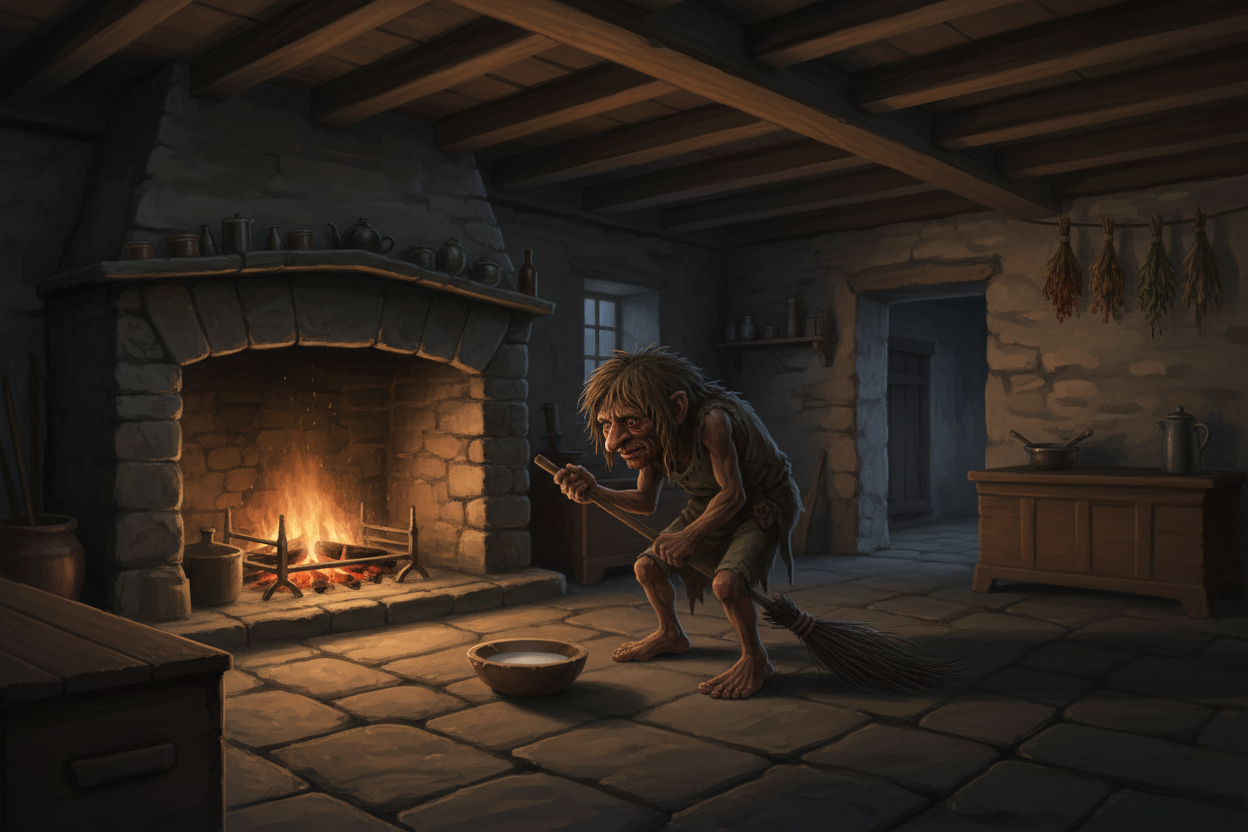
Brownies are household spirits found across Scotland, in both Scots- and Gaelic-speaking communities. Brownies are known as broonies in Scots and as brùnaidh or gruagach in Scottish Gaelic, and they appear in stories from the Lowlands, the Borders, Orkney, Shetland and the Highlands and Islands. They come out at night while the household sleeps and complete chores and farm tasks, bringing luck and prosperity if treated with respect. In return, they expect simple offerings of food, usually a small bowl of milk, cream or porridge left by the hearth, and they leave forever if they feel slighted or insulted.
Appearance:
Brownies are generally small, often about the size of a child, although older tales sometimes describe them as human-sized or larger. Their skin is brown, and they are usually covered in hair. They are almost always male, though a few female figures like Meg Mullach, or Hairy Meg, do appear in tradition. They go naked or wear only rags and show no interest in fine clothing. Regional details vary. In the Scottish Lowlands some stories say brownies have just a single hole instead of a nose, while in Aberdeenshire some are said to lack fingers and toes. Despite their rough appearance, brownies are wise and sharply observant.
Habitat:
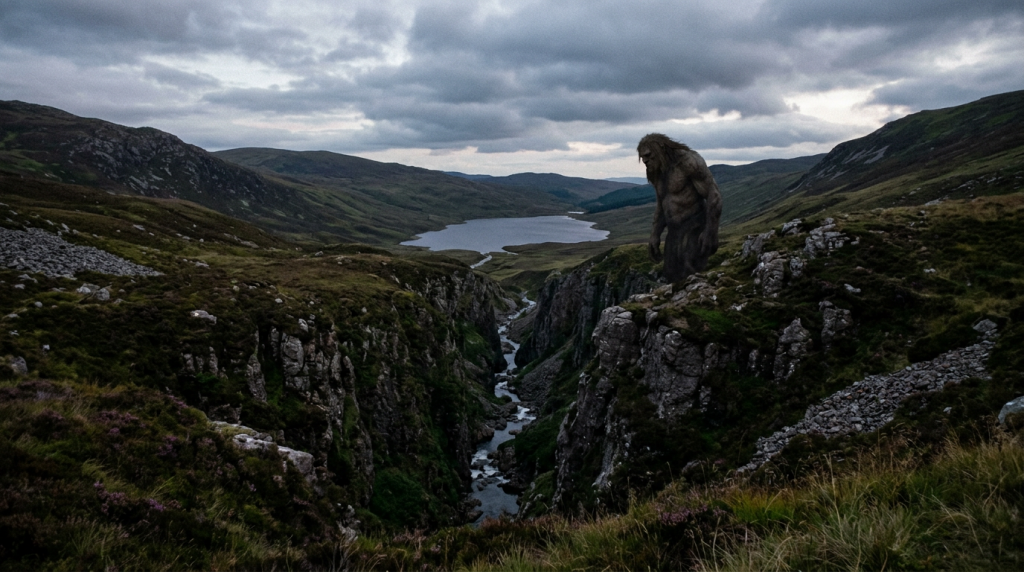
Brownies are domestic spirits, so their main habitat is the human home and farm. They favour old houses, mills and barns, but they rarely sleep where they work. Instead, they often live in nearby natural places such as caves, rocky outcrops, burns, streams or glens. In Gaelic-speaking areas, the brùnaidh or gruagach may be linked with particular stones or hillocks close to a township or shieling. They usually attach themselves to one household at a time, sometimes staying for generations if the relationship remains respectful.
Behaviour:
Brownies work at night and avoid being seen. They sweep floors, tidy kitchens, churn butter, thresh grain and see to the animals, and they sometimes finish half-completed tasks for the humans they favour. They bring good luck and prosperity, but they are also quick to punish laziness, especially in servants. A brownie may pinch a slothful worker, hide tools, upset items or cause minor chaos for amusement. Criticism, mockery or unwanted gifts are extremely dangerous. If a brownie feels insulted, he may undo all his work, go on a rampage through the house or simply leave, taking the household’s good fortune with him.
Shape-shifting Ability:
Brownies have the ability to turn invisible, which allows them to move freely through a house without being noticed. Some accounts say that brownies can take the form of animals, especially around farms where an animal shape helps them blend in with livestock or wildlife. In more hostile tales, an angered brownie that becomes a boggart may shape-shift into a person’s greatest fear.
Variant:
The basic idea of brownies appears under several different names. In Scots and English tradition there are brownies, broonies, hobs and ùruisgs. In Gaelic tradition, the brùnaidh and gruagach belong to the same broad family of domestic or helper spirits, although some gruagach traditions link the figure more to cattle and outdoor work. Similar beings elsewhere in the British Isles include the Welsh Bwbach and the Manx Fenodyree. Links have also been drawn with the Roman Lares, who were domestic spirits of the hearth and ancestors.
Location in Scotland:
Stories of brownies come from many parts of Scotland. Lowland areas such as the Borders, Angus and Dumfries & Galloway have a dense cluster of brownie tales, including Bodesbeck Farm near Moffat, Bodsbeck, and Boghall. However, accounts collected by writers like John Brand in the early eighteenth century show that nearly every family in Orkney and Shetland was once said to have a brownie, and the Gaelic names brùnaidh and gruagach point to a long tradition in Gaelic-speaking districts as well. Place-names such as Brownie’s Cave and Brownie’s Chair also appear in different parts of the country.
Stories/ Sightings or Experiences:
The Brownie of Bodesbeck Farm
Bodesbeck Farm near Moffat owed much of its old prosperity to a hardworking brownie. Night after night he completed the farm’s chores in return for modest food offerings. After years of success, the farmer decided to leave out a much richer meal as a reward. Instead of feeling appreciated, the brownie took this as an insult, as if the farmer were trying to set wages for a being who already took what he needed. The brownie left Bodesbeck at once. The farm declined, and nearby Leithin Hall suddenly prospered, leading locals to say that the brownie had simply moved to a household that understood him better.
The Brownie of Fern Den
In an Angus glen near a river ford, a brownie chose to live outdoors rather than in the farmhouse itself. He still helped around the nearby farm and got on well with the farmer and his wife, but the servants mistrusted him and avoided his glen, spreading rumours that he was a dangerous creature. When the farmer’s wife fell gravely ill, someone had to fetch the healer from the village. None of the servants wanted to face the glen at night, so they hesitated, arguing while the woman’s condition worsened. The brownie, listening nearby, was disgusted by their cowardice.
He saddled the farmer’s horse, hid his features with a cloak and hat, and rode to the village himself. The healer noticed something odd about her guide and grew uneasy when she realised they were passing through the supposed lair of the Brownie of Fern Den. He calmly told her they would meet no creature more dangerous than he was. At the farmhouse, his hat fell back, and she saw his true form. He brushed off her questions and told her to tend to his mistress. Later, he asked that people simply say she had ridden with the Brownie of Fern Den, turning fear of him into respect.
The Brownie Who Hated Blankets at Boghall
Boghall Farm, in Fife, once had a brownie who worked tirelessly each night, sleeping on a simple straw bed in a corner of the barn during the day. One particularly harsh winter, snow lay deep across the land and frost clung to every window. The farmer’s wife worried that their brownie friend would freeze in the cold barn. Wanting to be kind, she laid warm blankets on his bed. She did not realise that this well-meant act broke one of the unspoken rules of brownie lore. When the brownie discovered the blankets, he stopped his work, cried out in anger and sorrow, and cursed the blankets for driving him away. His departure was instant. Boghall never regained its former order or prosperity.
Purpose of the myth or Legend:
The legend of brownies, in both Scots and Gaelic-speaking communities, helped shape behaviour in traditional households. For masters and mistresses, stories about brownies were a way to promote hard work and neatness, because lazy or careless servants risked being pinched or plagued by an unseen spirit. For servants, the same stories offered a way to explain broken items, strange noises or missing food and to justify leaving out extra food “for the brownie”. Brownies also echoed older beliefs about hearth spirits and ancestors, linking the living household to the unseen world. Today, brownies continue to fascinate as a bridge between domestic life, the landscape and the supernatural across all of Scotland.