Name pronunciation:
GLASH-tig (/ˈɡlæʃtɪɡ/)
General Information:
Glaistig is a mysterious fairy spirit from Scottish folklore, classified as a type of fuath. She is also widely known as the Green Maiden. Unlike many creatures from Scottish mythology, Glastig is ambivalent in nature. Sometimes she is a blood-drinking predator who lures men to their deaths. At other times she is a protective guardian who watches over cattle, children, or the households of ancient castles.
Her name and appearance link her to wider northern traditions. The Norse and Scandinavian “hidden-folk”, such as the huldra and Skogsrå, also conceal animal features beneath clothes or hair. In this way, Glaistig sits at a crossroads between fairy, ghost, and guardian spirit.
Each region of Scotland has its own Glaistig stories. The west coast tells of helpful spirits who aid farmers and fishermen. Meanwhile, castle traditions speak of Green Ladies who haunt stone corridors and perform household tasks. This geographical variation reflects how the same spirit can mean different things to different communities.
Appearance:
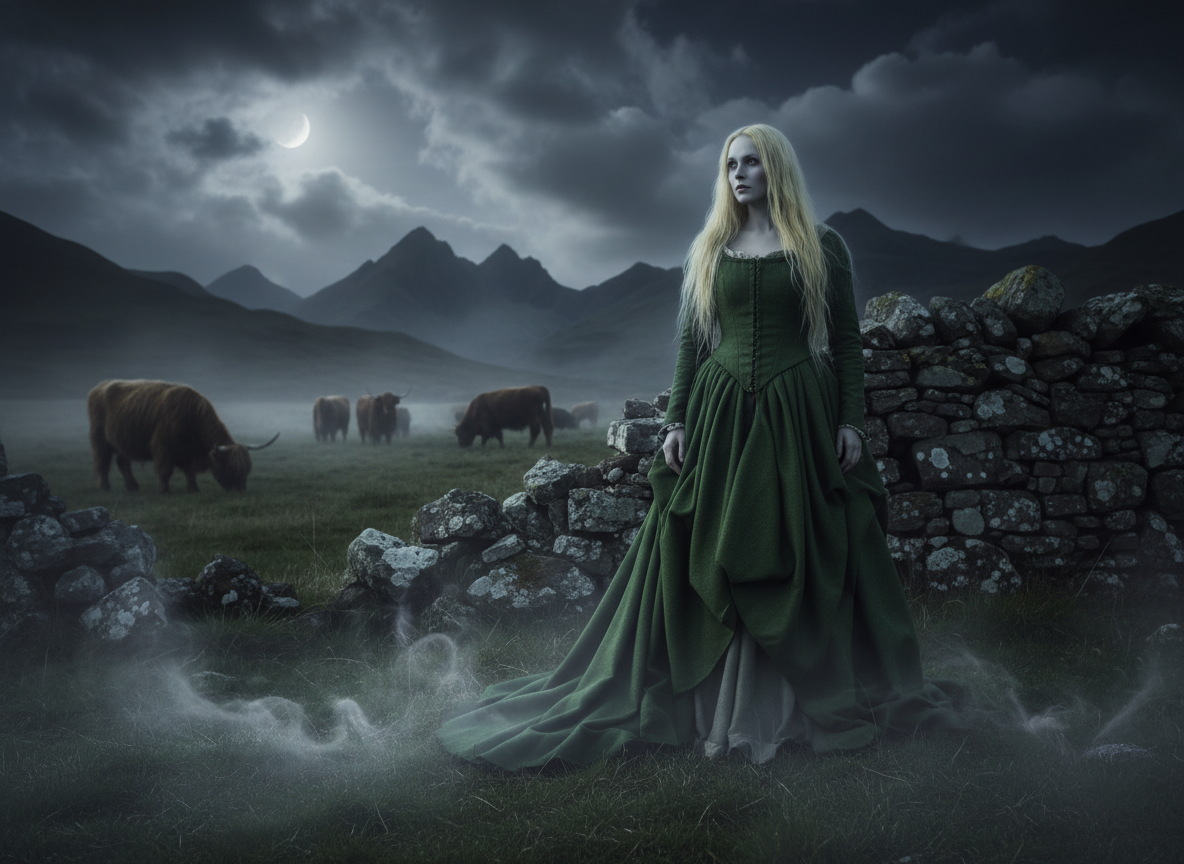
Glastig most often appears as a woman wearing a long, flowing green dress. Her face is sometimes described as grey, with long yellow hair that falls down her back. To a casual onlooker she may seem like a lovely, if eerie, lady of the hills.
However, the lower half of her body is not human. In many stories, she is half-woman and half-goat, like a faun or satyr. The dress hides her goat-like legs so she can move through human spaces without her true nature being obvious. In some variants she takes the full shape of a goat instead of a woman.
Habitat:
Glastig is strongly tied to rural and Highland environments. She is said to haunt:
- Remote farms and cattle pastures
- Glen-side tracks and rough hill paths
- Lochs, rivers, and water crossings
- Castle halls, staircases, and corridors, especially as a Green Lady
- Deer forests and hunting grounds
In her protective aspect she stays close to livestock and homes. In her dangerous aspect she lingers near water and isolated roads where travellers pass alone.
Behaviour:
Glaistig’s behaviour swings between kindness and cruelty. This ambivalence is at the heart of her myth.
In her darker aspect, she may:
- Lure men away from the safety of the road with song or dance
- Lead them to a hidden place and drink their blood
- Throw heavy stones, or cast stones into a traveller’s path to confuse or endanger them
- Play cruel tricks on those who disrespect her
In her kinder aspect, she may:
- Guard cattle and herders from harm
- Watch over children while parents work
- Protect deer herds, guiding hunters or punishing them if they break certain rules
- Look after houses and vulnerable people as a Green Lady, quietly carrying out chores
- Aid travellers in distress, even in dangerous conditions.
Many tales, show that how Glastig behaves depends on how she is treated. Respect and offerings can bring protection. Insults or cruelty can bring mischief, terror, or revenge.
Shape-shifting Ability:
Glastig shows clear shape-shifting qualities. She can appear:
- As a woman with hidden goat-legs
- As a full goat
- As an almost ordinary “Green Lady” ghost in castles
- As an old woman or frail-looking figure
She shifts not only in body but in role: predator, guardian of cattle, deer spirit, or domestic protector. However, this change often follows a consistent pattern. Her faun-like form leans towards wild, dangerous encounters outdoors, while her Green Lady form aligns with domestic settings and haunted houses.
Variant:
There are several notable variants of Glastig:
- Cattle-Guardian Glaistig (Ach-na-Creige): A helpful spirit who watches cattle and herders in return for offerings of milk poured into a hollowed stone.
- Deer-Guardian Glaistig / Maiden of Callart: A figure fiercely protective of deer herds, sometimes seen as a kind of hunting goddess. She may grant or withhold success in the chase depending on hunters’ behaviour and offerings.
- The Green Lady: A castle-dwelling spirit thought to be a once-mortal noblewoman given, or cursed with, fairy nature and goat’s legs. In some stories she is murdered in her green dress and hidden in a chimney, returning as a ghost.
- The Water Glaistig: A spirit associated with lochs and rivers who may aid or endanger those who cross her waters.
Location in Scotland:
Glastig and her Green Lady forms are associated with various locations across Scotland, including:
- Ach-na-Creige (cattle-guardian Glaistig tradition)
- Loch Linnhe (west coast water spirit)
- Dunollie Castle, Oban (castle-dwelling Glaistig)
- Ardnadrochet, Isle of Mull (cattle-guardian Glaistig)
- Lochaber (dangerous river spirit near Ben Nevis)
- Crathes Castle (Green Lady)
- Fyvie Castle
- Ashintully Castle
- Ballindalloch Castle
- Atholl Palace Hotel, Pitlochry
- Muchalls Castle
- Knock Castle (Isle of Skye)
- Tulloch Castle
- Balveny Castle
- Other sites such as Ardnacallich, Loch Fyne, and Newton Castle are also linked with Green Lady legends
Stories/ Sightings or Experiences:
1) The Glaistig of Ach-na-Creige and the Milk in the Stone
In the town of Ach-na-Creige, local tradition tells of a Glastig who guarded the cattle and their herders. In gratitude, the villagers poured fresh milk into a hollow stone as an offering. She protected the herds and even watched over the children while mothers milked the cows and fathers tended the beasts.
However, one day a thoughtless youth poured boiling milk into the stone, burning the Glaistig. Stung by this cruelty, she withdrew her protection and left the area. The story explains both her kindness and her sudden departure. It also stresses the importance of respect towards the unseen powers of the land.
2) The Glaistig of Loch Linnhe and the Storm
A farmer named Shalvach McKelvie was delivering goods across Loch Linnhe when a storm began to whip up around him. Every other boat had already set off for home, and the water grew choppier by the minute. As he pushed his boat out, a little old lady approached, asking for a lift across the loch.
McKelvie was happy to oblige, but only if the water wasn’t too rough for her. “If you’re happy then so am I,” she replied. The big farmer began to row into the stormy waves, but things were getting rougher and he was struggling to handle both oars. His passenger asked him to hand her one and let them fight the storm together.
He took one look at the wee, old lady and chuckled. Surely she would be dragged overboard! Yet the storm was only getting worse. With nothing to lose, he passed an oar to his insistent companion. As she heaved on her oar, the boat began to turn to the side. McKelvie had to put all his strength into matching her strokes to keep them steady.
With every pull the pair picked up speed, almost skimming across the surface of Loch Linnhe. They overtook every other boat and landed with such speed that they skidded up the banks. McKelvie turned in awe to this powerful, old lady and invited her for dinner in thanks. She declined with a curious smile.
The farmer began to walk home, turning at the last moment to catch a glimpse of his new friend diving below the surface of the loch. McKelvie realised he had been saved by a mysterious Scottish Glaistig.
3) The Green Lady in the Chimney
Another branch of the legend says Glastig was once a mortal noblewoman. She was either granted a fairy nature or cursed with goat’s legs and long life. She became known as the Green Lady, haunting a great house in her flowing green gown.
In one grim version, a servant murdered her and hid her body up the chimney. After her death, footsteps began to echo along the corridors. Furniture moved by itself at night. Dishes and floors were mysteriously cleaned. While she sometimes helped with household tasks, she also played pranks on servants if they angered or disrespected her. Her restless presence turned the house into a permanently haunted home.
4) The Glaistig of Dunollie Castle
Before Dunollie Castle in Oban was abandoned for a new mansion, it was known to be visited by a Scottish Glaistig. For all the violence that the castle had seen, this Glaistig was a calming, hard-working presence. She would arrive every evening at dusk before spending the night sweeping and cleaning the castle.
She worked hard, but could be a fickle being. The Glaistig of Dunollie Castle could be incredibly grumpy and to make sure her hosts knew she wasn’t happy, would sprinkle dust in their meals. She wasn’t indiscriminate though. She had a sense of humour, so always left the castle fool’s food alone.
When the MacDougalls left the castle in the 18th century, sightings appear to have stopped. It seems like that was one thing this grumpy Glaistig couldn’t forgive.
5) The Glaistig of Ardnadrochet and the Stone Cattle
Ardnadrochet is a tiny place on the very eastern edge of Mull, not far from Duart Castle. Here we find a story of the Scottish Glaistig’s heartfelt dedication. This particular spirit was linked with a Lamont family who lived in this corner of the island. In return for just a little bit of milk, she spent her time watching over the cattle and under her care they flourished.
That was until one day raiders from Lorn landed on the Isle of Mull. They were there to lift as many animals as they could before disappearing without a trace. But the Glaistig was watching. She rounded up the Lamont cattle and began to herd them to safety in the mountains. Before long, it became clear that they wouldn’t make it. The raiders were catching up fast.
The Glaistig was left with only one option. She would rather nobody had the cattle than they were stolen under her watch. Striking each cow one by one, she turned them all into large stone boulders on the hillside. When the Lorn raiders arrived, they were confused to find no cattle to steal, without realising they were sitting on top of them.
In frustration, their leader struck a boulder with his sword and split it in two. That was more than the Glaistig could handle. She returned to the Lamont’s home and died of a broken heart. The family had felt just as fondly towards the Glaistig as she did to their cattle, so she was given a dignified burial on the edge of the Sound of Mull.
6) Big Kennedy and the Glaistig of Lochaber
There were occasions when a Scottish Glaistig wasn’t helpful or friendly though. In Lochaber, an angry spirit once haunted a river in the shadow of Ben Nevis. Anybody who dared cross the bridge was risking their life, especially after dark. A local blacksmith called Big Kennedy had heard the stories, but he wasn’t easily scared.
As he approached the river, a frail-looking woman appeared out of nowhere, begging to share his horse. Kennedy agreed, but only if she sat in front rather than behind him. Strong as an ox, he hoisted her up and before she could play any tricks, wrapped his magic sword belt around her. The Glaistig was trapped.
She pleaded with him to let her go but he refused. This was his chance to get a reward from the locals. The Glaistig offered him a herd of quality cattle and the finest house in all of Lochaber. Kennedy agreed, but only if she completed her work before the sun came up. Then they would shake hands and be done.
She screamed into the darkness, calling all manner of fairy creatures to assist her. Kennedy heard them working through the night and as dawn approached, stoked his new forge, placing an iron in the glowing embers.
As the cattle entered the barn, the Glaistig asked her captor to shake her hand, then she would be on her way. Instead, Kennedy pulled the hot iron from the forge and thrust it into the outreached hand. She screamed loud enough to shake the freshly built beams. As the Glaistig withered away, she cursed Kennedy. He would grow old before his time and his sons would all die before him. It was a high price to pay for a new house and a herd of cows.
Purpose of the myth or Legend:
The Glaistig legend explores how power responds to human behaviour. She can be nurturing or deadly, and that tension reflects the uncertainty of rural life. Cattle, deer, and land were vital, yet easily lost to misfortune. Her stories show that kindness and proper offerings might bring protection, while disrespect could invite disaster.
In castle settings, the Green Lady form turns Glastig into a symbol of memory and guilt. Her quiet chores and echoing footsteps keep the past alive within stone walls. Across all versions, Glastig reminds listeners that the boundary between human and otherworld is thin, and that how you treat the unseen may shape your fate.